
Describe a Useful Invention: IELTS Speaking Part 2-Style Practice with the True Story of the Ballpoint Pen
The ballpoint pen is an ideal "useful invention" because everyone uses one. Hungarian journalist László Bíró noticed that newspaper ink dried quickly. With his chemist brother György he developed a pen with a ball turning in a socket, patented it in Paris in 1938, and fled to Argentina, where it was sold as the Birome.
Updated · 3 sources · How we work
SoulfulStories is an independent speaking-practice tool. It is not affiliated with, endorsed by or connected to IELTS, the British Council, IDP: IELTS or Cambridge University Press & Assessment. IELTS is a trademark of its respective owners. Our feedback is practice feedback, not an IELTS score or band.
What makes a good answer to "describe a useful invention"?
An object you have actually used, plus the story of who solved what. "My phone" starts an argument with the examiner's follow-up questions; a pen with a history is concrete, checkable and finished. Here is the practice card, our own wording:
Describe an invention that is useful in everyday life.
You should say:
- what the invention is
- who invented it and how
- how people use it
and explain why you think it is so useful.
The invention is the ballpoint pen, and its history is better than any spec sheet. Read it first.
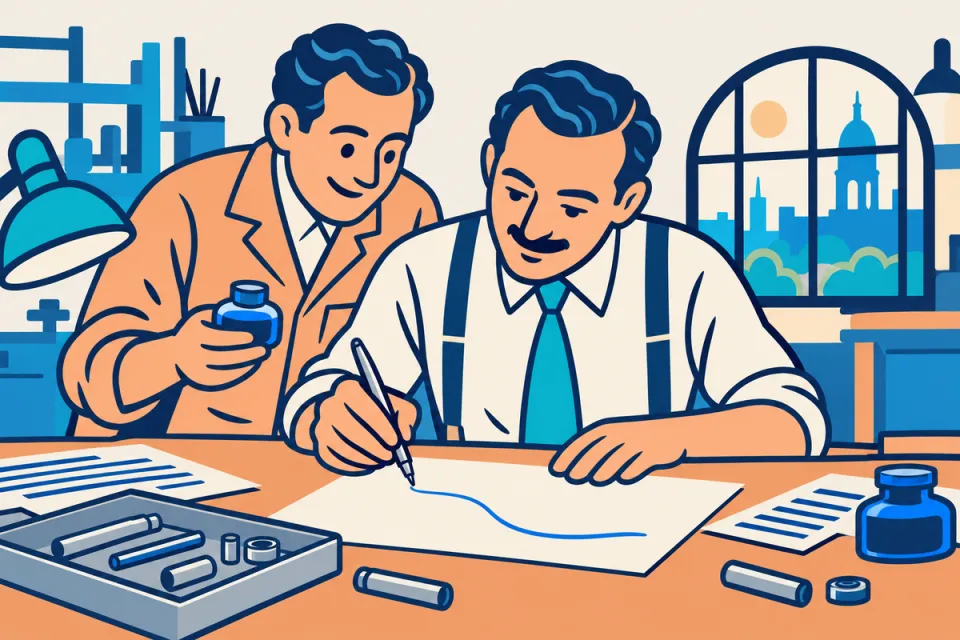
Facts you’ll need — each one is checked, with its source, on the story page:
- Called a "biro" in the UK, Ireland, Australia, New Zealand and Italy
- Bíró, born in Budapest in 1899, was a journalist and magazine editor
- Newspaper ink dried fast without smudging but was too viscous for a fountain pen
- 1930: marbles in a puddle left a trail of water — the ball idea
- With his chemist brother György: a ball free to turn in a socket, ink of the right consistency
- Shown at the Budapest International Fair, 1931; patented in Paris, 1938; left for France on 31 December 1938
- Fled to Argentina in 1943 at the invitation of President Agustín Justo; sold as the "Birome"
- RAF reportedly ordered 30,000 pens in 1943; the BIC Cristal (1950) has sold over 100 billion
- An earlier ballpoint: John J. Loud, 1888 — too coarse for paper
One more fact worth having in reserve: the first ballpoint had been patented roughly fifty years earlier, in 1888, by John J. Loud — but his pen was too coarse for paper. "The idea was old; the ink was the problem" is a sentence that buys you fluency points.
Why choose an everyday object over a famous machine?
Because "useful in everyday life" is on the card, and nothing is more everyday than a pen. A famous machine pushes you into numbers you cannot verify and vocabulary you cannot hold. An object in your pocket gives you the "how people use it" bullet from your own morning. How to tell a story out loud makes the same argument for storytelling: choose material you can carry.
How do you tell the ballpoint pen's story in two minutes?
Idea, escape, spread — and note one word per point in your minute:
- Opener (~30 words)The ballpoint pen — called a "biro" in the UK, Ireland, Australia, New Zealand and Italy. Your part: when you last used one.
- Idea (~80 words)László Bíró, born in Budapest in 1899, worked as a journalist and magazine editor. Newspaper ink dried fast without smudging but was too thick for a fountain pen. In 1930 he noticed marbles in a puddle leaving a trail of water. With György, a chemist, he developed a ball free to turn in a socket and an ink of exactly the right consistency.
- Escape (~70 words)He showed the pen at the Budapest International Fair in 1931 and patented it in Paris in 1938. On 31 December 1938 — the last day before a law banned taking patents abroad — he left for France. After German troops occupied France in 1940 he fled to Argentina, whose president, Agustín Justo, he had met; the brothers relocated in 1943 and the pen became the "Birome".
- Spread (~55 words)According to legend, the RAF ordered 30,000 of the pens in 1943, because fountain pens blotted at high altitude. Marcel Bich's BIC Cristal, launched in 1950, has sold more than 100 billion and sits in New York's Museum of Modern Art.
- Explain (~45 words)Useful means cheap, reliable and everywhere — and Bíró never got rich; he is reported to have said that seeing the biro overtake the fountain pen made him forget the riches he missed. Argentina's Inventors' Day is his birthday, 29 September. Your part: why it matters to you.
About 238 words in total — 1:35 to 1:54 spoken at 125–150 words per minute.
| Card point | Your note |
|---|---|
| what the invention is | biro |
| who invented it and how | journalist, ink |
| how people use it | ball + ink |
| and explain why you think it is so useful | everywhere |
One word per point, written in the preparation minute — never a sentence you could recite by accident.
Which words help you talk about inventions?
Patent, viscous, smudge, mass-produce, commercially successful, everyday object. Two of them are legal and two are physical — that spread is deliberate, because invention cards always ask who protected the idea and what problem it solved. If you keep only one sentence, keep the hedged one: the RAF order is "according to legend", and saying so is accurate, not weak.
What do examiners listen for?
The four criteria are the ones in the public band descriptors. What the app can measure is narrower, and it never produces a score or band for any of them:
- Fluency and coherence
- Problem, then solution, then impact — the three-move shape keeps a small object talking for two minutes.SoulfulStories measures: your pace, your pauses and your filler words — how long you keep the floor and how your answer is organised.
- Lexical resource
- Patent, viscous, smudge, mass-produce, commercially successful, everyday object — precise without being technical.SoulfulStories measures: the CEFR level of the words you used, and where you rephrased around a missing word.
- Grammatical range and accuracy
- Relative clauses (a ball that turns in a socket) and passives (was patented, was sold) carry this answer's range.SoulfulStories measures: nothing — grammar is not measured, because a transcript-based check would be guesswork; the examiner on test day judges it.
- Pronunciation
- Contrastive stress carries the story: it dried quickly, but was too thick. Land both halves.SoulfulStories measures: nothing automatic today — pitch and volume variation are measured, but clear pronunciation is yours to hear in the playback.
Can the same story answer "a piece of technology you find useful"?
It can — the "how people use it" bullet becomes your own hand: signing, marking, crossing out, lending it to the person who forgot theirs. Where else the story bends:
- Describe a food that has an interesting historyThe fortune cookie uses the same hidden-history structure around an everyday thing.
- Describe a painting or work of art you know aboutAnother object worth describing for what happened to it, not just how it looks.
The Part 2 practice page has the full angle-switch method, and the filler-word counter shows whether nerves are eating your first sentences.
How do you practise this answer out loud?
Read the pen's story, close the page, write your four words, and speak for two minutes. The report measures pace, fillers and pauses and checks which facts you kept — measurements computed in code, never a score, as the methodology documents. Tomorrow, retell it again and compare the two reports.
Tell the pen's journey from Budapest to Buenos Aires in two minutes.
Feedback on your pace, filler words, pauses, which key facts you covered, and the CEFR level of your vocabulary. Free to try, no card — and no score or band.
Questions and answers
Who invented the ballpoint pen?
László Bíró, a Hungarian-born journalist, worked with his chemist brother György and patented the first commercially successful modern ballpoint pen in Paris in 1938. John J. Loud had patented an earlier ballpoint in 1888, but it was too coarse for paper.
Is a pen a good choice for an invention cue card?
Yes. Everyday objects are easy to describe, and a short history of who made it and why gives you enough to speak for two minutes.
How many points do I need to cover on a Part 2 card?
Cover every 'You should say' point and the final 'explain' point. Note one word per point during your minute of preparation.
Is SoulfulStories connected to IELTS?
No. It is an independent practice tool, not affiliated with or endorsed by IELTS, the British Council, IDP or Cambridge.
Sources
Every outside fact on this page comes from the story’s cited sources, listed with their accessed dates on the story page.
- László Bíró — Wikipedia · accessed 25 October 2026
- Ballpoint pen — German Patent and Trade Mark Office · accessed 25 October 2026
- IELTS Academic: Speaking test format — ielts.org · accessed 1 November 2026
Keep going
- IELTS Speaking Part 2 cue cardsPart 2-style practice cue cards backed by true, sourced stories, with a one-minute note grid and a model outline.
- IELTS Speaking Part 2 Practice: The Long Turn AloneA free, repeatable loop for the long turn: one minute of notes, two recorded minutes, one listen, one fix — with a worked cue card taken three ways.
- How to Tell a Story Out Loud: Voice, Pace, PausesDelivery for spoken stories — openings, pace, the three pauses — with the same opening told three ways and timed, so you can hear the difference.
- Filler word counterPaste a transcript, see every um and you know highlighted, and get a rate per 100 words.
- The Pen That Crossed the WorldA Jewish journalist fleeing Hitler's Europe carried a new kind of pen to Buenos Aires — and the world still writes with his idea.
IELTS is a registered trademark of its owners. SoulfulStories is not affiliated with, endorsed by or connected to IELTS, the British Council, IDP or Cambridge. We don't give band scores.