
Describe a Food: IELTS Speaking Part 2-Style Practice with the True Story of the Fortune Cookie
For "describe a food", pick one with a story behind it. The fortune cookie is served in Chinese restaurants in America but most likely began as a Japanese cookie made in 19th-century Kyoto. It reached San Francisco with Japanese immigrants, and during World War II Chinese-owned factories took over making it.
Updated · 4 sources · How we work
SoulfulStories is an independent speaking-practice tool. It is not affiliated with, endorsed by or connected to IELTS, the British Council, IDP: IELTS or Cambridge University Press & Assessment. IELTS is a trademark of its respective owners. Our feedback is practice feedback, not an IELTS score or band.
What does a "describe a food" card want you to talk about?
Not a menu. The card asks what the food is, where people eat it, where it came from, and — the point candidates drop — why its history interests you. A food with a story answers all four in order. Here is the practice card, our own wording:
Describe a food that has an interesting history.
You should say:
- what the food is
- where people eat it
- where it originally came from
and explain why you think its history is interesting.
The food is the fortune cookie — a true, sourced history. Read the story first, then keep the checklist straight.
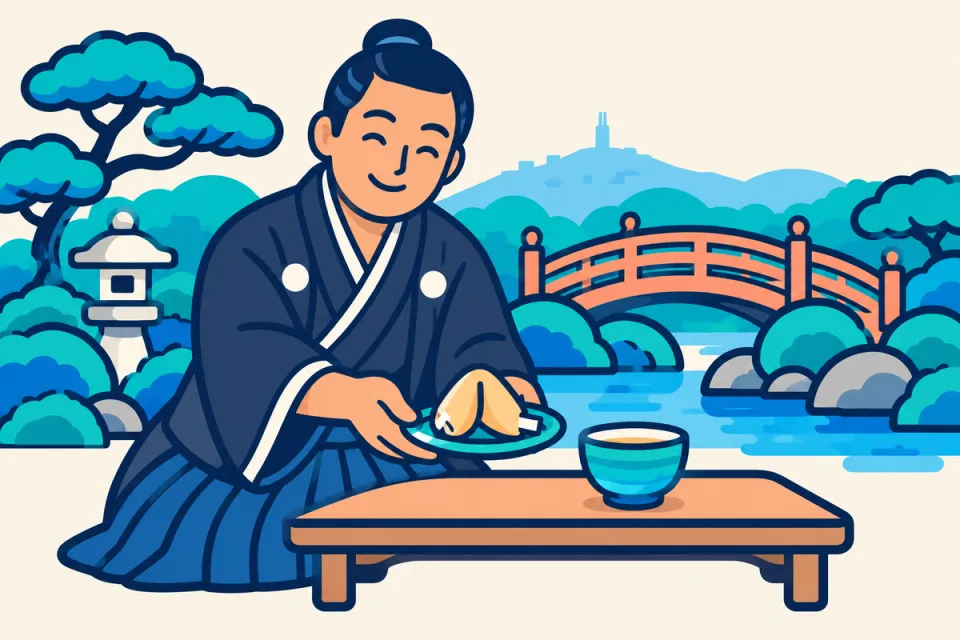
Facts you’ll need — each one is checked, with its source, on the story page:
- Served in Chinese restaurants but not Chinese in origin; in China seen as an American import
- A very similar cookie was made in 19th-century Kyoto: larger, darker dough with sesame and miso
- The Japanese paper slip was wedged into the bend; tsujiura senbei still sold near Fushimi Inari
- Makoto Hagiwara reportedly first served the modern cookie; made by the Benkyodo bakery; never patented
- Called "fortune tea cakes" before WWII; about 120,000 Japanese Americans interned during the war
- Japanese-run factories halted; Chinese-owned factories filled the gap
- 1983: San Francisco's Court of Historical Review ruled for Hagiwara over the 1918 LA claim
- About 3 billion fortune cookies are made each year
Can you talk about a food from another country?
Yes — the card asks for a food, not a passport. What it needs is specificity: where you have seen it, where it actually began, and what surprised you. "A food I know mostly from restaurants, with an origin nobody at the table guesses" is a stronger answer than a nervous list of national dishes. If the card says a traditional food from your country instead, switch the angle and tell a food you do know — the method is the same one used across all retelling practice.
How do you tell the fortune cookie's history in two minutes?
Five moves, one word each in your preparation minute:
- Opener (~35 words)The fortune cookie, served in Chinese restaurants in America, though not Chinese in origin. Your part: whether you have eaten or seen one.
- Origin (~70 words)In the 19th century, Kyoto bakers made a very similar cookie. It was larger, with darker dough containing sesame and miso, and the paper slip was wedged into the bend. Tsujiura senbei are still sold near the Fushimi Inari shrine, and Edo-era fortunes held proverbs, jokes and song lyrics.
- Journey (~70 words)Makoto Hagiwara, a Japanese immigrant who ran the Japanese Tea Garden in Golden Gate Park, reportedly first served the modern cookie with tea in the early 1900s. They were made by the San Francisco bakery Benkyodo and called "fortune tea cakes". He never patented the recipe.
- Twist (~60 words)During World War II about 120,000 Japanese Americans, the Hagiwaras among them, were interned. Production at Japanese-run factories halted, and Chinese-owned factories filled the gap. In 1983 San Francisco's Court of Historical Review ruled for Hagiwara over Los Angeles's claim of a 1918 invention — one cookie in evidence read "S.F. Judge who rules for L.A. Not Very Smart Cookie."
- Explain (~35 words)A "Chinese" dessert that is probably Japanese, spread by Chinese-American factories, and seen in China as an American import — about 3 billion are made each year. Your part: what that shows about food and migration.
The twist is the part worth telling slowly. During the war the Japanese-American families who made the cookie were interned, their factories stopped — and Chinese-owned factories picked up the recipe. So the cookie Americans call Chinese is, most likely, a Japanese tea cake that changed hands in the 1940s.One sample paragraph only — the rest stays an outline on purpose. A memorised script collapses when the card differs by one word; facts survive nerves.
About 261 words in total — 1:44 to 2:05 spoken at 125–150 words per minute.
| Card point | Your note |
|---|---|
| what the food is | cookie |
| where people eat it | US Chinese restaurants |
| where it originally came from | Kyoto |
| and explain why you think its history is interesting | changed hands |
One word per point, written in the preparation minute — never a sentence you could recite by accident.
At a calm pace this outline fills about two minutes — the speech length calculator shows the maths for your own words per minute.
Which words help you describe food and where it comes from?
Originate, immigrant, internment, ingredient, dough, tradition. Two are history words, four are food words — that mix is what the card rewards. And keep the hedges: most likely, reportedly, is said to have. The cookie's history is genuinely disputed, so hedged sentences are the accurate ones.
What do examiners listen for?
The four criteria are the ones in the public band descriptors. What the app can measure is narrower, and it never produces a score or band for any of them:
- Fluency and coherence
- Signpost the contrast — most people think, but actually — and keep one paragraph per move: origin, journey, twist.SoulfulStories measures: your pace, your pauses and your filler words — how long you keep the floor and how your answer is organised.
- Lexical resource
- Originate, immigrant, internment, ingredient, dough, tradition — six words that lift any food-or-culture card.SoulfulStories measures: the CEFR level of the words you used, and where you rephrased around a missing word.
- Grammatical range and accuracy
- Hedging is the grammar highlight here: most likely, is said to have, reportedly. It shows control and keeps every sentence accurate.SoulfulStories measures: nothing — grammar is not measured, because a transcript-based check would be guesswork; the examiner on test day judges it.
- Pronunciation
- Say the names smoothly — Kyoto, Hagiwara, Benkyodo — with no restarts; place names are where nerves show first.SoulfulStories measures: nothing automatic today — pitch and volume variation are measured, but clear pronunciation is yours to hear in the playback.
What if the card asks for your favourite food instead?
Give it a history anyway. "My favourite food is a cookie with a wrong name" opens the same story and covers the personal point honestly. The moves transfer to other cards, too:
- Describe a useful inventionThe same hidden-history structure around an everyday object — the ballpoint pen.
- Describe an interesting true story you heard or readIf the card turns personal, the cookie's history is a story you read: say where, then tell it.
More on changing the angle without changing the topic: the Part 2 practice page.
How do you practise this answer out loud?
Read the story once, close it, write your four one-word notes, and speak for two minutes. Then look at the report: pace, fillers, pauses, and which of the story's facts came through. Record the take again tomorrow — how to practise alone has the full loop, and how the report is built explains every number on it.
Tell the fortune cookie's journey from Kyoto to San Francisco in two minutes.
Feedback on your pace, filler words, pauses, which key facts you covered, and the CEFR level of your vocabulary. Free to try, no card — and no score or band.
Questions and answers
Where does the fortune cookie come from?
It most likely comes from a cookie made in Kyoto, Japan, in the 19th century. Japanese immigrants brought it to San Francisco, and Chinese-owned factories took over production during World War II.
Is it fine to describe a food from another country?
Yes, if the card allows it. Answer every point, and if the card asks about food you eat, say when you tried it or would like to.
How do I avoid a memorised-sounding food answer?
Learn the story's key facts, not a script. Note one word per card point, then tell it in your own words. Facts keep you on track if you get nervous.
Is this an official IELTS question?
No. It is an original IELTS Speaking Part 2-style practice card. SoulfulStories is not affiliated with IELTS, the British Council, IDP or Cambridge.
Sources
Every outside fact on this page comes from the story’s cited sources, listed with their accessed dates on the story page.
- Fortune cookie — Wikipedia · accessed 25 October 2026
- Surprise Ancestry of the Fortune Cookie — Los Angeles Times · accessed 25 October 2026
- From Japan to America, the changing fortunes of fortune cookies — CNN · accessed 25 October 2026
- IELTS Academic: Speaking test format — ielts.org · accessed 1 November 2026
Keep going
- IELTS Speaking Part 2 cue cardsPart 2-style practice cue cards backed by true, sourced stories, with a one-minute note grid and a model outline.
- IELTS Speaking Part 2 Practice: The Long Turn AloneA free, repeatable loop for the long turn: one minute of notes, two recorded minutes, one listen, one fix — with a worked cue card taken three ways.
- How to Tell a Story Out Loud: Voice, Pace, PausesDelivery for spoken stories — openings, pace, the three pauses — with the same opening told three ways and timed, so you can hear the difference.
- Filler word counterPaste a transcript, see every um and you know highlighted, and get a rate per 100 words.
- The Fortune Cookie Isn't ChineseThe fortune cookie most likely began as a Japanese tea cracker, and World War II helped make it "Chinese" in America.
IELTS is a registered trademark of its owners. SoulfulStories is not affiliated with, endorsed by or connected to IELTS, the British Council, IDP or Cambridge. We don't give band scores.