
Describe an Interesting Story You Heard or Read: IELTS Speaking Part 2-Style Practice with the True Story of Poon Lim
For "describe an interesting story", a true survival story gives you a clear beginning, middle and end. In November 1942 a German submarine sank the British ship Benlomond, and steward Poon Lim survived 133 days alone on a raft in the South Atlantic — the longest such survival recorded by Guinness.
Updated · 3 sources · How we work
SoulfulStories is an independent speaking-practice tool. It is not affiliated with, endorsed by or connected to IELTS, the British Council, IDP: IELTS or Cambridge University Press & Assessment. IELTS is a trademark of its respective owners. Our feedback is practice feedback, not an IELTS score or band.
What makes a story "interesting" enough for a Part 2 card?
Shape, not shock. Examiners listen for a beginning, a middle, an end, and a reason it mattered to you — which is why a true story with a documented arc is easier to tell well than a dramatic one you half-remember. Here is the practice card, our own wording:
Describe an interesting true story you heard or read.
You should say:
- what the story was about
- where you heard or read it
- what happened in it
and explain why you found it interesting.
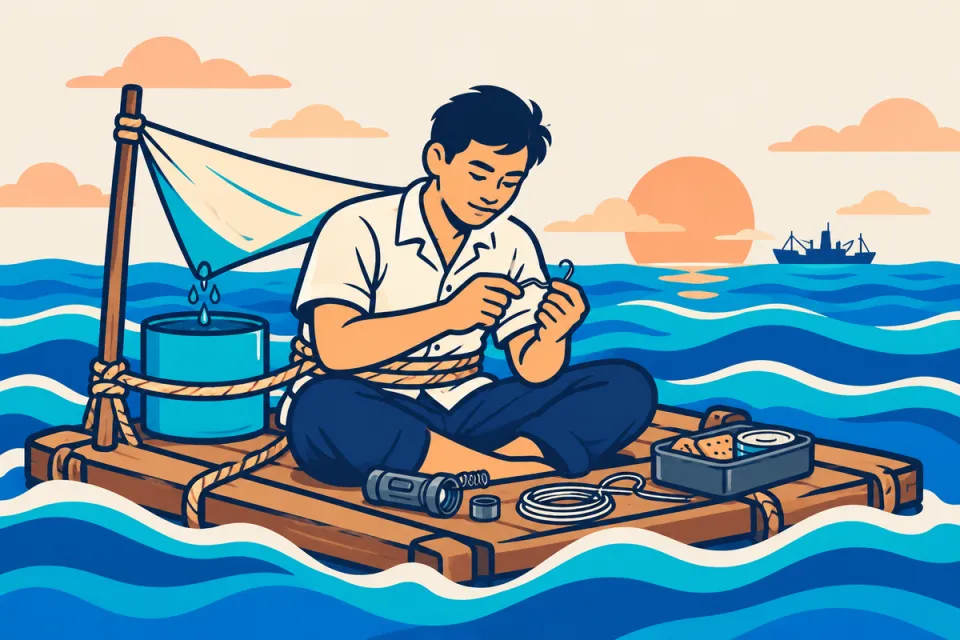
The story is Poon Lim's 133 days on a raft — the longest survival alone on a raft that Guinness records. Read it first.
Facts you’ll need — each one is checked, with its source, on the story page:
- 23 November 1942: U-172 sank the Benlomond with two torpedoes; it went down in about two minutes
- Poon Lim, born 1918, trained as a sailor in British Hong Kong; the sole survivor
- After about two hours in the water he found an eight-foot raft with fresh water, hardtack, chocolate and a flashlight
- Food ran out after about 55 days; water fifteen days later
- He could not swim well and tied a rope from the raft to his wrist
- Hooks from the flashlight spring and a nail; fish, seabirds, even a shark; rain in a life-jacket cover
- Cargo ships passed; a US Navy plane's marker buoy was lost in a storm
- 133 days; rescued 5 April 1943 by three Brazilian fishermen, about 750 miles adrift
- King George VI awarded him the British Empire Medal; Guinness lists the record
This page is also the bridge to everything else here: any story in the library can answer this card, because "describe a story" is what retelling practice already is.
Can you use a story you read rather than one someone told you?
Yes — the card says "heard or read". Make the "where" point specific and true: the article, the book, the museum panel, this page. Specific beats dramatic: "I read it on a storytelling site that lists its sources" covers the point and sets up your final one.
How do you tell Poon Lim's story in two minutes?
Disaster, survival, near-misses, rescue. One word per point in the preparation minute:
- Opener (~35 words)A story about survival at sea. Your part: where you read or heard it — say it honestly, it is on the card.
- Disaster (~60 words)On 23 November 1942 U-172 hit the Benlomond with two torpedoes, and it sank in about two minutes. Poon Lim, born in 1918 and trained as a sailor in British Hong Kong, was dragged underwater. After about two hours he found an eight-foot raft. He was the sole survivor.
- Survival (~90 words)The raft carried fresh water, hardtack and chocolate. The food ran out after about 55 days, the water fifteen days later. He could not swim well, so he tied a rope from the raft to his wrist. He made a hook from the flashlight spring, later a nail, caught fish, seabirds and even a shark, and collected rain in a life-jacket cover.
- Near-misses (~55 words)Cargo ships saw him but did not stop — the source gives two explanations, so keep both. A US Navy plane dropped a marker buoy, but a storm hit. He counted the days with knots in a rope, then by full moons.
- Rescue and your view (~50 words)On 5 April 1943 three Brazilian fishermen picked him up, about 750 miles from the wreck; King George VI awarded him the British Empire Medal. His words: "I hope no one will ever have to break that record." Your part: why it interested you.
The detail that makes it real is the rope. He could not swim, so his first act on that raft was to tie himself on. Everything after that — the fish hook from a flashlight spring, the rain caught in a life-jacket cover — starts from one honest admission: I cannot swim.One sample paragraph only — the rest stays an outline on purpose. A memorised script collapses when the card differs by one word; facts survive nerves.
About 268 words in total — 1:47 to 2:09 spoken at 125–150 words per minute.
| Card point | Your note |
|---|---|
| what the story was about | ship sunk |
| where you heard or read it | raft, sole survivor |
| what happened in it | fish, rain |
| and explain why you found it interesting | 133 days |
One word per point, written in the preparation minute — never a sentence you could recite by accident.
Notice what the outline keeps: both explanations for the ships that passed. The story page hedges them, and so should you — "one account says… another says…" is fluent, honest and exactly what the descriptors reward.
Which narrative tenses should you use?
Past continuous opens the scene (he was working as a steward), past simple drives events (the submarine hit, he found), past perfect reaches earlier (he had trained in Hong Kong), and could/couldn't handles ability (he couldn't swim well). That spread is the grammatical range criterion — the four criteria are laid out below.
What do examiners listen for?
The four criteria are the ones in the public band descriptors. What the app can measure is narrower, and it never produces a score or band for any of them:
- Fluency and coherence
- Narrative sequencing does the work — after two hours, by day 55, eventually — so the listener never wonders where you are.SoulfulStories measures: your pace, your pauses and your filler words — how long you keep the floor and how your answer is organised.
- Lexical resource
- Drift, ration, survive, improvise, rescue, sole survivor — the survival register, all reusable on journey and challenge cards.SoulfulStories measures: the CEFR level of the words you used, and where you rephrased around a missing word.
- Grammatical range and accuracy
- Past continuous for background, past simple for events, past perfect for earlier ones — and could/couldn't for ability.SoulfulStories measures: nothing — grammar is not measured, because a transcript-based check would be guesswork; the examiner on test day judges it.
- Pronunciation
- Intonation carries the drama: slow down before the rescue and pause — the silence is part of the story.SoulfulStories measures: nothing automatic today — pitch and volume variation are measured, but clear pronunciation is yours to hear in the playback.
How do you explain why a story interested you?
Point at the hinge, not the whole: "the rope" — a man who couldn't swim tying himself to the thing that might kill him. One concrete detail plus your reaction fills the final point without a speech about storytelling. The same frame fits related cards:
- Describe a person you admireThe same facts re-anchored on one man's resourcefulness — Manjhi's page shows the frame.
- Describe a scientist you admireAnother true story where one person bets their own safety on an idea.
The Part 2 practice page has the full method, and how to retell a story teaches the close-the-book step this page uses.
How do you practise this answer out loud?
Read the story, close it, write your four words, and speak for two minutes into the recorder. The report measures your pace, fillers, pauses and which of the story's facts survived the retelling — measurements only, never a score, as the methodology documents. Then tell it again tomorrow; survival stories reward a calm second take.
Tell Poon Lim's 133 days in two minutes.
Feedback on your pace, filler words, pauses, which key facts you covered, and the CEFR level of your vocabulary. Free to try, no card — and no score or band.
Questions and answers
Can I use a true story from a book or website?
Yes, if the card asks for a story you heard or read. Say where you read it, retell the main events in order, and explain why it interested you.
Who was Poon Lim?
A steward on the British ship Benlomond, which was sunk in 1942. He survived 133 days alone on a raft in the South Atlantic before Brazilian fishermen rescued him in April 1943.
Which tenses should I use to tell a story in Part 2?
Mainly the past simple for events, the past continuous for background, and the past perfect for things that happened earlier.
Is SoulfulStories affiliated with IELTS?
No. It is an independent storytelling practice tool. Feedback covers pace, fillers, pauses, key facts and CEFR vocabulary, not scores or bands.
Sources
Every outside fact on this page comes from the story’s cited sources, listed with their accessed dates on the story page.
- Poon Lim — Wikipedia · accessed 25 October 2026
- Longest time adrift at sea - alone — Guinness World Records · accessed 25 October 2026
- IELTS Academic: Speaking test format — ielts.org · accessed 1 November 2026
Keep going
- IELTS Speaking Part 2 cue cardsPart 2-style practice cue cards backed by true, sourced stories, with a one-minute note grid and a model outline.
- IELTS Speaking Part 2 Practice: The Long Turn AloneA free, repeatable loop for the long turn: one minute of notes, two recorded minutes, one listen, one fix — with a worked cue card taken three ways.
- How to Retell a Story Out Loud: 5 Steps + a True StoryA five-step retelling method worked on one true story shown at its three reading levels — beginner, intermediate and advanced.
- What Is Story Retelling? Meaning, Steps and ExamplesWhat retelling actually is for adults and English learners, how it differs from a summary or a paraphrase, and why it builds speaking fluency.
- 133 Days on a RaftIn 1942–43, a ship's steward who couldn't swim well survived 133 days alone on a raft, using a flashlight spring as a fish hook.
IELTS is a registered trademark of its owners. SoulfulStories is not affiliated with, endorsed by or connected to IELTS, the British Council, IDP or Cambridge. We don't give band scores.