
133 Days on a Raft
133 Days on a Raft
1942–1943South Atlantic Ocean, off BrazilExploration & survival
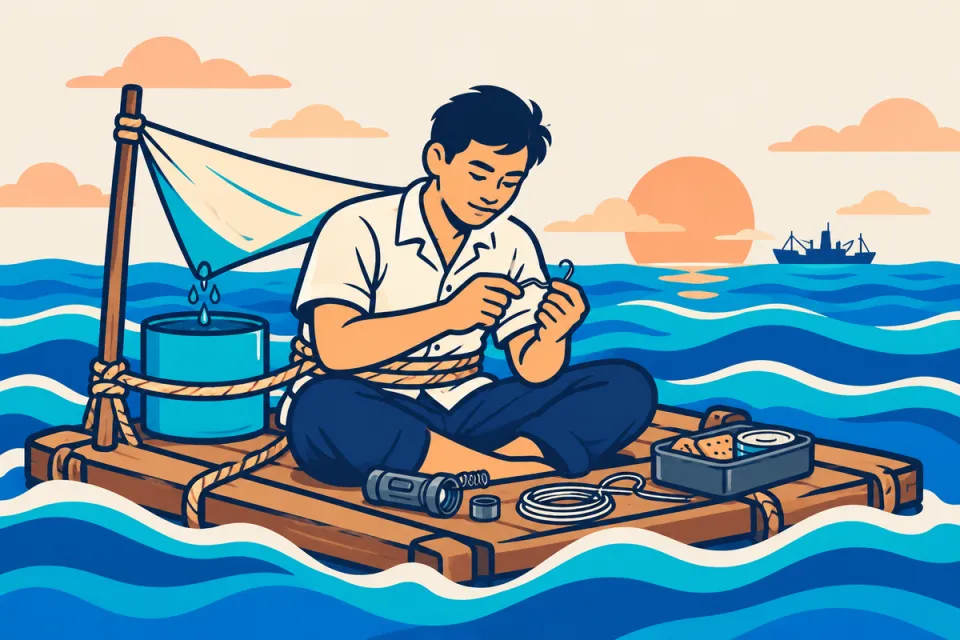
In 1942–43, a ship’s steward who couldn’t swim well survived 133 days alone on a raft, using a flashlight spring as a fish hook.
Reading level
The same true story, told at three lengths. Pick one to read, close your eyes, and tell it back in your own words.
219 words · about 1 min to read · retell it in about 2 minutes
In November 1942, a German submarine sank a British cargo ship in the Atlantic. On board was a young Chinese steward named Poon Lim. The ship went down in about two minutes. Poon was pulled under the water, but he came back up. After about two hours, he found a small wooden raft.
The raft held food and water. The food lasted almost two months, and the water a little longer. Then Poon had to find his own food. He could not swim well, so he tied a rope from the raft to his wrist. He made a fish hook from the spring of a flashlight. Later he pulled a nail out of the raft and made a stronger hook. He caught fish and birds, and he caught rain in a piece of canvas.
Sometimes ships passed by. They saw him, but they did not stop. Once a plane saw him, but then a storm came.
At first, Poon counted the days with knots in a rope. Later he just counted full moons.
One day, the sea changed color. Land was near! Three Brazilian fishermen found him. He had been alone for 133 days.
Later, people told him nobody had ever survived longer on a raft. Poon said, “I hope no one will ever have to break that record.”
322 words · about 2 min to read · retell it in about 2 minutes
On 23 November 1942, a German submarine torpedoed the British cargo ship Benlomond in the South Atlantic. The ship sank in about two minutes. One of the crew, a Chinese steward named Poon Lim, was dragged underwater, came back up, and spent about two hours in the sea before he found a wooden raft just eight feet long.
He saw another raft in the distance, with four or five men waving at him. But Poon had no way to move his raft, and the two rafts drifted apart.
The raft had water, biscuits, and a flashlight. The food ran out after about 55 days, and the water fifteen days later. Poon could not swim well, so he tied a rope from the raft to his wrist in case he fell in. Then he got creative. He turned the spring from the flashlight into a fish hook, unravelled rope for a line, and used crushed biscuits as bait. Later he dug a nail out of the raft for a stronger hook. Small fish became bait for bigger fish. He caught seabirds, and he collected rain in canvas.
Sometimes he was seen, but not saved. Cargo ships passed and did not stop. Poon believed it was because he was Asian. Once, a plane dropped a marker buoy near him, but a storm hit the area and he was lost again.
He counted days with knots in a rope, then gave up and simply counted full moons.
By April 1943, he noticed the water was no longer deep ocean blue. Land was close. On 5 April, three Brazilian fishermen found him, about 750 miles from where he started. He had survived 133 days alone, and he was the only survivor of his ship.
When people told him no one had ever survived longer on a raft, Poon said, “I hope no one will ever have to break that record.” As of 2024, no one has.
514 words · about 3 min to read · retell it in about 4 minutes
On 23 November 1942, a German submarine fired two torpedoes into the British cargo ship Benlomond in the South Atlantic. A young Chinese steward named Poon Lim, who had trained as a sailor in Hong Kong, was in his cabin. He grabbed his life jacket and went to his lifeboat station, and as the crew prepared to lower a boat, he was washed overboard. The ship sank within about two minutes, dragging him under. When he came up, there was almost nothing left but a few planks.
The submarine’s crew saw him, and left him there. After about two hours in the water, Poon found a wooden raft only eight feet long. In the distance he saw another raft, with four or five men waving at him to join them. He had no way to paddle or steer, and he watched that raft slowly drift away.
At first the raft’s supplies kept him alive. There was a can of fresh water, boxes of hard biscuits, chocolate, and a flashlight. After about 55 days the food was gone. Fifteen days later, so was the water, and he spent five days without a drink. And then this man, who could not swim well and often tied a rope from the raft to his wrist, turned into an engineer. He took the spring out of the flashlight and made it into a fish hook. He unravelled rope into a line and crushed biscuits for bait. When the hook wasn’t strong enough, he dug a nail out of the raft’s boards. Small fish became bait for bigger fish. He caught seabirds that landed on the raft, rigged the canvas into a canopy that shaded him and caught rain, and once he even caught a shark.
Hunger was not the only danger he faced. Several times, cargo ships came close enough to see him, and sailed on despite his shouts in English. Poon was convinced it was because he was Asian; another explanation is that U-boats were rumored to use fake survivors on rafts as bait for rescue ships. A US Navy patrol plane did spot him and dropped a marker buoy, and then a storm hit and he was lost again.
He kept track of time by tying knots in a rope. Eventually he decided there was no point counting days, and counted full moons instead.
By April 1943, he noticed something: the sea was no longer that deep ocean blue. On 5 April, three Brazilian fishermen came across his raft near the coast of Brazil. He had drifted about 750 miles west. He had lost 20 pounds and had to be lifted off the raft, yet before long he could walk again. He was the only survivor from his ship.
King George VI awarded him the British Empire Medal, and the Royal Navy put his story into its survival manuals. When someone told him no one had ever survived longer on a raft, Poon gave the most modest answer imaginable: “I hope no one will ever have to break that record.” As of 2024, no one has.
Read it once, close the page, and tell it back. The coach listens for pace, fillers and the facts.
Key facts and sources
Poon Lim was Second Mess Steward on the British cargo ship Benlomond, sunk by the German submarine U-172 on 23 November 1942.
“Poon was Second Mess Steward on SS Benlomond, a British cargo ship that the German submarine U-172 sank on 23 November 1942.” — Poon Lim, Wikipedia
He survived a record 133 days alone on a life raft in the South Atlantic.
“In 1942–43, he survived a record 133 days alone on a life raft in the South Atlantic.” — Poon Lim, Wikipedia
The ship sank within about two minutes and Poon was dragged underwater.
“The ship sank within about two minutes of being hit, and Poon was dragged underwater.” — Poon Lim, Wikipedia
After about two hours in the water he found a wooden life raft.
“After about two hours in the water, Poon found and boarded a wooden life raft.” — Poon Lim, Wikipedia
The raft was eight feet long.
“He survived on an eight-foot (2.4 m) wooden raft with supplies.” — Poon Lim, Wikipedia
He saw another raft carrying four or five men, who waved to him to join them.
“In the distance he saw another raft, carrying four or five men, who waved to him to join them.” — Poon Lim, Wikipedia
He had no way to propel his raft, and the rafts drifted apart.
“Poon had no means to propel his raft, and the two rafts drifted apart.” — Poon Lim, Wikipedia
The food ran out after about 55 days and the water fifteen days later.
“After around 55 days, the food ran out, followed by the water supply fifteen days later.” — Poon Lim, Wikipedia
He turned to fishing, catching seabirds and collecting rainwater in a life jacket cover.
“Poon resorted to fishing, catching seabirds, and collecting rainwater in a canvas life jacket covering.” — Poon Lim, Wikipedia
He could not swim well and tied a rope from the raft to his wrist.
“He could not swim well, and often tied a rope from the boat to his wrist in case he fell into the sea.” — Poon Lim, Wikipedia
He made a fish hook from the spring of the flashlight, line from unravelled rope, and bait from hardtack.
“He took a spring from the flashlight and made it into a fish hook, unravelled hemp rope to make a fishing line, and crushed pieces of hardtack to make bait.” — Poon Lim, Wikipedia
He dug a nail out of the raft to make a stronger hook.
“He dug a nail from the boards on the wooden raft to make a stronger fish hook.” — Poon Lim, Wikipedia
He used small fish as bait for bigger fish.
“When he caught a small fish, he used it as bait to catch bigger fish.” — Poon Lim, Wikipedia
He even caught a shark.
“When Poon saw sharks, he caught one” — Poon Lim, Wikipedia
Cargo ships saw him but did not pick him up.
“Occasionally, the crews of cargo ships saw him but did not pick him up or even greet him despite his proficient shouts in English.” — Poon Lim, Wikipedia
Poon believed they would not rescue him because he was Asian; another explanation is that U-boats were rumoured to use fake survivors as traps.
“Poon contended that they would not rescue him because he was Asian and they may have assumed he was a stricken Japanese sailor, although another explanation is that German U-boats were rumored to set a “survivor” on a raft as a trap” — Poon Lim, Wikipedia
A US Navy patrol plane dropped a marker buoy, but a storm hit and he was lost again.
“one dropped a marker buoy in the water. The plane reported back to US Navy authorities in Belém, Brazil, but a storm hit the area at the same time and he was lost again.” — Poon Lim, Wikipedia
He counted days with knots in a rope, then gave up and counted full moons.
“At first, he counted the days by tying knots in a rope, but later decided that there was no point in counting the days and simply began counting full moons.” — Poon Lim, Wikipedia
He knew land was near because the sea was no longer deep ocean blue.
“Poon realized that he was nearing land, as the color of the sea was no longer a deep ocean blue.” — Poon Lim, Wikipedia
On 5 April 1943 three Brazilian fishermen rescued him near the coast of Brazil after he drifted about 750 miles west.
“On 5 April 1943, three Brazilian fishermen rescued Poon as he neared the coast of Brazil, having drifted westward about 750 miles (1,210 km).” — Poon Lim, Wikipedia
He was the sole survivor of the Benlomond.
“He was the sole survivor from Benlomond.” — Poon Lim, Wikipedia
He had lost 20 pounds and had to be lifted off the raft.
“Poon had lost 20 pounds (9 kg) in weight. He was so weak that his rescuers had to lift him off his raft.” — Poon Lim, Wikipedia
He was able to walk ashore.
“was able to walk ashore” — Longest time adrift at sea - alone, Guinness World Records
King George VI awarded him the British Empire Medal.
“King George VI awarded him the British Empire Medal” — Poon Lim, Wikipedia
The Royal Navy put his story into survival manuals.
“The Royal Navy incorporated his tale into manuals of survival techniques.” — Poon Lim, Wikipedia
Told nobody had survived longer on a raft, Poon replied, ‘I hope no one will ever have to break that record.’
“Poon replied, “I hope no one will ever have to break that record.”” — Poon Lim, Wikipedia
As of 2024, no one has broken his life-raft record.
“As of 2024, no one has broken Poon’s record on a life raft.” — Poon Lim, Wikipedia
Guinness lists 133 days as the longest recorded survival alone on a raft.
“The longest recorded survival alone on a raft is 133 days by Second Steward Poon Lim” — Longest time adrift at sea - alone, Guinness World Records
Poon trained as a sailor in British Hong Kong.
“In 1936, Poon was sent to British Hong Kong, where he was trained as a sailor.” — Poon Lim, Wikipedia
He rigged the canvas tarpaulin as a canopy against the sun and to catch rain.
“The raft had four poles and a canvas tarpaulin, which he rigged as a canopy. This both protected him from the sun and caught rainwater.” — Poon Lim, Wikipedia
The raft carried fresh water, hardtack and chocolate.
“The raft was stocked with a can of fresh water containing 10 imperial gallons (45 litres), six boxes of hardtack, 2 pounds (0.9 kg) of chocolate” — Poon Lim, Wikipedia
The crew of U-172 spotted him but did not rescue him.
“Poon was spotted by the crew of U-172, but instead of rescuing him, they laughed at him and waved him away.” — Poon Lim, Wikipedia
He was washed overboard while officers tried to launch a lifeboat.
“They had raised the boat off its chocks, and were about to lower it, when Poon was washed overboard.” — Poon Lim, Wikipedia
He went five days without water before turning to the sea.
“After spending five days without water” — Poon Lim, Wikipedia
Poon Lim was born in 1918.
“8 March 1918 – 4 January 1991) was a Chinese seafarer” — Poon Lim, Wikipedia
The raft also had a flashlight.
“It also had flares, two smoke pots, and a flashlight” — Poon Lim, Wikipedia
U-172 hit the Benlomond with two torpedoes.
“U-172 intercepted and hit Benlomond with two torpedoes” — Poon Lim, Wikipedia
Poon was in his cabin, took his life jacket and went to his boat station.
“Poon, who was in his cabin, took his life jacket and went to his boat station” — Poon Lim, Wikipedia
When he resurfaced he found only a few planks floating.
“When he resurfaced, he found only a few planks floating” — Poon Lim, Wikipedia
He caught gulls that settled on his raft.
“When gulls settled on his raft, he caught and killed them.” — Poon Lim, Wikipedia
Three days later, landed at Belém, he could walk again.
“when the fishermen landed him at Belém, three days later, he was able to walk again” — Poon Lim, Wikipedia
Sources consulted for this story: Poon Lim (Wikipedia, accessed 2026-10-25); Longest time adrift at sea - alone (Guinness World Records, accessed 2026-10-25). Every story is checked against its sources before it is published — how we verify stories.
Why this story is worth telling
A life-raft record no one had broken as of 2024, set by a man who hoped nobody would ever have to.