
Try SCE to AUX
Try SCE to AUX
1969Kennedy Space Center and Mission Control, USASpace & the cosmos
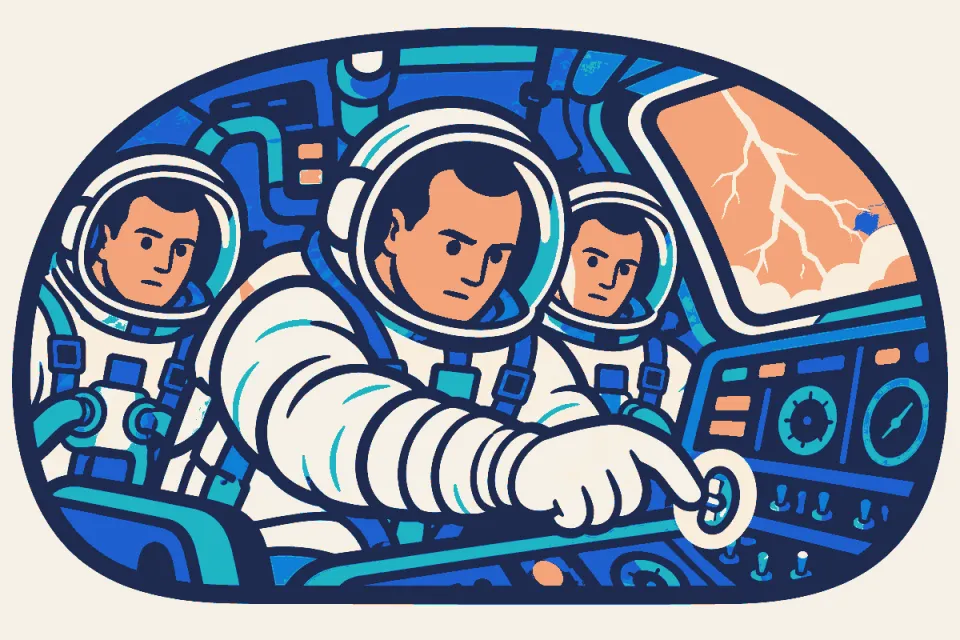
Lightning hit Apollo 12 twice in its first minute. The fix was one obscure switch almost nobody in Mission Control had ever heard of.
Reading level
The same true story, told at three lengths. Pick one to read, close your eyes, and tell it back in your own words.
220 words · about 1 min to read · retell it in about 2 minutes
In November 1969, a giant rocket stood in the rain in Florida. Apollo 12 was going to the Moon. The president had come to watch.
Thirty-six seconds after liftoff, lightning hit the rocket. The control panel lit up with warning lights. Nobody knew what was broken. Then, fifty-two seconds in, lightning hit again.
On the ground, the screens of the flight controllers went crazy. A young engineer named John Aaron stared at the mess of numbers. He remembered something. A year before, in a test, he had seen this same strange pattern. He had figured out what caused it, and he knew the fix. There was a rarely used switch for a part called the SCE. It had to be turned to a setting called auxiliary.
He told his boss: try SCE to auxiliary. Almost nobody knew what he meant. The message went up to the spacecraft. Inside, astronaut Alan Bean flipped that switch. The numbers on the ground came back. Nothing serious was broken.
The leaders on Earth were still afraid the lightning had damaged the parts that open the parachutes. They did not tell the astronauts and let the mission go on. The parachutes worked fine, days later at the end.
Apollo 12 landed on the Moon, right where it was supposed to. The crew came home safe.
357 words · about 2 min to read · retell it in about 3 minutes
On the morning of November 14, 1969, rain was falling on the launch pad in Florida, and the President of the United States had come to watch Apollo 12 leave for the Moon. The Saturn V rose into the clouds, and the commander, Pete Conrad, radioed down that it was a lovely liftoff.
Thirty-six and a half seconds after liftoff, lightning struck the rocket. Not near it: the rocket itself had triggered the strike. Inside the spacecraft, the caution-and-warning board lit up red, and all three fuel cells dropped offline. In Mission Control, the data on the controllers’ screens turned to gibberish. Fifty-two seconds after liftoff, a second strike knocked out the spacecraft’s attitude indicator, the 8-ball.
The rocket, flying on its own guidance system, kept going perfectly. The spacecraft was the problem, and nobody could see what was wrong. In Houston, a young engineer named John Aaron was staring at the garbled numbers when his memory caught something. A year earlier, he had watched a ground test throw up this exact strange pattern, and he had spent time tracing it until he understood it. It meant the spacecraft’s signal conditioning equipment, the SCE, had lost power. The fix was one switch, flipped to its auxiliary setting.
Aaron simply called it out: Flight, EECOM. Try SCE to Aux. The flight director didn’t know what it meant. The astronaut talking to the crew didn’t know what it meant. The message went up anyway, and inside the spacecraft Alan Bean, the crew’s engineer, found the obscure switch on his panel; NASA says he remembered where it was, though another account says Dick Gordon knew the switch and told Bean to flip it. Within seconds, the numbers on Aaron’s screen came back to normal. The mission was saved.
What the crew was not told was that officials on the ground quietly feared the lightning might have damaged the explosive bolts that open the parachute compartment. Since nothing could be done about that, they kept flying. On November 24, the parachutes bloomed over the Pacific and worked normally. Apollo 12 had landed on the Moon, exactly on target, and come home.
511 words · about 3 min to read · retell it in about 4 minutes
Apollo 12’s first minute nearly ended the mission before it began, and it started with the weather. On the morning of November 14, 1969, completely overcast rainy skies hung over the Kennedy Space Center, and for the first time ever a sitting president had come to watch a crewed launch. The Saturn V rose into the clouds with Pete Conrad, Dick Gordon, and Alan Bean aboard, and Conrad keyed his radio: it’s a lovely liftoff. Thirty-six and a half seconds after liftoff, lightning struck the vehicle. Not a nearby flash; the rocket itself, plowing through the clouds, had become a lightning rod.
The effect inside the spacecraft was chaos. A voltage surge knocked all three fuel cells offline, the caution-and-warning board lit up like a Christmas tree, and nothing pointed to a single cause. In Mission Control, the telemetry on the consoles turned to gibberish. At 52 seconds, a second strike knocked out the eight-ball, the attitude indicator. The one reassuring fact was that the Saturn V’s own guidance system, which flew the rocket independently, was untouched. The moonship kept ascending on a perfect trajectory while the humans inside it, and the humans watching it, went half-blind.
At the EECOM console sat John Aaron, a young engineer born in 1943, and staring at him was a pattern he had seen before. A year earlier, he had watched a test at the Kennedy Space Center produce strange telemetry, and on his own initiative he had traced it back to an obscure box called the Signal Conditioning Equipment, learning what few others knew: that flipping the SCE to its auxiliary setting could restore it. He told the flight director: Flight, EECOM. Try SCE to Aux. Neither the flight director nor the capsule communicator, Jerry Carr, knew what it meant, but Carr passed the call up anyway.
In the spacecraft, Bean — the crew’s engineer — threw the switch; NASA’s account says he remembered where it sat on his panel, while another says Command Module Pilot Dick Gordon knew it and told him to flip it. Telemetry returned to the screens almost at once, and Bean brought the fuel cells back online. The mission was alive again. The save earned Aaron the lasting respect of his colleagues, who declared him a steely-eyed missile man.
There was one more card the ground kept hidden. Engineers feared the lightning might have damaged the explosive bolts that open the command module’s parachute compartment, but since the crew would die if the parachutes failed whether they aborted from Earth orbit or came back from the Moon, nothing was to be gained by aborting; the decision was made not to tell the astronauts and to keep flying. Ten days later, on November 24, the parachutes deployed and worked normally. Apollo 12, saved at the very start, went on to land on the Moon with pinpoint accuracy, touching down within walking distance of the robotic Surveyor 3 probe, which had been sitting there since 1967. Conrad had already radioed Houston that he thought they needed to do a little more all-weather testing.
Read it once, close the page, and tell it back. The coach listens for pace, fillers and the facts.
Key facts and sources
Apollo 12 launched as planned on November 14, 1969, at 11:22 AM EST from the Kennedy Space Center.
“Lift off came precisely at 11:22 AM EST on Nov. 14, 1969” — 50 Years Ago: Return to the Moon, NASA
President Nixon’s presence marked the first time a sitting president attended a human spaceflight launch.
“Nixon’s presence marking the first time a sitting President attended a human spaceflight launch” — 50 Years Ago: Return to the Moon, NASA
Lightning struck the Saturn V 36.5 seconds after lift-off, at about 6,000 feet altitude, triggered by the vehicle itself.
“Lightning struck the Saturn V 36.5 seconds after lift-off, triggered by the vehicle itself.” — Apollo 12, Wikipedia
The Saturn V was struck by lightning again at 52 seconds.
“The Saturn V rocket was struck by lightning again at 52 seconds and caused an electrical disturbance.” — Lightning Strikes Twice, NASA
The discharge occurred at about 6,000 feet altitude.
“took place 36.5 seconds after lift-off when the Apollo 12 space vehicle was at about 6,000 feet altitude” — Lightning Strikes Twice, NASA
The voltage transient knocked all three fuel cells offline.
“The static discharge caused a voltage transient that knocked all three fuel cells offline” — Apollo 12, Wikipedia
The astronauts had a board of caution and warning lights and could not tell exactly what was wrong; ground displays turned to gibberish.
“The astronauts unexpectedly had a board red with caution and warning lights, but could not tell exactly what was wrong.” — Apollo 12, Wikipedia
Aaron had seen a similar telemetry pattern during a test a year before the flight.
“A year before the flight, Aaron observed a test at Kennedy Space Center and noticed some unusual telemetry readings.” — John Aaron, Wikipedia
He traced the anomaly to the obscure Signal Conditioning Electronics system and found normal readings returned with SCE on its auxiliary setting.
“he traced this anomaly back to the obscure Signal Conditioning Electronics (SCE) system” — John Aaron, Wikipedia
Aaron made the call: Flight, EECOM. Try SCE to Aux.
“Aaron made a call, “Flight, EECOM. Try SCE to Aux”, to switch the SCE to a backup power supply.” — Apollo 12, Wikipedia
The switch was fairly obscure, and neither the flight director, the capsule communicator, nor Conrad knew what it was.
“The switch was fairly obscure, and neither Flight Director Gerald Griffin, CAPCOM Gerald P. Carr, nor Conrad knew what it was” — Apollo 12, Wikipedia
Bean knew where to find the switch, threw it, and the telemetry came back online; he put the fuel cells back online and the mission continued.
“Bean, who as LMP was the spacecraft’s engineer, knew where to find it and threw the switch, after which the telemetry came back online” — Apollo 12, Wikipedia
It was feared the lightning could have damaged the explosive bolts that opened the parachute compartment; the decision was made not to share this with the astronauts.
“Initially, it was feared that the lightning strike could have damaged the explosive bolts that opened the Command Module’s parachute compartment. The decision was made not to share this with the astronauts and to continue with the flight plan” — Apollo 12, Wikipedia
The parachutes deployed and functioned normally at the end of the mission.
“The parachutes deployed and functioned normally at the end of the mission.” — Apollo 12, Wikipedia
Despite the two lightning strikes, the crew made it safely to the Moon and back to Earth.
“Despite the two lightning strikes, the crew made it safely to the Moon and back home to Earth.” — Lightning Strikes Twice, NASA
There were completely overcast rainy skies at launch.
“There were completely overcast rainy skies” — Apollo 12, Wikipedia
Thirty-six seconds after liftoff the spacecraft was struck, causing a power surge, malfunctioning instruments and garbled telemetry.
“Thirty-six seconds after liftoff, the spacecraft was struck by lightning, causing a power surge. Instruments began to malfunction and telemetry data became garbled.” — John Aaron, Wikipedia
The strikes had not affected the Saturn V instrument unit guidance system, which functioned independently.
“the strikes had not affected the Saturn V instrument unit guidance system, which functioned independently” — Apollo 12, Wikipedia
A second strike at 52 seconds knocked out the 8-ball attitude indicator.
“A second strike at 52 seconds knocked out the “8-ball” attitude indicator.” — Apollo 12, Wikipedia
On his own initiative, Aaron traced the anomaly and became one of the few flight controllers familiar with the SCE.
“On his own initiative, he traced this anomaly back to the obscure Signal Conditioning Electronics (SCE) system” — John Aaron, Wikipedia
CAPCOM Carr relayed the order to the crew: Apollo 12, Houston. Try SCE to auxiliary.
“Yet he relayed the order to the crew: “Apollo 12, Houston. Try SCE to auxiliary.”” — John Aaron, Wikipedia
Aaron is widely credited with saving the Apollo 12 mission.
“He is widely credited with saving the Apollo 12 mission” — John Aaron, Wikipedia
Colleagues declared Aaron a steely-eyed missile man.
“who declared that he was a “steely-eyed missile man”” — John Aaron, Wikipedia
Conrad commented during the liftoff that it was a lovely liftoff.
“with Conrad even commenting that, “It’s a lovely liftoff. It’s not bad at all,”” — 50 Years Ago: Return to the Moon, NASA
Once Conrad understood the cause, he radioed that they needed a little more all-weather testing.
“Once Conrad understood the cause of the excitement, he radioed to Houston, “I think we need to do a little more all-weather testing.”” — 50 Years Ago: Return to the Moon, NASA
Aaron, born in 1943, was a young engineer at the console.
“John W. Aaron (born 1943) is a former NASA engineer and was a flight controller during the Apollo program.” — John Aaron, Wikipedia
Apollo 12 was the second mission to land humans on the Moon, landing in the Ocean of Storms on November 19, 1969.
“the second to land on the Moon. It was launched on November 14, 1969, by NASA from the Kennedy Space Center in Florida, landing on the part of the Moon called the Ocean of Storms on November 19, 1969.” — Apollo 12, Wikipedia
Apollo 12 landed at its expected location within walking distance of the Surveyor 3 robotic probe, which had landed in April 1967.
“landing at their expected location within walking distance of the Surveyor 3 robotic probe, which had landed on April 20, 1967” — Apollo 12, Wikipedia
Several seconds after Bean’s action, Aaron reported seeing good data on his screen; his quick action saved the launch.
“Several seconds later, Aaron reported seeing good data on his screen. His quick action saved the launch” — 50 Years Ago: Return to the Moon, NASA
The Apollo 12 crew was Conrad, Gordon and Bean.
“Commander Charles “Pete” Conrad, Command Module Pilot (CMP) Richard F. Gordon, and Lunar Module Pilot (LMP) Alan L. Bean” — 50 Years Ago: Return to the Moon, NASA
Apollo 12 ended with a splashdown on November 24, 1969.
“The Apollo 12 mission ended on November 24 with a splashdown.” — Apollo 12, Wikipedia
Dick Gordon knew both the location and function of the SCE switch and instructed Alan Bean to flip it to auxiliary.
“Dick Gordon, a ground expert on the CSM as well as the Apollo 12 command module pilot, was familiar with both the location and the function of the SCE switch, and instructed Alan Bean to flip it to aux.” — John Aaron, Wikipedia
Sources consulted for this story: Apollo 12 (Wikipedia, accessed 2026-10-25); John Aaron (Wikipedia, accessed 2026-10-25); 50 Years Ago: Return to the Moon (NASA, accessed 2026-10-25); Lightning Strikes Twice (NASA, accessed 2026-10-25). Every story is checked against its sources before it is published — how we verify stories.
Why this story is worth telling
A young controller remembered a rare glitch that few others understood, and saved a Moon mission with four words.