Six Dots
Six Dots
1821–1854Paris, FranceInventions & business
Blinded by five, a teenager shrank a code of up to twelve raised dots down to six. His school waited thirty years to say yes.
Reading level
The same true story, told at three lengths. Pick one to read, close your eyes, and tell it back in your own words.
204 words · about 1 min to read · retell it in about 2 minutes
Louis Braille was a small boy in France two hundred years ago. He loved playing in his father’s workshop, where harnesses for horses were made. One day, a sharp tool called an awl slipped and hurt his eye. An infection spread, and by the age of five, Louis could not see at all.
Louis was clever, and at ten he won a scholarship to a school for blind students in Paris. The school had books, but they were strange. The letters were raised printed shapes, and reading them took forever. Nobody could write by hand at all.
One day, a captain from the army came to show an invention: a code of raised dots that people could read with their fingers. Some say it was first made for soldiers. Each symbol could use up to twelve dots. It was too complicated.
Louis, a teenager, worked on it for years. He cut the code down to six. Now one fingertip could read a whole letter at once. It worked for words, and even for music.
Louis died before his school accepted the code. But the students refused to let it go, and in 1854 the school finally adopted it. Today the world calls it braille.
311 words · about 2 min to read · retell it in about 2 minutes
When Louis Braille was three years old, in a leather-worker’s home near Paris, he was trying to punch a hole in tough leather. The awl slipped. The wound infected, the infection spread to both eyes, and by five he was totally blind.
He was lucky in one way: he was brilliant, and at ten he earned a scholarship to the Royal Institute for Blind Youth in Paris. The school’s books were heavy and bulky, with raised printed letters that a patient finger could trace, slowly. Writing anything by hand was impossible.
Then an army captain visited the school to demonstrate what became known as night writing — a code of raised dots pressed into thick paper that, the Library of Congress says, let soldiers pass messages silently. The dots were wonderful. The system was not: each symbol carried up to twelve dots, too many for a fingertip to take in at once. Its inventor, Charles Barbier, had promoted it for blind readers as well as soldiers, but it spelled out sounds, not letters. The dots needed no ink and no eyesight — only paper and a fingertip.
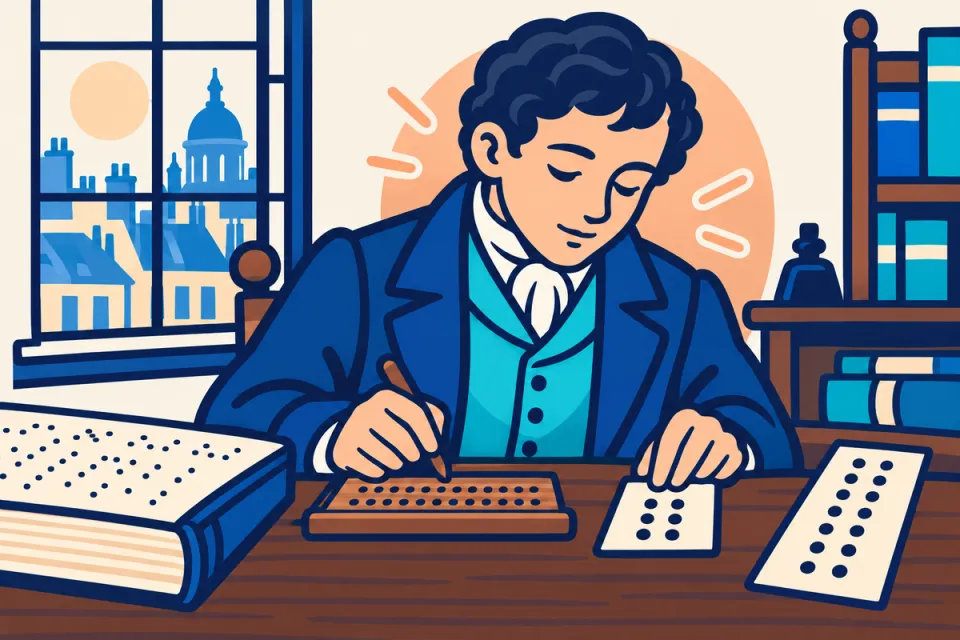
Louis Braille spent his teenage years shrinking it. Between thirteen and sixteen he worked the code down to a compact cell of six dots — small enough that one finger could read a whole character in a single touch, flexible enough for words and music. At twenty he published it.
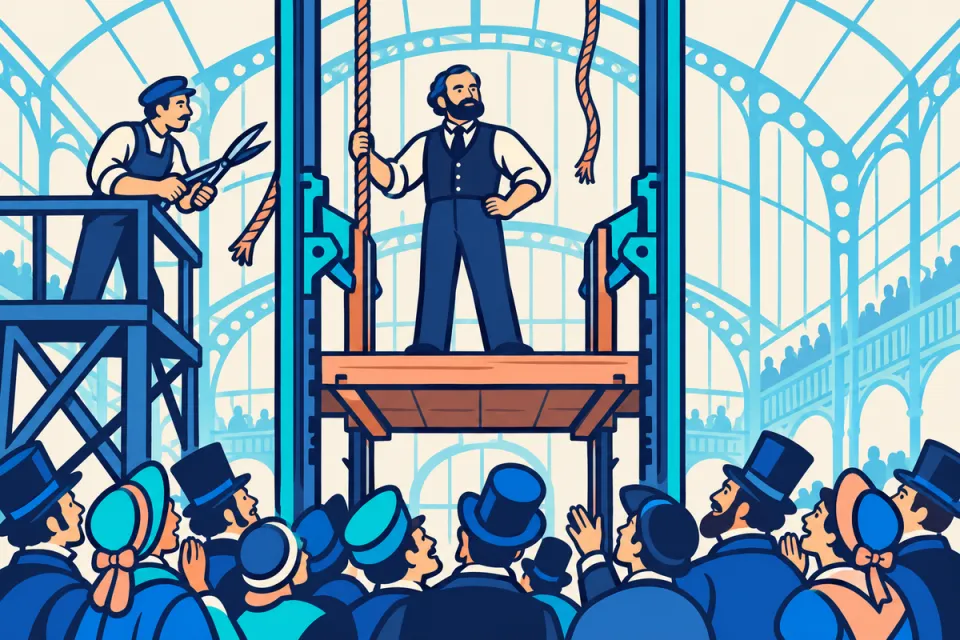
One principal supported it, but later leaders opposed it, and it was never officially adopted while he lived. Students learned it on their own anyway. Braille became a professor at the Institute, teaching history, geometry, and algebra, and died in 1852 at forty-three. Two years later, worn down by the overwhelming insistence of his blind pupils, the Institute adopted the six-dot code. Every braille reader today still uses the six-dot cell he worked out as a teenager.
461 words · about 2 min to read · retell it in about 4 minutes
The tool that blinded Louis Braille was an awl, the pointed leather punch from his father’s harness-making shop in Coupvray, east of Paris. At three he was playing with it, pressing it into a scrap of leather; it glanced off and stabbed one eye. Infection did the rest, and by five he was completely blind. There was little schooling designed for a blind child then, but his bright mind impressed the local teachers and priests, a village school let him sit in, and at ten his intelligence earned a scholarship to the Royal Institute for Blind Youth in Paris.
The Institute owned a library its founder had embossed with raised Latin letters, and the boys could read it — barely. The books were bulky and fragile, the reading slow, and the process produced no way to write. Then, in 1821, word arrived of a communication system devised by Charles Barbier. As the Library of Congress tells the story, an army captain came to demonstrate night writing, a raised-dot alphabet created so soldiers could communicate silently on the battlefield. Barbier’s code packed each symbol with up to twelve dots in two columns; a trained reader could interpret them entirely by finger, but the grid was too large to take in at a touch, and it encoded sounds rather than letters.
Louis Braille, twelve years old when Barbier’s system reached the school, spent the next several years doing surgery on it. Between thirteen and sixteen he compressed the twelve-dot cell to six, uniform for every character, small enough for a fingertip to read in one motion, adaptable to words, numbers, and music. His first version mixed dots with dashes, published in 1829; by the second edition in 1837 the dashes were gone, too difficult to read, and the six-dot cell that survives today was set.
The Institute’s response was the story’s second act, and it is the reason the story needs telling. The method was not officially taught during Braille’s lifetime. Pupils learned it on their own in spite of that; when a new director, Pierre-Armand Dufau, opposed the system after 1840, another teacher, Joseph Guadet, helped bring it back in 1844 — but only the pupils’ overwhelming insistence won formal adoption, in 1854, two years after Braille’s death at forty-three, of the respiratory illness that had dogged him for sixteen years. He had taught history, geometry, and algebra there as a professor, though one account says illness forced him to stop teaching by forty.
France marked the centenary of his death by moving his remains to the Panthéon; some villagers of Coupvray objected to losing him, so as a compromise his hands stayed behind in Coupvray. The code itself never needed a monument. It went worldwide and remains, virtually unchanged, the teenager’s six dots.
Read it once, close the page, and tell it back. The coach listens for pace, fillers and the facts.
Key facts and sources
Braille was blinded in one eye at the age of three in an accident with a stitching awl in his father’s harness-making shop.
“Braille was blinded in one eye at the age of three. This occurred as a result from an accident with a stitching awl in his father’s harness-making shop.” — Louis Braille, Wikipedia
An infection spread and by the age of five he was completely blind in both eyes.
“Braille survived the torment of the infection, but by the age of five he was completely blind in both eyes.” — Louis Braille, Wikipedia
At ten he was awarded a scholarship to the Royal Institute for Blind Youth in Paris.
“at the age of ten he was awarded a scholarship to the Royal Institute for Blind Youth (Institution des jeunes aveugles) in Paris.” — Louis Braille (1809–1852), Library of Congress
At the Royal Institute students read embossed print letters; reading was very slow and writing by hand was impossible.
“At the Royal Institute, students were taught to read books that used embossed print letters. Reading was very slow, and it was impossible to write anything by hand.” — Louis Braille (1809–1852), Library of Congress
Braille was inspired after an army captain visited to demonstrate night writing, created to let soldiers communicate silently on the battlefield with a raised-dot alphabet.
“Braille was inspired after an army captain visited to demonstrate “night writing.” Night writing was created to allow soldiers to communicate silently on the battlefield using a raised-dot alphabet.” — Louis Braille (1809–1852), Library of Congress
Barbier’s invention was a code of up to twelve dots in two columns, impressed into thick paper and read entirely by the fingers.
“Barbier’s invention was a code of up to twelve dots in two columns, impressed into thick paper. These impressions could be interpreted entirely by the fingers.” — Louis Braille, Wikipedia
Between the ages of thirteen and sixteen Braille worked to modify the system, changing a twelve-dot system to the six-dot cell still in use.
“Braille found the system complicated, and, between the ages of thirteen and sixteen, he worked to modify it, changing a twelve-dot system to the six-dot cell that is still in use today.” — Louis Braille (1809–1852), Library of Congress
Students had to learn braille on their own because the method was not officially taught during his lifetime.
“students had to learn braille on their own because his method was not officially taught during his lifetime.” — Louis Braille (1809–1852), Library of Congress
Because of the overwhelming insistence of the blind pupils, the Institute adopted Braille’s system in 1854, two years after his death.
“Because of the overwhelming insistence of the blind pupils, Braille’s system was finally adopted by the Institute in 1854, two years after his death.” — Louis Braille, Wikipedia
At twenty Braille published a procedure for writing words, music, and plainsong in dots.
“At the age of twenty, Braille published Procedure for Writing Words, Music, and Plainsong in Dots” — Louis Braille (1809–1852), Library of Congress
Braille found Barbier’s system complicated; its two-by-six dot grid made symbols impossible to take in at a single touch.
“the height of the grid (2 × 6 points) made it impossible to read in a single go with one finger” — Night writing, Wikipedia
Braille reworked Barbier’s system, made uniform columns for each letter, and reduced the maximum of twelve raised dots to six.
“Braille reworked Barbier’s system by simplifying its form and maximizing its efficiency. He made uniform columns for each letter, and reduced the maximum of twelve raised dots to six.” — Louis Braille, Wikipedia
Braille became a professor at the Royal Institute, teaching history, geometry, and algebra until his death in 1852.
“Braille became a professor at the Royal Institute and remained there, teaching history, geometry, and algebra, until his death in 1852.” — Louis Braille (1809–1852), Library of Congress
Braille died in 1852, two days after he turned 43.
“he died in 1852, two days after he turned 43.” — Louis Braille, Wikipedia
At three he pressed an awl into leather; it glanced across and stabbed him in one eye.
“At the age of three, he was playing with some of the tools, trying to make holes in a piece of leather with an awl. Squinting closely at the surface, he pressed down hard to drive the point in, and the awl glanced across the tough leather and stabbed him in one of his eyes.” — Louis Braille, Wikipedia
In 1821 Braille learned of a communication system devised by Charles Barbier.
“In 1821, Braille learned of a communication system devised by Charles Barbier.” — Louis Braille, Wikipedia
Night writing is a form of tactile writing invented by Charles Barbier de la Serre.
“Night writing is the name given to a form of tactile writing invented by Charles Barbier de la Serre (1767–1841).” — Night writing, Wikipedia
His first version used dots and dashes, published in 1829; by the second edition in 1837 the dashes were discarded as too difficult to read.
“His first version used both dots and dashes. He published this version in 1829, but by the second edition in 1837 discarded the dashes because they were too difficult to read.” — Louis Braille, Wikipedia
A persistent respiratory illness, long believed to be tuberculosis, dogged Braille for 16 years.
“A persistent respiratory illness, long believed to be tuberculosis, dogged him. Despite the lack of a cure at the time, Braille lived with the illness for 16 years.” — Louis Braille, Wikipedia
On the centenary of his death his remains were moved to the Panthéon, and in a symbolic gesture his hands were left in Coupvray, buried near his home.
“On the centenary of his death, his remains were moved to the Panthéon in Paris. In a symbolic gesture, Braille’s hands were left in Coupvray, reverently buried near his home.” — Louis Braille, Wikipedia
Braille’s system is used worldwide and remains virtually unchanged to this day.
“His system is used worldwide and remains virtually unchanged to this day.” — Louis Braille, Wikipedia
Louis Braille was born in 1809 in the village of Coupvray, near Paris.
“Louis Braille was born in 1809 in the village of Coupvray, near Paris.” — Louis Braille (1809–1852), Library of Congress
Sources consulted for this story: Louis Braille (Wikipedia, accessed 2026-10-25); Louis Braille (1809–1852) (Library of Congress, accessed 2026-10-25); Night writing (Wikipedia, accessed 2026-10-25). Every story is checked against its sources before it is published — how we verify stories.
Why this story is worth telling
He had the six-dot cell working by his mid-teens; the adults needed decades to say yes.