The Sword Through the Book
The Sword Through the Book
1738Pennsylvania and New Jersey, colonial AmericaCourage & kindness
In 1738, a four-foot Quaker walked into meeting with a sword, a Bible and a bladder of fake blood, and made his point.
Reading level
The same true story, told at three lengths. Pick one to read, close your eyes, and tell it back in your own words.
209 words · about 1 min to read · retell it in about 2 minutes
Meet Benjamin Lay. He was born in 1682, and he was only about four feet tall. He had seen slavery in Barbados with his own eyes, and it never left him. He later moved to Pennsylvania, where many Quakers, his own religious group, owned slaves.
Benjamin would not let that pass. One freezing morning he stood outside the meetinghouse with one bare foot in the snow. People urged him to come inside and get warm. He answered: you feel sorry for me, but you feel nothing for the slaves who go all winter half dressed.
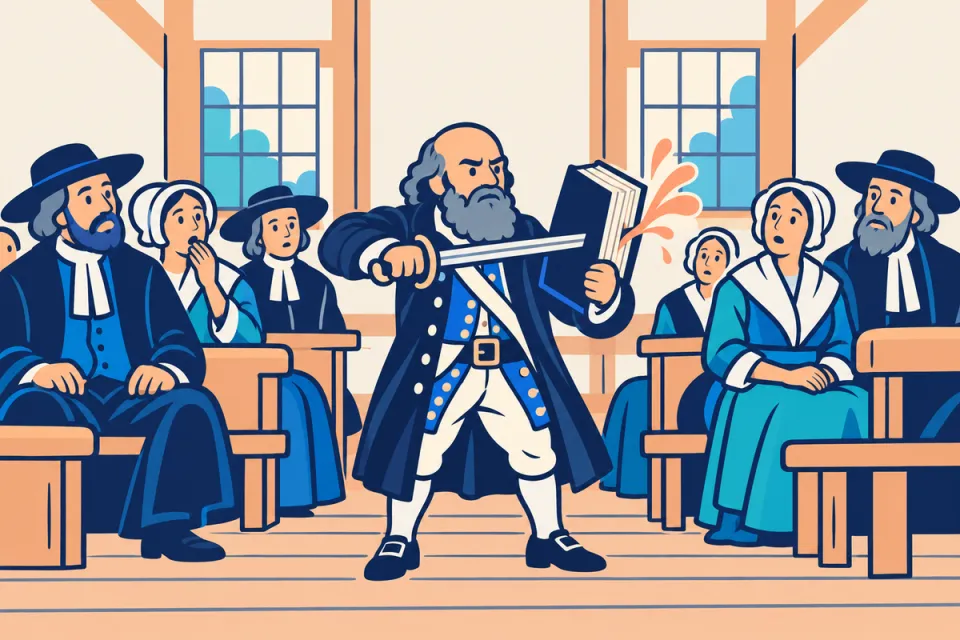
Then came his biggest moment. In 1738 he walked into the yearly meeting wearing a soldier’s uniform under his coat, with a sword. Under his coat he hid a hollowed-out book. Inside the book he had hidden a bag full of red berry juice, the color of blood. He stood up and said that God sees all people as equal. Then he pushed the sword right through the book. Red juice splashed over the slave owners. People gasped.
The Quakers expelled him. But Benjamin never stopped. Two decades later, the Quakers began to act against members who traded slaves. When he heard the news, the old man said he could now die in peace.
291 words · about 1 min to read · retell it in about 2 minutes
Benjamin Lay was a Quaker with a taste for theater and a conscience that would not rest. Born in England in 1682, barely four feet tall, he had worked as a sailor and a merchant, and in Barbados he once watched an enslaved man choose death rather than face another whipping. Lay carried that image for the rest of his life.
He settled in Pennsylvania, where many of his fellow Quakers, rich from Atlantic trade, kept slaves. Lay refused to look away. He made his own clothes to boycott anything touched by slave labor. One winter morning he stood at the meetinghouse gateway with a bare leg thrust into the snow, and when friends urged him to come in from the cold, he told them they pitied him but felt nothing for the slaves who went half clad all winter.
His masterpiece came in 1738. At the Philadelphia Yearly Meeting in Burlington, New Jersey, he rose, a soldier’s uniform under his great coat, a sword at his side, holding a hollowed-out book. Hidden inside was an animal bladder filled with red pokeberry juice. He declared that God respects all peoples equally, then drove the sword through the book. Red liquid spattered the slave owners. The room exploded into chaos, but Lay stood as still as a statue while Quakers carried him out. For that, and for his book against slave-keeping, printed by his friend Benjamin Franklin, the Quakers disowned him.
Over the years, other Quakers kept pushing too. In 1758, the Yearly Meeting began to discipline members who traded slaves. Told the news, the old man in his cave home said, “I can now die in peace.” He died the next year. In 2018, Quakers in Britain formally took him back.
517 words · about 3 min to read · retell it in about 4 minutes
Benjamin Lay was one of the most theatrical protesters of his age, and almost nobody remembers him. Born in England in 1682, he stood barely four feet tall, a hunchback with arms as long as his legs. He called himself Little Benjamin, and likened himself to little David confronting the Goliath of slavery. He had been a shepherd, a glover’s apprentice, a sailor and a merchant, and in Barbados, where nearly nine people in ten were enslaved, he watched a man kill himself rather than submit to another whipping. Lay never recovered from the sight, and never forgave it.
In the early 1730s he settled in Pennsylvania, the Quaker heartland of America. The Quakers were wealthy, respectable and, in large part, slaveholders. Lay refused to let them keep both their piety and their human property. He lived his protest: he made his own clothes to boycott goods produced by exploited labor and kept to a diet of fruits, vegetables, honey and milk. Once he stood at the meetinghouse gateway on a winter morning, one bare leg buried in the snow. Friends passing by urged him to come in from the cold. He answered that they pretended compassion for him while feeling nothing for the slaves who went half clad through the winter fields. Another time he temporarily took a slaveholder’s child, to show the parents what African families felt when their relatives were sold away.
The great scene came on 19 September 1738, at the Philadelphia Yearly Meeting in Burlington, New Jersey. Lay arrived in a great coat over a military uniform, a sword at his side, carrying a hollowed-out book with a secret compartment. Inside it was an animal bladder filled with bright red pokeberry juice. He waited his turn to speak, then told the assembled Quakers that God respects all peoples equally, and asked how people who profess the golden rule could keep slaves. He threw off the coat, raised the book, and plunged the sword through it. Red liquid gushed over his arm and spattered the slave keepers. The room exploded, but Lay stood like a statue while several Quakers carried him out.
For this, and for his book All Slave-Keepers... Apostates, printed by his friend Benjamin Franklin, he was disowned. Disowned, he built a small cottage in a natural cave and lived there with his books; his beloved Sarah had died in 1735. Then, in 1758, the news he had waited a lifetime for arrived: the Yearly Meeting had begun a process to discipline, and eventually disown, Quakers who traded in slaves. Lay rose from his chair and gave thanks. “I can now die in peace”, he said. He died in early 1759 and was buried in an unmarked grave. Well into the next century, abolitionist Quakers kept his picture in their homes. In 2018 the last meeting that had disowned him formally took him back, and a grave marker for Benjamin and Sarah was unveiled in the Abington graveyard.
Slavery in the Quaker world outlived him, but the road ran through him. Every movement needs someone who stands in the snow first.
Read it once, close the page, and tell it back. The coach listens for pace, fillers and the facts.
Key facts and sources
Benjamin Lay was born in England in 1682.
“Benjamin Lay (January 26, 1682 - February 8, 1759) was an English-born writer, farmer and activist.” — Benjamin Lay, Wikipedia
In 1718 he moved to Barbados as a merchant, where his abolitionist principles made him unpopular.
“In 1718, Lay moved to Barbados as a merchant. Soon his abolitionist principles, fueled by his Quaker radicalism, made him unpopular” — Benjamin Lay, Wikipedia
In Barbados he saw an enslaved man kill himself rather than be whipped again.
“during an 18-month sojourn as a shopkeeper in Barbados, he saw an enslaved man kill himself rather than submit to yet another whipping” — The “Quaker Comet” Was the Greatest Abolitionist You’ve Never Heard Of, Smithsonian Magazine
He settled in Pennsylvania and many Quakers there owned slaves.
“Three of those leaders, and probably all four, owned slaves. So did the majority of Philadelphia Quakers.” — The “Quaker Comet” Was the Greatest Abolitionist You’ve Never Heard Of, Smithsonian Magazine
His 1737 book against slave-keepers, All Slave-Keepers That Keep the Innocent in Bondage, Apostates, was one of the first abolitionist works published in the Thirteen Colonies.
“His 1737 book All Slave-Keepers That Keep the Innocent in Bondage, Apostates was one of the first abolitionist works published in the Thirteen Colonies.” — Benjamin Lay, Wikipedia
On 19 September 1738 he strode into the Quaker meetinghouse at Burlington for the Philadelphia Yearly Meeting.
“On September 19, 1738, a man named Benjamin Lay strode into a Quaker meetinghouse in Burlington, New Jersey, for the biggest event of the Philadelphia Yearly Meeting.” — The “Quaker Comet” Was the Greatest Abolitionist You’ve Never Heard Of, Smithsonian Magazine
He wore a great coat hiding a military uniform and a sword.
“He wore a great coat, which hid a military uniform and a sword.” — The “Quaker Comet” Was the Greatest Abolitionist You’ve Never Heard Of, Smithsonian Magazine
He carried a hollowed-out book with a secret compartment holding an animal bladder of pokeberry juice.
“Lay carried a hollowed-out book with a secret compartment, into which he had tucked a tied-off animal bladder filled with bright red pokeberry juice.” — The “Quaker Comet” Was the Greatest Abolitionist You’ve Never Heard Of, Smithsonian Magazine
He announced that God respects all peoples equally, rich and poor, men and women, white and black.
“Lay announced in a booming voice that God Almighty respects all peoples equally, rich and poor, men and women, white and black alike.” — The “Quaker Comet” Was the Greatest Abolitionist You’ve Never Heard Of, Smithsonian Magazine
He threw off his coat, revealed the garb, the book and the blade.
“He then threw off his great coat, revealing the military garb, the book and the blade.” — The “Quaker Comet” Was the Greatest Abolitionist You’ve Never Heard Of, Smithsonian Magazine
He said: ‘Thus shall God shed the blood of those persons who enslave their fellow creatures.’
““Thus shall God shed the blood of those persons who enslave their fellow creatures.”” — The “Quaker Comet” Was the Greatest Abolitionist You’ve Never Heard Of, Smithsonian Magazine
He raised the book above his head and plunged the sword through it.
“He pulled out the sword, raised the book above his head, and plunged the sword through it.” — The “Quaker Comet” Was the Greatest Abolitionist You’ve Never Heard Of, Smithsonian Magazine
People gasped as the red liquid gushed down his arm and he spattered ‘blood’ on the slave keepers.
“People gasped as the red liquid gushed down his arm; women swooned. To the shock of all, he spattered “blood” on the slave keepers.” — The “Quaker Comet” Was the Greatest Abolitionist You’ve Never Heard Of, Smithsonian Magazine
The room exploded into chaos while Lay stood still like a statue.
“The room exploded into chaos, but Lay stood quiet and still, “like a statue,” a witness remarked.” — The “Quaker Comet” Was the Greatest Abolitionist You’ve Never Heard Of, Smithsonian Magazine
Several Quakers carried him from the building and he did not resist.
“Several Quakers quickly surrounded the armed soldier of God and carried him from the building. He did not resist.” — The “Quaker Comet” Was the Greatest Abolitionist You’ve Never Heard Of, Smithsonian Magazine
Once in winter he stood at a meetinghouse gateway with a bare leg and foot in the snow.
“He left “his right leg and foot entirely uncovered” and thrust them into the snow.” — The “Quaker Comet” Was the Greatest Abolitionist You’ve Never Heard Of, Smithsonian Magazine
When Friends urged him not to expose himself to the freezing cold, he said: you pretend compassion for me but feel nothing for the poor slaves in your fields who go all winter half clad.
“One Quaker after another took notice and urged him not to expose himself to the freezing cold lest he get sick. He replied, “Ah, you pretend compassion for me but you do not feel for the poor slaves in your fields, who go all winter half clad.”” — The “Quaker Comet” Was the Greatest Abolitionist You’ve Never Heard Of, Smithsonian Magazine
He once temporarily took a slaveholder’s child to show the parents how Africans felt when relatives were sold overseas.
“he kidnapped the child of slaveholders temporarily, to show them how Africans felt when their relatives were sold overseas” — Benjamin Lay, Wikipedia
After the visit in 1758 he said ‘I can now die in peace’.
“A few moments later he added, “I can now die in peace.”” — The “Quaker Comet” Was the Greatest Abolitionist You’ve Never Heard Of, Smithsonian Magazine
He was buried in an unmarked grave in the Quaker burial ground in Abington, near Sarah.
“he was buried in an unmarked grave, near his cherished Sarah, in the Quaker burial ground in Abington.” — The “Quaker Comet” Was the Greatest Abolitionist You’ve Never Heard Of, Smithsonian Magazine
In 1758 the Philadelphia Yearly Meeting began disciplining Quakers who traded slaves.
“the Philadelphia Yearly Meeting, after much agitation from below, had initiated a process to discipline and eventually disown Quakers who traded slaves.” — The “Quaker Comet” Was the Greatest Abolitionist You’ve Never Heard Of, Smithsonian Magazine
Slaveholding itself was still permitted for another 18 years.
“Slaveholding itself was still permitted—and would be for another 18 years” — The “Quaker Comet” Was the Greatest Abolitionist You’ve Never Heard Of, Smithsonian Magazine
Lay was disowned by Quaker meetings for his protests.
“Four Quaker meetings disowned Lay for his inconvenient campaigning.” — Benjamin Lay, Wikipedia
In 2018 Britain Yearly Meeting formally ‘undisowned’ him.
“In 2018, Southern East Anglia Area Meeting, part of Britain Yearly Meeting, became the last of the four to “undisown” him.” — Benjamin Lay, Wikipedia
In the 19th century abolitionist Quakers kept pictures of Lay in their homes.
“throughout the early and mid-19th century, it was common for abolitionist Quakers to keep pictures of Lay in their homes.” — Benjamin Lay, Wikipedia
He likened himself to little David confronting the Goliath of slavery.
“he also likened himself to “little David” confronting the Goliath of slavery.” — Benjamin Lay, Wikipedia
He and his wife Sarah lived by boycotts: he made his own clothes and refused products of slave labor.
“Lay created his own clothes to boycott all commodities produced by the exploitation of others” — Benjamin Lay, Wikipedia
The Overseers issued a condemnation of his book and the Abington meeting expelled him in 1738.
“That fall, the board issued an official condemnation, signed by John Kinsey, proclaiming that the book “contains gross Abuses, not only against some of their Members in particular, but against the whole Society,” and adding: “That the Author is not of their religious Community.” The meeting in Abington, too, expelled the Author.” — The “Quaker Comet” Was the Greatest Abolitionist You’ve Never Heard Of, Smithsonian Magazine
In the 18th century slavery seemed to many as natural as the sun and moon and stars.
“At a time when slavery seemed to many people around the world as natural and unchangeable as the sun, the moon and the stars, he became one of the very first to call for the abolition of slavery” — The “Quaker Comet” Was the Greatest Abolitionist You’ve Never Heard Of, Smithsonian Magazine
His wife Sarah died in 1735.
“after Sarah died, of unknown causes, in late 1735” — The “Quaker Comet” Was the Greatest Abolitionist You’ve Never Heard Of, Smithsonian Magazine
At a Quaker meeting he dashed three tobacco pipes, one among the men ministers, one among the women ministers and one among the congregation.
“As the meeting came to an end, he rose in indignant silence and “dashed one pipe among the men ministers, one among the women ministers, and the third among the congregation assembled.”” — The “Quaker Comet” Was the Greatest Abolitionist You’ve Never Heard Of, Smithsonian Magazine
Franklin later promised in his 1757 will that the people he enslaved would be freed after his death.
“In April 1757, Franklin drafted his new will in which he promised Peter and Jemima that they would be freed after his death.” — Benjamin Lay, Wikipedia
Lay lived in a cave home in Abington.
“erecting a small cottage in a “natural excavation in the earth”-a cave.” — The “Quaker Comet” Was the Greatest Abolitionist You’ve Never Heard Of, Smithsonian Magazine
A grave marker for Benjamin and Sarah Lay was unveiled in 2018.
“On April 21, 2018, Abington Friends Meeting unveiled a grave marker for Benjamin and Sarah Lay in its graveyard.” — Benjamin Lay, Wikipedia
He was about four feet tall, a hunchback with arms as long as his legs.
“Standing barely four feet (1.2 metres) tall, Lay was a hunchback with a protruding chest, and his arms were as long as his legs.” — Benjamin Lay, Wikipedia
Benjamin Franklin, his friend, printed the book.
“he went directly to his friend, the printer Benjamin Franklin, and asked him to publish it, which he did in August 1738” — The “Quaker Comet” Was the Greatest Abolitionist You’ve Never Heard Of, Smithsonian Magazine
When the news came he rose from his chair and gave thanks.
“he rose from his chair and “in an attitude of devotional reverence” said, “Thanksgiving and praise be rendered unto the Lord God.”” — The “Quaker Comet” Was the Greatest Abolitionist You’ve Never Heard Of, Smithsonian Magazine
He died on 3 February 1759, at the age of 77.
“There he died, on February 3, 1759, at the age of 77.” — The “Quaker Comet” Was the Greatest Abolitionist You’ve Never Heard Of, Smithsonian Magazine
He had worked as a shepherd, a glover’s apprentice and a sailor.
“After working as a farm labourer and shepherd, later as an apprentice glove-maker, Lay ran away to London and became a sailor at the age of 21.” — Benjamin Lay, Wikipedia
In 1731 he emigrated to Pennsylvania.
“In 1731, he emigrated to the Province of Pennsylvania” — Benjamin Lay, Wikipedia
He called himself Little Benjamin and likened himself to little David facing the Goliath of slavery.
“Referring to himself as “Little Benjamin”, he also likened himself to “little David” confronting the Goliath of slavery.” — Benjamin Lay, Wikipedia
He ate fruits, honey and vegetables, and drank only milk and water.
“As a vegetarian, Lay ate fruits, honey and vegetables, and drank only milk and water.” — Benjamin Lay, Wikipedia
He kept a library of two hundred books inside his cave home.
“Inside the cave he stowed his library: two hundred books of theology, biography, history and poetry.” — Benjamin Lay, Wikipedia
Almost nine in ten people on Barbados were enslaved.
“compared with almost nine in ten on the island” — The “Quaker Comet” Was the Greatest Abolitionist You’ve Never Heard Of, Smithsonian Magazine
Many Quakers in Pennsylvania and New Jersey had grown rich on Atlantic commerce, and many bought slaves.
“Many Friends in Pennsylvania and New Jersey had grown rich on Atlantic commerce, and many bought human property.” — The “Quaker Comet” Was the Greatest Abolitionist You’ve Never Heard Of, Smithsonian Magazine
Lay waited his turn to speak at the meeting.
“Lay, a Quaker himself, waited his turn.” — The “Quaker Comet” Was the Greatest Abolitionist You’ve Never Heard Of, Smithsonian Magazine
He asked how a people who profess the golden rule could keep slaves.
“He said that slave keeping was the greatest sin in the world and asked, How can a people who profess the golden rule keep slaves?” — The “Quaker Comet” Was the Greatest Abolitionist You’ve Never Heard Of, Smithsonian Magazine
On a Sunday morning in winter he stood at a gateway to the Quaker meetinghouse.
“One Sunday morning he stood at a gateway to the Quaker meetinghouse” — The “Quaker Comet” Was the Greatest Abolitionist You’ve Never Heard Of, Smithsonian Magazine
The book he pierced was a Bible.
“He ended by plunging a sword into a Bible containing a bladder of blood-red pokeberry juice” — Benjamin Lay, Wikipedia
His shock at the brutal treatment of slaves in Barbados led him to develop lifelong abolitionist principles.
“While working as a merchant, his shock at the brutal treatment of slaves in Barbados led Lay to develop lifelong abolitionist principles” — Benjamin Lay, Wikipedia
What he saw in Barbados traumatized him and drove his passion for antislavery.
“that and myriad other barbarities in that British colony both traumatized him and drove his passion for antislavery” — The “Quaker Comet” Was the Greatest Abolitionist You’ve Never Heard Of, Smithsonian Magazine
Sources consulted for this story: Benjamin Lay (Wikipedia, accessed 2026-10-25); The “Quaker Comet” Was the Greatest Abolitionist You’ve Never Heard Of (Smithsonian Magazine, accessed 2026-10-25); Quakers & Slavery: Benjamin Lay (Bryn Mawr, Haverford and Swarthmore Colleges, accessed 2026-10-25). Every story is checked against its sources before it is published — how we verify stories.
Why this story is worth telling
One angry little man refused to let his church look away from slavery.