
The King’s Inventor
The King’s Inventor
Early 1400s–1442Hanseong (Seoul), Joseon KoreaInventions & business
A slave built some of Korea’s most admired machines and won the king’s trust — until one broken palanquin ended his recorded life.
Reading level
The same true story, told at three lengths. Pick one to read, close your eyes, and tell it back in your own words.
201 words · about 1 min to read · retell it in about 2 minutes
Long ago in Korea, there was a young man named Jang Yeong-sil. He was born a slave. He was a government slave, which meant he belonged to the state. Nobody expected a slave to become famous.
But King Sejong saw Jang’s clever hands. The king let him work in the palace. The king also did something almost unheard of. He sent Jang to China to study scientific instruments. People said such a trip was a rare honor for a slave.
In 1434, Jang finished a great water clock. It struck the time by itself, with a bell, a gong, and a drum. Everyone in the city could know the hour. Jang also helped build tools to track the stars and to tell time by the sun, and many people say he made a rain gauge too.
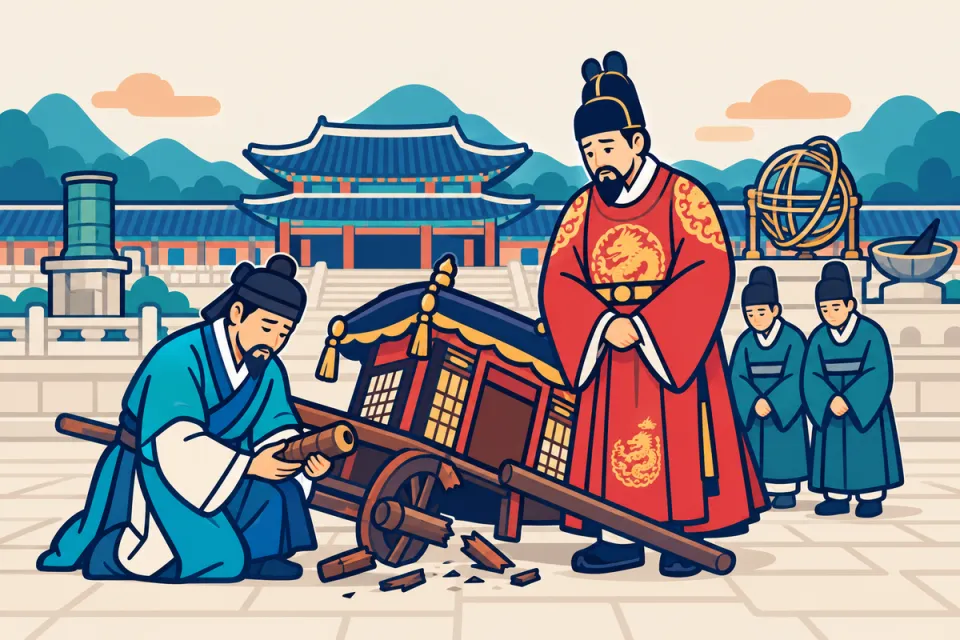
Then came one bad day in 1442. A covered chair that Jang had built broke while the king rode inside it. Jang was blamed. The king did not want to punish him, but Jang was still thrown out of the palace.
After that, no one wrote down what happened to him. The man who made Korea’s clock strike by itself simply disappeared from the page.
296 words · about 1 min to read · retell it in about 2 minutes
In fifteenth-century Korea, the court of King Sejong held a man who should not have been there at all. Jang Yeong-sil was born a nobi, a government-owned slave, the lowest rank in Joseon society. His mother was a government-owned entertainer; his father came from a noble family and had served as a high official in the old Goryeo government. By every rule of his world, Jang should have spent his life carrying loads.
But word of his skillful, clever workmanship spread, and both King Taejong and then King Sejong took notice. Sejong gave him a position at court and sent him to China to study astronomical instruments — a journey so unusual for a slave that historians still mention it as extraordinary.
What Jang built after that changed daily life in Korea. In 1433 came an armillary sphere that turned by water power and tracked the sun, moon, and stars. In 1434 came his masterpiece: Korea’s first self-striking water clock. Water dripped from jar to jar until a floating arrow tipped iron balls down a pipe; the balls struck a giant cymbal, wooden figures moved to show the hour, and a bell, a gong and a drum marked it. The clock became the standard of time for the whole country. He went on to build a water gauge, helped make sundials for busy main streets, and is often credited with a rain gauge.
Officials at court grew jealous. A former slave outranked expectations and held the king’s trust. Then, in 1442, a palanquin Jang had designed broke while the king rode in it. Jang was judged responsible. Sejong himself opposed the punishment, but Jang was expelled from the palace anyway.
After that, silence. Nothing he did, nothing he made, nothing about his death was ever written down.
468 words · about 2 min to read · retell it in about 4 minutes
Open the record of Joseon Korea in the 1430s and you will find a court technician who, about a decade earlier, had legally been property. Jang Yeong-sil was born the son of a government-registered courtesan, which made him a nobi — a slave owned by the state, the bottom layer of a rigid class system. His father’s family had served as ministers in the old Goryeo court; the son inherited none of that standing. What he had instead was a gift for machines.
Word of that gift traveled upward until it reached two kings. Taejong cherished him, and Sejong did something remarkable even by open-minded royal standards: he gave a man born a slave a post at court and sent him to China to research astronomical devices. The Academy of Korean Studies calls the trip an extremely rare privilege for a slave. It tells you how badly Sejong wanted what Jang could build; Korean histories still admire Jang as one of the greatest scientific minds the country produced.
Joseon needed instruments. Chinese and Arabian books held instructions so incomplete that Jang and his colleagues had to invent much of the design themselves. Jang’s first celestial globe came out of two months of study and performed with only mediocre accuracy; the honcheonui of 1433 was the correction, an armillary sphere driven by a waterwheel that kept turning out the positions of sun, moon, and stars day and night. In 1434 came the Jagyeokru, Korea’s first self-striking water clock. Inside it, water seeped from upper jars into a lower one; a floating arrow tipped a board of small iron balls; a ball rolled, collided with larger balls, and sent them crashing into a giant cymbal. Twelve wooden figures circled the clock, and the hour rang out on a bell, a gong, and a drum. Time in Joseon now had a single, public, mechanical voice.
Jang kept building: a calibrated stone water gauge, bronze bowl-shaped sundials for busy main streets, and a survey of metals that aided Korean weaponry; he is also often credited with a rain gauge that measured rainfall across the provinces, though records name Crown Prince Yi Hyang as its proposer. The court noticed. Some officials seethed — a man of common origin, a former slave, held the king’s trust and outranked their expectations.
In 1442 came the accident. Sejong had ordered Jang to build a gama, a sedan chair. It broke while the king rode in it. Jang was held responsible, and though Sejong opposed the sentence, the court punished him and expelled him from the palace. The Korean record of his life stops there. No death date, no last work, nothing. Korea’s great inventor simply exits the page mid-sentence — remembered now through reconstructions of the machines he made, and because in 2018 Google gave his name a doodle.
Read it once, close the page, and tell it back. The coach listens for pace, fillers and the facts.
Key facts and sources
Jang Yeong-sil’s social status was that of a government-owned slave, part of the lowest class in Joseon society.
“Jang’s social status was that of a government-owned slave (gwanno) – part of the lowest class in Joseon society.” — From Slave to Prolific Scientific Inventor – Jang Yeong-sil, Academy of Korean Studies
Although Jang was born a nobi, King Sejong gave him a court-technician position.
“Although Chang was born a nobi, King Sejong gave him a court-technician position in the royal court.” — Chang Yŏngsil, Wikipedia
Sejong sent Jang to China to research astronomical devices, an extremely rare privilege for a slave.
“Sejong sent Jang to China to research astronomical devices – an extremely rare privilege for a slave.” — From Slave to Prolific Scientific Inventor – Jang Yeong-sil, Academy of Korean Studies
Sejong was impressed by Jang’s craft and engineering skills and let him work as a court technician.
“Sejong was impressed by Chang’s craft and engineering skills and allowed Chang to work as a court technician in the palace.” — Chang Yŏngsil, Wikipedia
In 1434 Jang created Korea’s first self-striking water clock, the Jagyeokru, marking the hour with a bell, gong, and drum, used as Joseon’s standard of time.
“When he returned in 1434, Chang created Korea’s first self-striking water clock, the Jagyeokru (자격루), which would mark the hour automatically with the sounds of a bell, gong, and drum, and was used to keep the standard of time in Joseon.” — Chang Yŏngsil, Wikipedia
The clock had 12 wooden figures as time indicators, with iron balls tripping its strike.
“Circling the clock were 12 wooden figures that served as indicators of time.” — Chang Yŏngsil, Wikipedia
Jang’s creations included a celestial globe, water clock, over six types of sundials, a rain gauge, a water gauge, and weapons-related technology.
“These included astronomical instruments such as a celestial globe (honcheonui), a water clock (jagyeokru), over six types of sundials (ilgu), a rain gauge (cheugugi), a water gauge (supyo), and various technologies relating to weaponry.” — From Slave to Prolific Scientific Inventor – Jang Yeong-sil, Academy of Korean Studies
In 1442 a sedan chair Jang designed broke while the king rode inside; Jang was deemed responsible and, though the king opposed it, was expelled from the palace, and nothing is recorded of his life thereafter.
“In 1442, a sedan chair which was designed by Jang broke while the king was being carried inside. Jang was deemed responsible, and, though the king opposed it, was expelled from the palace. Nothing is recorded of his life thereafter.” — From Slave to Prolific Scientific Inventor – Jang Yeong-sil, Academy of Korean Studies
Jang was jailed for an extended period and flogged 80 times before expulsion.
“Chang was jailed for an extended period of time, flogged 80 times and expelled from the royal palace.” — Chang Yŏngsil, Wikipedia
Some government officials were jealous of Jang’s achievements despite his common origin.
“Some government officials were very jealous of Chang, especially when he had achieved so much despite his common origin.” — Chang Yŏngsil, Wikipedia
Word of Jang’s skillful workmanship spread, and both King Taejong and King Sejong cherished and looked after him.
“Despite this, word of his skillful and clever workmanship spread, and both Kings Taejong (r. 1400-1418) and Sejong (r. 1418-1450) cherished and looked after Jang.” — From Slave to Prolific Scientific Inventor – Jang Yeong-sil, Academy of Korean Studies
In 1433 Jang built the armillary sphere known as the honcheonui.
“In 1433, a year after his first attempt, Chang made an armillary sphere known as the honcheonui (혼천의; 渾天儀).” — Chang Yŏngsil, Wikipedia
Google celebrated Jang Yeong-sil with a Google Doodle on May 19, 2018.
“On May 19, 2018, Google celebrated Chang Yŏngsil with a Google Doodle.” — Chang Yŏngsil, Wikipedia
Jang’s mother was a government-registered courtesan, which made him a government-owned nobi.
“He was born to a mother who was a government-registered courtesan (관기; 官妓) and a father of Yuan dynasty descent.” — Chang Yŏngsil, Wikipedia
Jang referenced Chinese and Arabian texts whose instructions were incomplete, so significant design work fell to Jang and his colleagues.
“Jang referenced Chinese and Arabian texts to create his inventions, but as these instructions were incomplete, a significant amount of design had to be done by Jang and his colleagues.” — From Slave to Prolific Scientific Inventor – Jang Yeong-sil, Academy of Korean Studies
The honcheonui used a waterwheel to rotate an internal globe and could be updated on the positions of the sun, moon, and stars day or night.
“Honcheonui depended on a waterwheel to rotate the internal globe to indicate time. Whether day or night, this allowed the instrument to be updated on the positions of the sun, moon, and the stars.” — Chang Yŏngsil, Wikipedia
Jang lived at the beginning of the Joseon dynasty, in the first half of the 15th century, and is admired as one of the greatest scientific minds of Korean history.
“Jang Yeong-sil (?-?), who lived at the beginning of the Joseon dynasty during the first half of the 15th century, is admired as one of the greatest scientific minds of Korean history” — From Slave to Prolific Scientific Inventor – Jang Yeong-sil, Academy of Korean Studies
After two months of study Jang made a first spherical device that performed with mediocre accuracy, a year before the 1433 honcheonui.
“After two months of study, Chang made a spherical device that performed with mediocre accuracy. In 1433, a year after his first attempt, Chang made an armillary sphere known as the honcheonui (혼천의; 渾天儀).” — Chang Yŏngsil, Wikipedia
Sejong sent Jang to Gyeongsang Province, where he had developed metal alloys for weapons and tools.
“he sent Chang to Gyeongsang Province, where Chang had spent his earlier life developing metal alloys for various weapons and tools.” — Chang Yŏngsil, Wikipedia
In the water clock, water tilted a board of small iron balls, which rolled and knocked larger balls into a giant cymbal to announce the hour.
“As the water from the upper containers seeped down the pipe to the lower container, one of the arrows would tilt a board filled with small iron balls; a ball would roll down a pipe to a container of larger iron balls. The collision would cause the larger balls to travel down a lower pipe and hit a giant cymbal, announcing the time to the community.” — Chang Yŏngsil, Wikipedia
Jang’s father’s family had served as ministers in the old Goryeo court.
“Chang Seong-hwi was the third of five brothers, all of whom previously served as ministers in Goryeo.” — Chang Yŏngsil, Wikipedia
Sources consulted for this story: Chang Yŏngsil (Wikipedia, accessed 2026-10-25); From Slave to Prolific Scientific Inventor – Jang Yeong-sil (Academy of Korean Studies, accessed 2026-10-25). Every story is checked against its sources before it is published — how we verify stories.
Why this story is worth telling
Genius could lift him from slavery; one accident could erase him.