
Describe a Famous Leader from History: IELTS Speaking Part 2-Style Practice with the True Story of Emperor Ashoka
Ashoka, the third Mauryan king of ancient India, fits "a leader you admire" or "a famous person from history". After conquering Kalinga, where his own Edict 13 records 100,000 killed and 150,000 deported, he wrote of deep remorse in inscriptions on rocks and pillars, and declared conquest by Dhamma the best conquest.
Updated · 4 sources · How we work
SoulfulStories is an independent speaking-practice tool. It is not affiliated with, endorsed by or connected to IELTS, the British Council, IDP: IELTS or Cambridge University Press & Assessment. IELTS is a trademark of its respective owners. Our feedback is practice feedback, not an IELTS score or band.
Who counts as a "famous person from history" for Part 2?
Anyone whose story you can source in your own memory: a ruler, a scientist, a reformer. The card is about structure — who, when and where, what changed, your view — not about fame. A leader with one documented turning point is the easiest to organise. Here is the practice card, our own wording:
Describe a leader from history who changed the way they ruled.
You should say:
- who this leader was
- when and where they ruled
- what changed in them
and explain what you think of this leader.
The leader is Emperor Ashoka, and the turning point is in his own inscriptions. Read the story first.
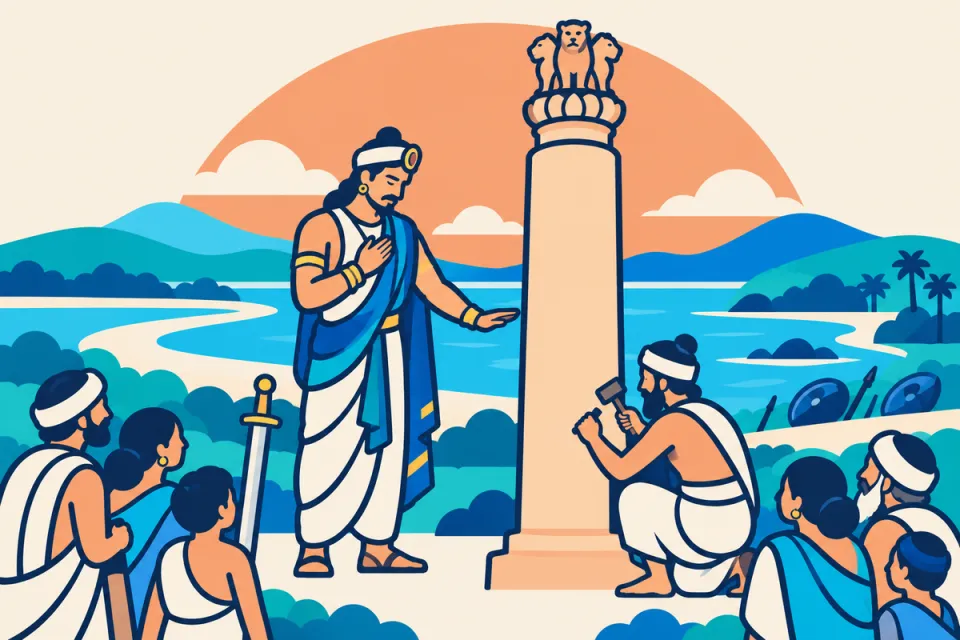
Facts you’ll need — each one is checked, with its source, on the story page:
- Third king of the Mauryan dynasty; ruled after his father Bindusara, a vast empire in ancient India
- Conquered Kalinga (roughly modern Odisha) in the eighth year of his reign
- Edict 13 records 150,000 deported and 100,000 killed, with many more dying
- He wrote of deep remorse; pained most that people of different religions were hurt or separated
- "Conquest by Dhamma is the best conquest"; wrongdoers forgiven where possible; "all men are my children"
- Edicts in more than thirty places across India, Nepal, Pakistan and Afghanistan, mostly Brahmi script
- Pillars 40–50 feet tall, up to fifty tons, with mirror-like polish
- James Prinsep deciphered a Delhi pillar in 1837; a 1915 find at Maski named "Asoka"
Always attribute the casualty figures to their source — "his own Edict 13 records" — because that hedge is both accurate and impressive.
Why is Ashoka a strong choice for a leader card?
Because the change is written in stone. Most "admire" answers argue from opinion; this one quotes an inscription the candidate can then explain. It also travels: the same story answers "a leader you admire", "a famous person from history" and — for candidates in India, Pakistan and Nepal — "a famous person from your country". One story, three cards; that is the economy story retelling is built on.
How do you tell Ashoka's story in two minutes?
War, change, stone, judgement. One word per point in the preparation minute:
- Opener (~35 words)Ashoka, the third king of the Mauryan dynasty, who followed his father Bindusara and ruled a vast empire in ancient India. Your part: where you learned about him.
- War (~60 words)In the eighth year of his reign his armies conquered Kalinga, on the east coast — roughly modern Odisha. His own Edict 13 records the numbers: 150,000 deported, 100,000 killed, and many more dying afterwards.
- Change (~80 words)He wrote that he felt deep remorse and was pained by the killing, the dying and the deportation — pained even more that good people of different religions were hurt or separated from loved ones. He declared conquest by Dhamma the best conquest, said wrongdoers should be forgiven where possible, and wrote that "all men are my children".
- Stone (~60 words)He carved these edicts in more than thirty places across India, Nepal, Pakistan and Afghanistan, mostly in Brahmi script so people could read them. Some stand on polished pillars 40–50 feet tall, weighing up to fifty tons, dragged hundreds of miles.
- Rediscovery and your view (~45 words)Forgotten for nearly 700 years, he was identified again after James Prinsep deciphered a Delhi pillar in 1837; a 1915 find at Maski naming "Asoka" confirmed the author. Your part: what you think of a ruler admitting regret in public — and note the cruel-prince stories are legends.
About 207 words in total — 1:23 to 1:39 spoken at 125–150 words per minute.
| Card point | Your note |
|---|---|
| who this leader was | Ashoka |
| when and where they ruled | Kalinga war |
| what changed in them | remorse, edicts |
| and explain what you think of this leader | my view |
One word per point, written in the preparation minute — never a sentence you could recite by accident.
How do you give a balanced opinion of a historical leader?
Concede first, then judge: "Although he won the war, he…" or "Judged by his own inscriptions, he…". A balanced view is also the accurate one — the remorse is real (he wrote it), and so is the conquest (he recorded it). If you mention the cruel-prince legends, label them as legends; the story page does the same.
What do examiners listen for?
The four criteria are the ones in the public band descriptors. What the app can measure is narrower, and it never produces a score or band for any of them:
- Fluency and coherence
- Before and after, then your judgement — the two-part contrast is the spine, and it is easy to hold under pressure.SoulfulStories measures: your pace, your pauses and your filler words — how long you keep the floor and how your answer is organised.
- Lexical resource
- Empire, conquest, remorse, edict, inscription, tolerance, legacy — history words that general answers never reach.SoulfulStories measures: the CEFR level of the words you used, and where you rephrased around a missing word.
- Grammatical range and accuracy
- Reporting verbs (he declared, he admitted) and concession (although he won the war, he…) show the range this card rewards.SoulfulStories measures: nothing — grammar is not measured, because a transcript-based check would be guesswork; the examiner on test day judges it.
- Pronunciation
- Word stress on inscription and deportation — long nouns stumble when rushed, so rehearse them slowly.SoulfulStories measures: nothing automatic today — pitch and volume variation are measured, but clear pronunciation is yours to hear in the playback.
Can the same story answer "a famous person in your country"?
Yes — swap the opening to place him ("a king whose pillars still stand in my country") and keep the rest. Other cards this story bends toward:
- Describe a famous person in your countryFor Indian candidates Ashoka fits that card too; the Manjhi page shows the person-card structure in a modern story.
- Describe a person whose work has helped many peopleThe edicts were public communication at scale — Louis Braille's page carries that frame.
The Part 2 practice page has the full method, and how to retell a story covers the close-the-book technique.
How do you practise this answer out loud?
Read Ashoka's story at your level, close it, note your four words, and speak for two minutes. The report measures pace, fillers, pauses and fact coverage — computed in code, never a score, as the methodology explains. Retell it again tomorrow; the concessions sound steadier on the second take.
Tell how a conqueror came to regret his war, in two minutes.
Feedback on your pace, filler words, pauses, which key facts you covered, and the CEFR level of your vocabulary. Free to try, no card — and no score or band.
Questions and answers
Who was Emperor Ashoka?
The third king of the Mauryan dynasty in ancient India. After conquering Kalinga he expressed deep remorse in edicts carved on rocks and pillars, and promoted conquest by Dhamma instead of war.
Is a historical figure a good choice for 'a leader you admire'?
Yes, if you can say who they were, what they did and why you admire them. A clear turning point, like Ashoka's change after Kalinga, keeps your answer organised.
Do I need exact dates in IELTS Speaking Part 2?
No. Approximate time references are fine. Clear organisation and accurate language matter more than precise numbers.
Is this an official IELTS cue card?
No. It is an original practice card. SoulfulStories is not affiliated with IELTS, the British Council, IDP or Cambridge.
Sources
Every outside fact on this page comes from the story’s cited sources, listed with their accessed dates on the story page.
- The Edicts of King Asoka (S. Dhammika translation) — Buddhist Publication Society / Britannica · accessed 25 October 2026
- Edicts of Ashoka — Wikipedia · accessed 25 October 2026
- Kalinga War — Wikipedia · accessed 25 October 2026
- IELTS Academic: Speaking test format — ielts.org · accessed 1 November 2026
Keep going
- IELTS Speaking Part 2 cue cardsPart 2-style practice cue cards backed by true, sourced stories, with a one-minute note grid and a model outline.
- IELTS Speaking Part 2 Practice: The Long Turn AloneA free, repeatable loop for the long turn: one minute of notes, two recorded minutes, one listen, one fix — with a worked cue card taken three ways.
- How to Retell a Story Out Loud: 5 Steps + a True StoryA five-step retelling method worked on one true story shown at its three reading levels — beginner, intermediate and advanced.
- MethodologyHow a retelling is measured and how every story is verified before it is published.
- The King Who Wrote His Regret in StoneAn ancient Indian emperor won his greatest war, felt such remorse that he carved a public apology in stone.
IELTS is a registered trademark of its owners. SoulfulStories is not affiliated with, endorsed by or connected to IELTS, the British Council, IDP or Cambridge. We don't give band scores.