
Describe a Person Who Helps Others: IELTS Speaking Part 2-Style Practice with the True Story of Louis Braille
Louis Braille is a strong answer for "a person who helps others" because his help still reaches people every day. He was blind in both eyes by the age of five. Between 13 and 16 he reworked a 12-dot army code into the six-dot system that blind readers worldwide still use, virtually unchanged.
Updated · 4 sources · How we work
SoulfulStories is an independent speaking-practice tool. It is not affiliated with, endorsed by or connected to IELTS, the British Council, IDP: IELTS or Cambridge University Press & Assessment. IELTS is a trademark of its respective owners. Our feedback is practice feedback, not an IELTS score or band.
Who can you choose for "a person who helps others"?
Someone whose help you can point at. The strongest answers name a problem, a creation, and proof the help still works today. A historical figure passes all three as long as you can show the present-day line — which is exactly what braille gives you. Here is the practice card, our own wording:
Describe a person whose work has helped many other people.
You should say:
- who this person was
- what problem they noticed
- what they created or did
and explain how their work still helps people today.
The person is Louis Braille, and the help is a code you can touch in any lift in the world. Read the story first.
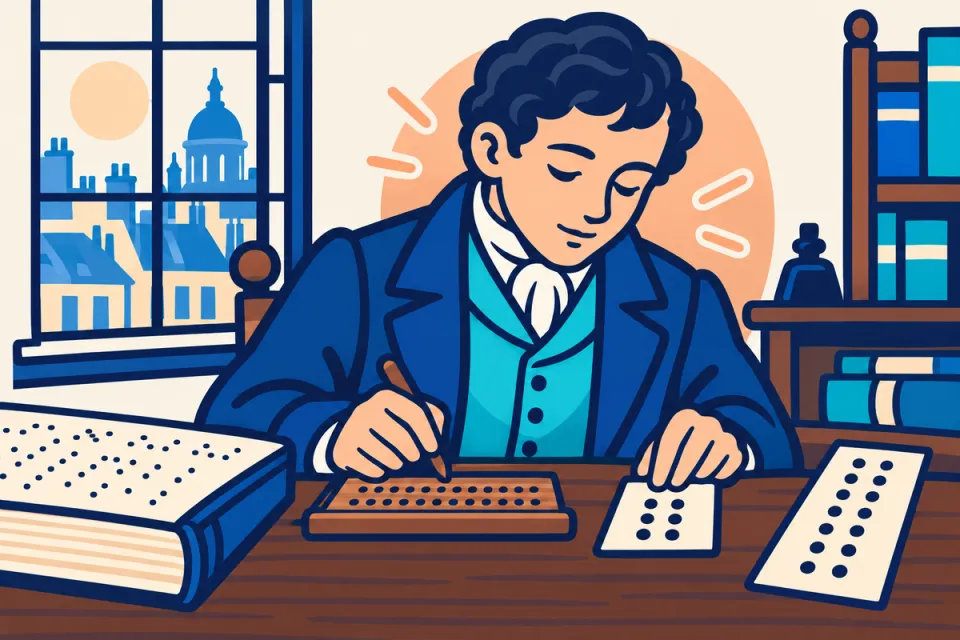
Facts you’ll need — each one is checked, with its source, on the story page:
- Born 1809 in Coupvray, near Paris; blinded by an awl at three, fully blind by five
- At ten, a scholarship to the Royal Institute for Blind Youth in Paris
- Embossed letters were very slow to read; writing by hand was impossible
- 1821: Charles Barbier's night writing — up to 12 dots, too many for one touch
- Between 13 and 16 he reworked it into the six-dot cell
- At twenty he published a method for words, music and plainsong
- Not officially taught in his lifetime; students learned it on their own
- The Institute adopted it in 1854, two years after his death; used worldwide, virtually unchanged
Does the person have to be someone you know?
No, unless the card says "someone you know personally". What the card does demand is the last point — how their work still helps people today — and that is where a living acquaintance sometimes beats a famous name. Braille clears it easily: the system is used worldwide and virtually unchanged. How to tell a story out loud calls this the evidence move: end with something checkable.
How do you tell Louis Braille's story in two minutes?
Problem, spark, solution, today. One word per point in the preparation minute:
- Opener (~30 words)Louis Braille, born in 1809 in Coupvray, near Paris. Your part: where you have seen braille yourself, if you have.
- Problem (~70 words)At three, an awl in his father's harness-making shop stabbed one eye; an infection spread, and by five he was blind in both. At ten he won a scholarship to the Royal Institute for Blind Youth in Paris, where students read embossed letters very slowly and could not write by hand at all.
- Spark (~60 words)In 1821 he learned of Charles Barbier's "night writing" — a raised-dot code that let soldiers communicate silently. It used up to twelve dots, which were too many to take in with a single touch.
- Solution (~70 words)Between 13 and 16 he reduced it to a six-dot cell, and at twenty he published a method for words, music and plainsong. The school did not officially teach it during his lifetime, so students learned it among themselves. He stayed on as a professor, teaching history, geometry and algebra.
- Explain (~50 words)Because the pupils insisted, the Institute adopted the system in 1854, two years after his death. It is used worldwide, virtually unchanged; his remains are in the Panthéon, his hands left symbolically in Coupvray. Your part: why that matters to you.
About 198 words in total — 1:19 to 1:35 spoken at 125–150 words per minute.
| Card point | Your note |
|---|---|
| who this person was | Braille |
| what problem they noticed | blind, slow reading |
| what they created or did | 12 dots to 6 |
| and explain how their work still helps people today | used today |
One word per point, written in the preparation minute — never a sentence you could recite by accident.
Which words describe helping and accessibility?
Visually impaired, tactile, raised dots, adopt, accessible, legacy. Three describe the code, three describe its spread — and "adopt" is the quiet hero of the story, because the pupils, not the school, made it happen. Say "the Institute adopted it in 1854" and you have used a precise verb where a weaker answer says "people liked it".
What do examiners listen for?
The four criteria are the ones in the public band descriptors. What the app can measure is narrower, and it never produces a score or band for any of them:
- Fluency and coherence
- Problem, idea, obstacle, result — four labelled moves that leave no silence to fill.SoulfulStories measures: your pace, your pauses and your filler words — how long you keep the floor and how your answer is organised.
- Lexical resource
- Visually impaired, tactile, raised dots, adopt, accessible, legacy — respectful, precise, reusable on any helping-people card.SoulfulStories measures: the CEFR level of the words you used, and where you rephrased around a missing word.
- Grammatical range and accuracy
- Time clauses (by the time he was five), passives (was adopted) and although-contrasts give the answer its range.SoulfulStories measures: nothing — grammar is not measured, because a transcript-based check would be guesswork; the examiner on test day judges it.
- Pronunciation
- Keep a steady rhythm through numbers: twelve dots down to six. Numbers rushed are numbers repeated.SoulfulStories measures: nothing automatic today — pitch and volume variation are measured, but clear pronunciation is yours to hear in the playback.
Can the same story answer "a creative person you admire"?
Yes — the creativity is the reduction, twelve dots to six, and the final point becomes what you admire. Where else the story bends:
- Describe a creative person whose work you admireThe Manjhi page shows the admiration frame; braille's six-dot invention carries the creativity point.
- Describe a leader from history who changed the way they ruledIf the card wants history, Ashoka's change is as documented as Braille's invention.
The Part 2 practice page collects the switches, and how to retell a story explains the close-the-book loop this page follows.
How do you practise this answer out loud?
Read Braille's story at your level, close it, write your four words, and speak for two minutes. The report measures pace, fillers, pauses and which facts came through — computed in code, never a score, as the methodology explains. Tell it again tomorrow and compare the two reports.
Tell the story of the six dots in two minutes.
Feedback on your pace, filler words, pauses, which key facts you covered, and the CEFR level of your vocabulary. Free to try, no card — and no score or band.
Questions and answers
How did Louis Braille create braille?
Between the ages of 13 and 16 he reworked Charles Barbier's night writing — a code of up to 12 raised dots — into a six-dot cell that could be read with one touch.
Can I talk about a historical person for 'a person who helps others'?
Yes, unless the card asks for someone you know personally. Explain how their work still helps people today to answer the final point.
What if the card asks for someone who 'often' helps others?
Show the help repeating over time. Braille taught at the Institute for years, and his system is used every day.
Is my feedback an IELTS band score?
No. SoulfulStories is independent practice and reports pace, fillers, pauses, key facts covered and CEFR vocabulary.
Sources
Every outside fact on this page comes from the story’s cited sources, listed with their accessed dates on the story page.
- Louis Braille — Wikipedia · accessed 25 October 2026
- Louis Braille (1809–1852) — Library of Congress · accessed 25 October 2026
- Night writing — Wikipedia · accessed 25 October 2026
- IELTS Academic: Speaking test format — ielts.org · accessed 1 November 2026
Keep going
- IELTS Speaking Part 2 cue cardsPart 2-style practice cue cards backed by true, sourced stories, with a one-minute note grid and a model outline.
- IELTS Speaking Part 2 Practice: The Long Turn AloneA free, repeatable loop for the long turn: one minute of notes, two recorded minutes, one listen, one fix — with a worked cue card taken three ways.
- How to Retell a Story Out Loud: 5 Steps + a True StoryA five-step retelling method worked on one true story shown at its three reading levels — beginner, intermediate and advanced.
- Six DotsBlinded by five, a teenager shrank a code of up to twelve raised dots down to six. His school waited thirty years to say yes.
IELTS is a registered trademark of its owners. SoulfulStories is not affiliated with, endorsed by or connected to IELTS, the British Council, IDP or Cambridge. We don't give band scores.