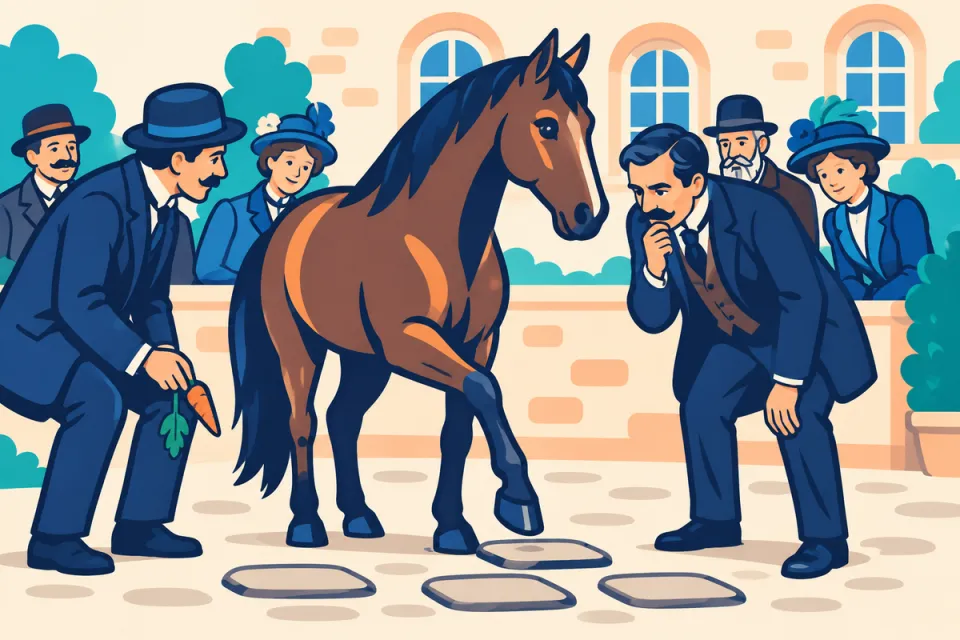
The Doctor the Experts Laughed At
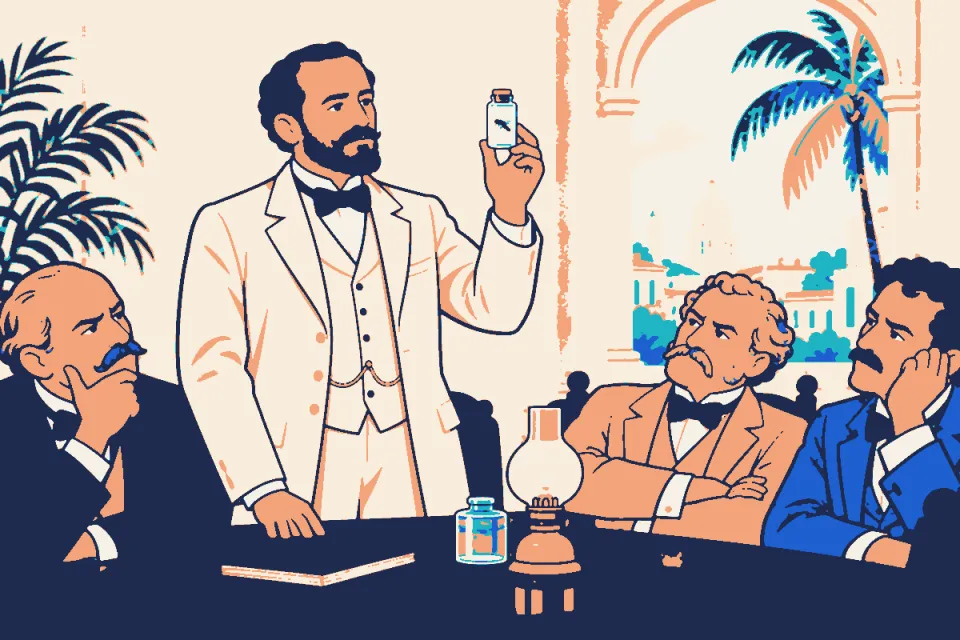
The Doctor the Experts Laughed At
1881–1901Havana, CubaScience & discovery
In 1881, a Cuban doctor blamed mosquitoes for yellow fever. Experts mocked him for nearly twenty years — until his idea nearly wiped it out.
Reading level
The same true story, told at three lengths. Pick one to read, close your eyes, and tell it back in your own words.
216 words · about 1 min to read · retell it in about 2 minutes
More than a hundred years ago, in Cuba, a doctor had a strange idea. Carlos Finlay believed that one tiny insect carried a deadly disease: yellow fever, the terror of tropical cities.
In 1881 he told a big meeting of scientists. The others mocked him. Most experts believed dirty clothes and bedding spread it, not one little bug.
For almost twenty years almost nobody believed him, but he never stopped.
Then, in 1900, the American army formed a team of scientists in Cuba, where yellow fever raged. Their leader, Walter Reed, decided to test the Cuban doctor’s strange idea.
One scientist, Jesse Lazear, caught the fever; many believe he let an infected mosquito bite him. He grew sick and died. But the others went on. They built a camp and tested it two ways: men who slept in fever victims’ dirty clothes stayed well, while men bitten by mosquitoes fell sick. The answer became clear. Mosquitoes carried the fever. Dirty clothes did not.
Soon Havana fought the mosquitoes, and in less than a year the fever was almost gone. The same idea later helped make the Panama Canal possible.
Finlay was nominated for the Nobel Prize seven times and never won. But in Panama City today, a statue thanks the man the experts once laughed at.
319 words · about 2 min to read · retell it in about 2 minutes
In 1881, in a paper for Havana’s Academy of Medical, Physical and Natural Sciences, a Cuban doctor named Carlos Finlay proposed something almost nobody could accept. Yellow fever, the terror of tropical cities, was not carried by dirty clothes or bedding. It was carried, he said, by a mosquito.
The experts mocked him. He himself admitted that nothing less than an absolutely incontrovertible demonstration would ever convince them. For nearly twenty years, his idea sat at the edge of medicine, treated as an eccentric obsession.
Then history intervened. In 1900, with the disease out of control in occupied Cuba, the American army formed a Yellow Fever Commission under Major Walter Reed. The commission, probably at the urging of one of its own members, Jesse Lazear, decided to test Finlay’s theory.
The tests demanded courage. James Carroll let an infected mosquito bite him and fell seriously ill, never fully recovering. Hearing that Carroll would survive, Reed scribbled on an envelope: Did the Mosquito DO IT? Lazear grew sick too, and died on September 25. It has long been believed that he let the mosquito bite himself.
The team built an isolated camp, named Camp Lazear for Lazear, and designed experiments that would settle the question. In one building, volunteers slept in the stained linens and clothes of men who had died of yellow fever. None of them caught it. In another, mosquitoes were released into one room and a second room left empty. The men in the mosquito room fell ill. The others stayed healthy.
The answer was clear: Finlay had been right.
Within a year, Havana attacked the mosquitoes and yellow fever virtually vanished. The same method later helped make the Panama Canal possible. Reed became famous, and he credited Finlay with the discovery. Cuba’s quiet doctor never won the Nobel Prize, despite seven nominations. But a statue in Panama City still honors the man the experts laughed at.
473 words · about 2 min to read · retell it in about 4 minutes
Consider what Carlos Finlay was claiming in 1881. Yellow fever had terrorized the Americas for generations. The best medical minds believed it traveled in infected objects, in the linens and belongings of the dead. Into this certainty walked a Cuban physician with a different culprit: the mosquito.
He published the idea through Havana’s Academy of Medical, Physical and Natural Sciences, and for years it was treated with ridicule. He understood the burden himself, writing that nothing less than an absolutely incontrovertible demonstration would convince his colleagues of a theory so entirely at variance with the prevailing ideas about yellow fever.
For nearly twenty years the theory sat at the fringes of medicine, and Finlay could not produce the demonstration. He tried. But his experiments could not produce results conclusive enough to challenge the mainstream, possibly because they did not allow for the 10-to-17-day delay before the disease spread.
In 1900, with yellow fever still threatening the 50,000 American troops in Cuba, the Army formed a Yellow Fever Commission under Major Walter Reed, a little-known medical researcher. Probably at the urging of the young surgeon Jesse Lazear, the commission decided to test the Cuban’s theory seriously.
It demanded bravery of a kind that makes modern readers flinch. James Carroll let an infected mosquito feed on him and survived, but suffered complications for the rest of his life. Lazear fell ill and died on September 25, 1900; the long-standing belief is that he let the insect bite him and was the volunteer known as Guinea Pig No. 1.
Grief hardened into method. The commission built an isolated camp outside Havana, named Camp Lazear for their dead colleague, and designed two buildings that would decide the question. In one, volunteers slept in bedding stained by the blood and waste of men who had died of yellow fever, dressed in the dead men’s clothes. None of them fell ill. In the other building, mosquitoes were released into one room while a second room stayed empty; the men from the mosquito room caught the fever, the others did not. Remarkably, none of the infected volunteers died.
The veil had lifted. On New Year’s Eve 1900, Reed wrote home that they had lifted what he called the impenetrable veil around the disease. Within a year, Havana’s new mosquito brigades virtually eradicated yellow fever, and the method later cut the terrible death rate of the Panama Canal works, where about a tenth of the workforce had been dying each year from malaria and yellow fever.
Reed became the hero of the story, and he credited Finlay with the discovery. Finlay was nominated seven times for the Nobel Prize and never won. He later served as the chief health officer of Cuba from 1902 to 1909, and in Panama City a statue stands near the canal he helped make possible.
Read it once, close the page, and tell it back. The coach listens for pace, fillers and the facts.
Key facts and sources
Carlos Finlay was a Cuban epidemiologist.
“Carlos Juan Finlay (December 3, 1833 – August 20, 1915) was a Cuban epidemiologist” — Carlos Finlay, Wikipedia
In 1881 he was the first to theorize that a mosquito could carry yellow fever from a sick person to a healthy one.
“He was the first to theorize, in 1881, that a mosquito was a carrier, now known as a disease vector, of the organism causing yellow fever: a mosquito that bites a victim of the disease could subsequently bite and thereby infect a healthy person.” — Carlos Finlay, Wikipedia
His 1881 paper on the mosquito theory was first published by Havana’s Academy of Medical, Physical and Natural Sciences.
“Reprint of an article by Carlos J. Finlay that was first published in: Anales de la Academia de Ciencias Médicas, Físicas y Naturales de la Habana, Volume 18, 1881.” — Walter Reed and the Scourge of Yellow Fever, University of Virginia
He knew only an incontrovertible demonstration would convince his colleagues.
“I understand too well that nothing less than an absolutely incontrovertible demonstration will be required before the generality of my colleagues accept a theory so entirely at variance with the ideas which have until now prevailed about yellow fever.” — Walter Reed and the Scourge of Yellow Fever, University of Virginia
His theory was treated with ridicule for years.
“His theory that an intermediary host was responsible for the spread of the disease was treated with ridicule for years.” — Carlos Finlay, Wikipedia
His proofs were confirmed nearly twenty years later by the Walter Reed Commission.
“His hypothesis and exhaustive proofs were confirmed nearly twenty years later by the Walter Reed Commission of 1900.” — Carlos Finlay, Wikipedia
In 1900 the U.S. Army formed the Yellow Fever Commission in Cuba.
“the U.S. Army, frustrated by this failure, formed the U.S. Army Yellow Fever Commission to gather data in Cuba” — Walter Reed and the Scourge of Yellow Fever, University of Virginia
Major Walter Reed was appointed to lead the group.
“A little-known medical army medical researcher, Major Walter Reed, was appointed to lead the group.” — Walter Reed and the Scourge of Yellow Fever, University of Virginia
The commission turned its attention to Finlay’s mosquito theory, most likely at Jesse Lazear’s urging.
“At this time, most likely at the urging of Jesse Lazear, the commission turned its attention to Finlay’s mosquito theory.” — Walter Reed and the Scourge of Yellow Fever, University of Virginia
James Carroll let a mosquito bite him and caught yellow fever, surviving with lifelong complications.
“Carroll decided to experiment on himself and contracted yellow fever from an infected mosquito. Carroll survived the infection, but would suffer from complications of yellow fever for the rest of his life.” — Walter Reed and the Scourge of Yellow Fever, University of Virginia
Jesse Lazear contracted yellow fever and died from the disease on September 25, 1900.
“On Sept. 18, Jesse Lazear contracted yellow fever, and died from the disease on Sept. 25.” — Walter Reed and the Scourge of Yellow Fever, University of Virginia
It has been widely believed that the volunteer known as Guinea Pig No. 1 was Lazear himself.
“It has been widely believed that “Guinea Pig No. 1” was in fact Lazear himself.” — Walter Reed and the Scourge of Yellow Fever, University of Virginia
The commission built an isolated camp named Camp Lazear in honor of their deceased colleague.
“the surviving members of the commission ordered the construction of an isolated experimental camp outside of Havana” — Walter Reed and the Scourge of Yellow Fever, University of Virginia
In the mosquito room, volunteers who spent time with infected mosquitoes caught yellow fever; those in the empty room did not.
“The commission released infected mosquitoes into one room, and kept the second room completely empty. Volunteers who spent time in the mosquito room contracted yellow fever while the volunteers in the empty room did not.” — Walter Reed and the Scourge of Yellow Fever, University of Virginia
In the fomite building, volunteers slept in the stained linens and clothes of yellow fever victims, and none caught the disease.
“three volunteers were sealed in a room and asked to sleep in linens covered with the excrement and dried blood of patients who had died of yellow fever and wear the clothes of the deceased patients. Although the three volunteers in this room had a very unpleasant experience, none of them contracted yellow fever.” — Walter Reed and the Scourge of Yellow Fever, University of Virginia
The three experiments together provided strong proof of Finlay’s theory, and none of the infected volunteers died.
“Combined, the three experiments provided strong proof for Carlos Finlay’s theory, and remarkably none of the infected volunteers died during the study.” — Walter Reed and the Scourge of Yellow Fever, University of Virginia
Reed scribbled on an envelope: Did the Mosquito DO IT?
“After sealing the letter, Reed scribbled on the envelope one final remark: “Did the Mosquito DO IT?”” — Walter Reed and the Scourge of Yellow Fever, University of Virginia
A Washington Post editorial called the mosquito hypothesis the silliest rigmarole about yellow fever yet in print.
“the silliest beyond compare is to be found in the arguments and theories engendered by the mosquito hypothesis” — Walter Reed and the Scourge of Yellow Fever, University of Virginia
On New Year’s Eve 1900 Reed wrote that they had lifted the impenetrable veil around the disease.
“to lift the impenetrable veil that has surrounded the causation of this most dreadful pest of humanity” — Walter Reed and the Scourge of Yellow Fever, University of Virginia
In less than a year, yellow fever was virtually eradicated in Havana.
“In less than a year, yellow fever had been virtually eradicated in Havana, providing the ultimate demonstration that Finlay’s mosquito theory was correct.” — Walter Reed and the Scourge of Yellow Fever, University of Virginia
The discovery helped make the Panama Canal possible from 1903 onwards.
“This discovery helped William C. Gorgas reduce the incidence and prevalence of mosquito-borne diseases in Panama during the American campaign, from 1903 onwards, to construct the Panama Canal.” — Carlos Finlay, Wikipedia
Before that, about 10 percent of the canal workforce had died each year from malaria and yellow fever.
“Prior to this, about 10% of the workforce had died each year from malaria and yellow fever.” — Carlos Finlay, Wikipedia
Reed received much of the credit in history books but credited Finlay with the discovery.
“Although Reed received much of the credit in history books for “beating” yellow fever, Reed himself credited Finlay with the discovery of the yellow fever vector” — Carlos Finlay, Wikipedia
General Leonard Wood called it the greatest step forward in medical science since Jenner’s vaccination.
““The confirmation of Dr. Finlay’s doctrine is the greatest step forward made in medical science since Jenner’s discovery of the vaccination [for smallpox].”” — Carlos Finlay, Wikipedia
Finlay was nominated seven times for the Nobel Prize and never won.
“As a result of his work, Finlay was nominated seven times for the Nobel Prize in Physiology or Medicine, although he was never awarded the prize.” — Carlos Finlay, Wikipedia
A statue of Finlay stands in Panama City near the canal.
“A statue commemorating Finlay is located on the bayfront in Panama City, near the canal he helped make possible.” — Carlos Finlay, Wikipedia
Finlay became chief health officer of Cuba from 1902 to 1909.
“Finlay went on to become the chief health officer of Cuba from 1902 to 1909.” — Carlos Finlay, Wikipedia
Reed celebrated the news from Cuba in a giddy letter.
““Hip! Hip! Hurrah! God be praised for the news from Cuba today” — Walter Reed and the Scourge of Yellow Fever, University of Virginia
Most researchers believed yellow fever was spread by fomites, objects soiled with blood and excrement.
“Most of them believed that yellow fever was caused by bacteria and spread by fomites – objects soiled with human blood and excrement.” — Walter Reed and the Scourge of Yellow Fever, University of Virginia
The United States had 50,000 troops stationed on the island and feared yellow fever would spread to the mainland.
“the 50,000 troops it had stationed on the island were in great peril and might spread the disease to the mainland” — Walter Reed and the Scourge of Yellow Fever, University of Virginia
There was a delay of 10 to 17 days between the first infection in an outbreak and its spread to secondary hosts.
“there was a delay of 10 to 17 days between the first infection of yellow fever in an outbreak and its spread to secondary hosts” — Walter Reed and the Scourge of Yellow Fever, University of Virginia
Sources consulted for this story: Carlos Finlay (Wikipedia, accessed 2026-10-25); Walter Reed and the Scourge of Yellow Fever (University of Virginia, accessed 2026-10-25). Every story is checked against its sources before it is published — how we verify stories.
Why this story is worth telling
Ridicule is not evidence: a quiet physician was vindicated nearly twenty years later.