The Horse Who Read Minds
The Horse Who Read Minds
1904Berlin, GermanyMind & behavior
In 1904 Berlin a horse named Hans answered math questions with his hoof; the answer hid in tiny movements of the people watching.
Reading level
The same true story, told at three lengths. Pick one to read, close your eyes, and tell it back in your own words.
197 words · about 1 min to read · retell it in about 2 minutes
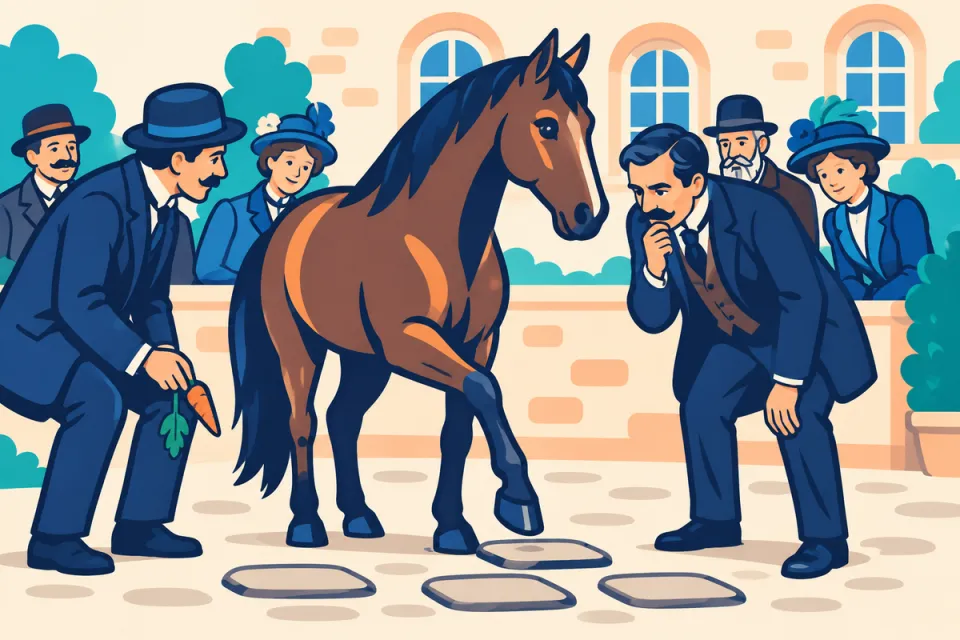
More than a hundred years ago, in a courtyard in Berlin, crowds came to watch a horse do math. His name is Hans. His owner, Wilhelm von Osten, is a former math teacher. He asks a question, and Hans taps the answer with his hoof. After a good answer, Hans gets bread or a carrot. People call him Clever Hans.
Was it a trick? A panel of thirteen people watched him closely, including a circus manager and a cavalry officer. They found no trick at all.
Then a psychologist named Oskar Pfungst tried something new. Sometimes he put blinders on the horse, so it could not see the person asking. Sometimes the person asking did not know the answer. And suddenly, Hans failed.
The truth was surprising. Hans could not count. He was watching people. When someone asked a question, they bent forward a little to look at his hoof. When he reached the right number, they lifted their head a tiny bit, without knowing it. That was his signal to stop.
So Hans was not a genius at math. He was a genius at reading people. And scientists still plan their experiments carefully because of him.
316 words · about 2 min to read · retell it in about 2 minutes
In a paved courtyard in the north of Berlin, surrounded by tall apartment houses, visitors gather every day around noon to watch a horse do arithmetic. The horse is Hans. His owner, Wilhelm von Osten, is an old mathematics teacher, and he never charges a penny.
Von Osten asks a question like this one: if the eighth day of the month comes on a Tuesday, what is the date of the following Friday? Hans lifts his hoof and taps eleven times. Correct. A bit of bread or a carrot, and on to the next question. Even The New York Times writes about him in 1904.
Surely it was a trick. So a panel of thirteen people came to check, among them a circus manager, a cavalry officer and the director of the Berlin zoo. In September 1904 they announced that there was no trick involved.
But the case was then handed to the psychologist Oskar Pfungst. He ran test after test. He let strangers ask the questions, and Hans still answered, so it was not fraud. Then he put blinders on the horse, or used questioners who did not know the answer themselves. When Hans could see a questioner who knew the answer, he was right about nine times out of ten. When he could not see the questioner, he was almost always wrong.
Then Pfungst saw it. Each questioner bent forward slightly to watch the hoof, and Hans began to tap. When the count reached the right number, the questioner made a tiny upward jerk of the head, and Hans stopped. Pfungst even noticed that Hans would start tapping whenever he bent down to write a note.
Von Osten was never convinced. But the lesson stuck. Hans could not do math, yet he could read the smallest movements of a person’s head. Today, scientists design experiments so that nobody can accidentally give the answer away.
496 words · about 2 min to read · retell it in about 4 minutes
In the early 1900s, if you walked into a certain paved courtyard in the north of Berlin around noon, you might find a small crowd watching a Russian trotting horse answer questions. Next to him stood his owner, Wilhelm von Osten, a mathematics teacher in his sixties with a white head and a black slouch hat. No fee was ever taken. There was no whip either, just gentle encouragement and a steady supply of bread and carrots.
Von Osten would ask something like: if the eighth day of the month comes on a Tuesday, what is the date of the following Friday? And Hans would tap his hoof, eleven times. He could add, subtract, work with fractions, tell the time, or so people said. In 1904 The New York Times reported on him. Germany had a celebrity, and his name was Clever Hans.
Of course people suspected a trick. So a panel of thirteen people came to inspect him, including a veterinarian, a circus manager, a cavalry officer, schoolteachers and the director of the Berlin zoological gardens. In September 1904 they announced that no tricks were involved. Von Osten had been vindicated, or so it seemed.
The case was passed to Oskar Pfungst, an assistant of the psychologist Carl Stumpf, and Pfungst set out to test the horse one condition at a time. Strangers asked the questions, and Hans still did well, so von Osten was not cheating. Then Pfungst used blinders, and questioners who did not know the answer themselves. The numbers were brutal. When Hans could see the questioner, he got fifty out of fifty-six right. When he could not, he got two out of thirty-five.
So what was Hans seeing? Pfungst watched the humans instead of the horse. As soon as a question was asked, the questioner bent forward, ever so slightly, to watch the hoof, and Hans began tapping. When the count reached the right number, the questioner gave a slight upward jerk of the head, and Hans stopped. Nobody was doing it on purpose. Pfungst noticed that Hans would start tapping whenever he himself stooped to jot down a note.
Then came the strangest part. Pfungst played the horse himself, with people standing beside him and concentrating on a number, and he saw the same small upward jerk of the head at the last tap. Worse, once he knew all about these cues, he found he produced the cues himself even when he tried hard to suppress them.
Von Osten never accepted any of it. When the investigators could no longer keep the results from him, he wrote to Pfungst forbidding further experiments, and went on showing Hans to large, delighted crowds.
But science had learned something it never forgot. Our bodies leak our expectations. That is one reason so many experiments today are double blind, so that neither the experimenter nor the subject knows what answer is expected. Hans could not count. He did something arguably harder. He read us.
Read it once, close the page, and tell it back. The coach listens for pace, fillers and the facts.
Key facts and sources
Clever Hans was a horse that appeared to perform arithmetic during exhibitions in Germany.
“Clever Hans (German: der Kluge Hans; c. 1894 – c. 1916) was a horse that appeared to perform arithmetic and other intellectual tasks during exhibitions in Germany in the early 20th century.” — Clever Hans, Wikipedia
Hans was owned by Wilhelm von Osten, a mathematics teacher.
“Hans was a horse owned by Wilhelm von Osten, who was a gymnasium mathematics teacher” — Clever Hans, Wikipedia
Exhibitions were held around noon in a paved courtyard among apartment houses in northern Berlin, and no fee was taken.
“an exhibition which was given daily before a select company at about the noon hour in a paved courtyard surrounded by high apartment houses in the northern part of Berlin. No fee was ever taken.” — Clever Hans (The Horse of Mr. von Osten) by Oskar Pfungst, 1911 English translation, Project Gutenberg
Asked about the date of the Friday after a Tuesday the eighth, Hans tapped eleven times.
“Von Osten would ask Hans, “If the eighth day of the month comes on a Tuesday, what is the date of the following Friday?” Hans would answer by tapping his hoof eleven times.” — Clever Hans, Wikipedia
Von Osten was a white-haired man in a black slouch hat; Hans was a Russian trotting horse managed by gentle encouragement and rewards of bread or carrots, not the whip.
“His white head was covered with a black, slouch hat. To his left the stately animal, a Russian trotting horse, stood like a docile pupil, managed not by means of the whip, but by gentle encouragement and frequent reward of bread or carrots.” — Clever Hans (The Horse of Mr. von Osten) by Oskar Pfungst, 1911 English translation, Project Gutenberg
Carl Stumpf formed a panel of 13 people including a veterinarian, a circus manager, a cavalry officer, schoolteachers and the Berlin zoo director.
“Carl Stumpf formed a panel of 13 people, known as the Hans Commission. This commission consisted of a veterinarian, a circus manager, a cavalry officer, a number of schoolteachers, and the director of the Berlin zoological gardens.” — Clever Hans, Wikipedia
In September 1904 the commission concluded no tricks were involved.
“This commission concluded in September 1904 that no tricks were involved” — Clever Hans, Wikipedia
The commission passed the evaluation to Oskar Pfungst, who used blinders and varied whether the questioner knew the answer.
“By means of blinders, varying whether the horse could see the questioner” — Clever Hans, Wikipedia
Pfungst varied whether the questioner knew the answer, and found Hans could answer even when von Osten did not ask, ruling out fraud.
“the horse could get the correct answer even if von Osten himself did not ask the questions, ruling out the possibility of fraud” — Clever Hans, Wikipedia
Hans gave the right answer only when the questioner knew it and Hans could see the questioner.
“the horse gave the right answer only when the questioner knew what the answer was and the horse could see the questioner” — Clever Hans, Wikipedia
Hans got 50 of 56 right when he could see the questioner and 2 of 35 when he could not.
“the horse got 89 percent (50 out of 56) of the answers correct, but when Hans was not able to see the questioner, the horse answered only six percent (2 out of 35)” — Clever Hans, Wikipedia
Questioners involuntarily bent forward when giving the problem, and Hans began to tap.
“he, involuntarily, bent his head and trunk slightly forward and the horse would then put the right foot forward and begin to tap” — Clever Hans (The Horse of Mr. von Osten) by Oskar Pfungst, 1911 English translation, Project Gutenberg
When the right number of taps was reached, the questioner made a slight upward jerk of the head.
“As soon as the desired number of taps was given, the questioner would make a slight upward jerk of the head.” — Clever Hans (The Horse of Mr. von Osten) by Oskar Pfungst, 1911 English translation, Project Gutenberg
Hans started tapping whenever Pfungst stooped to write a note.
“Hans would invariably begin to tap when I stooped to jot down some note I wished to make.” — Clever Hans (The Horse of Mr. von Osten) by Oskar Pfungst, 1911 English translation, Project Gutenberg
Von Osten was never persuaded and kept showing Hans to large enthusiastic crowds.
“von Osten, who was never persuaded by Pfungst’s findings, continued to show Hans around Germany, attracting large and enthusiastic crowds” — Clever Hans, Wikipedia
Pfungst played the horse in lab tests and observed a slight upward jerk of the head at the final tap.
“Pfungst carried out laboratory tests with human subjects, in which he played the part of the horse.” — Clever Hans, Wikipedia
The phenomenon has had a large effect on experimental design.
“Recognition of this phenomenon has had a large effect on experimental design and methodology for all experiments whatsoever involving sentient subjects, including humans.” — Clever Hans, Wikipedia
Pfungst found he produced the cues involuntarily even when trying to suppress them.
“he discovered that he would produce these cues involuntarily regardless of whether he wished to exhibit or suppress them” — Clever Hans, Wikipedia
Experiments are made double-blind so neither experimenter nor subject knows the condition.
“to make experiments double-blind, meaning that neither the experimenter nor the subject knows what condition the subject is in” — Clever Hans, Wikipedia
The New York Times reported on Hans in 1904.
“Hans’ abilities were reported in The New York Times in 1904.” — Clever Hans, Wikipedia
Pfungst was an assistant to Carl Stumpf.
“Pfungst was an assistant to German philosopher and psychologist Carl Stumpf” — Clever Hans, Wikipedia
Pfungst observed a sudden slight upward jerk of the head at the final tap in human subjects.
“He frequently observed “a sudden slight upward jerk of the head” when reaching the final tap” — Clever Hans, Wikipedia
After learning the results, von Osten wrote to Pfungst forbidding further experimentation.
“I received a letter from him in which he forbade further experimentation with the horse.” — Clever Hans (The Horse of Mr. von Osten) by Oskar Pfungst, 1911 English translation, Project Gutenberg
Hans could reportedly add, subtract, work with fractions and tell the time.
“Hans was said to have been taught to add, subtract, multiply, divide, work with fractions, tell the time” — Clever Hans, Wikipedia
Von Osten was between sixty and seventy years old.
“a man between sixty and seventy years of age” — Clever Hans (The Horse of Mr. von Osten) by Oskar Pfungst, 1911 English translation, Project Gutenberg
Sources consulted for this story: Clever Hans (Wikipedia, accessed 2026-10-25); Clever Hans (The Horse of Mr. von Osten) by Oskar Pfungst, 1911 English translation (Project Gutenberg, accessed 2026-10-25). Every story is checked against its sources before it is published — how we verify stories.
Why this story is worth telling
A horse fooled the experts by reading tiny signals we all give off without knowing.