
The Man Who Cut the Mountain
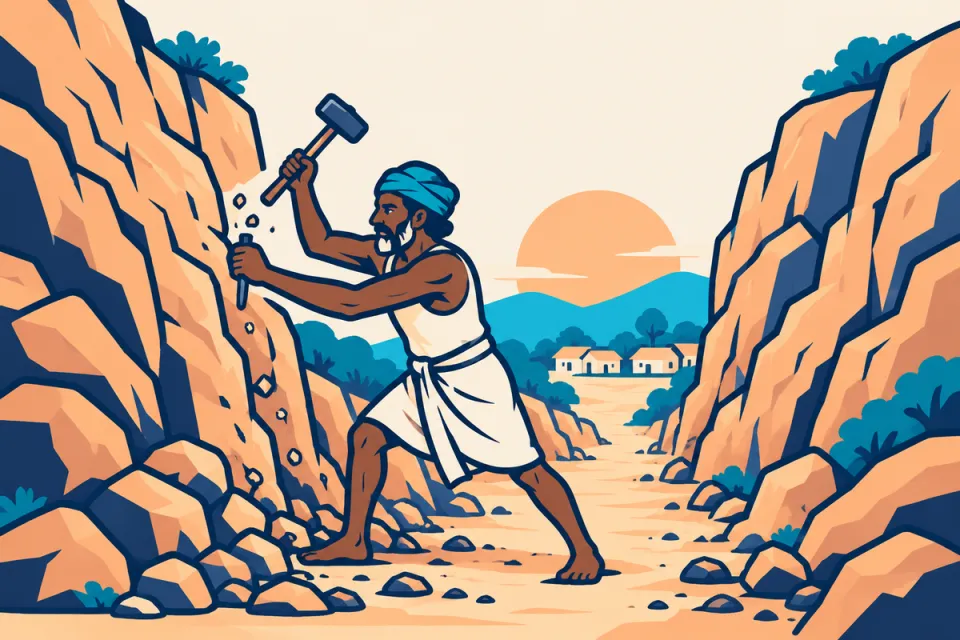
The Man Who Cut the Mountain
1960–1982Gehlaur, Bihar, IndiaCourage & kindness
After his wife died because the doctor was over the hill, a labourer cut a road through the rock with hammer and chisel. It took 22 years.
Reading level
The same true story, told at three lengths. Pick one to read, close your eyes, and tell it back in your own words.
171 words · about 1 min to read · retell it in about 1 minutes
In a village in India, a poor labourer named Dashrath Manjhi lost his wife in 1959. She fell on the rocky hill beside the village. The doctor was far, far away, on the other side of the hill, and help came too late.
So Dashrath picked up a hammer and a chisel. He decided he would cut a road through the hill himself, so that no one else would die like his wife. The village laughed at him. People called him crazy. He kept hitting the rock, day after day, year after year, for twenty-two years.
Slowly, the hill opened. When he finished, there was a road through the rock, and the long way around was short. A trip that took many kilometres now took far fewer.
The government built a real road there, but only after he died. Today he is called the Mountain Man, his story is in school books, and there is even a stamp with his face. One man with a hammer changed where the road goes.
316 words · about 2 min to read · retell it in about 2 minutes
Dashrath Manjhi was a poor labourer in Gehlaur, a village in Bihar with a steep rocky ridge along its southern edge. In 1959 his wife, Falguni Devi, was badly hurt on that ridge, and the nearest doctor was seventy kilometers away, on the other side of the hill. She died. Manjhi came to believe her death did not have to happen, and that no one else should suffer the same.
So he did something that sounded insane. Armed with a hammer and a chisel, he began cutting a road straight through the ridge. “When I started hammering the hill, people called me a lunatic,” he remembered, “but that steeled my resolve.” For twenty-two years, from 1960 to 1982, he struck the rock. At first most villagers taunted him, but later quite a few brought him food and helped him buy tools.
The gap grew meter by meter. In places he cut more than seven meters down into the rock. In the end it was real: a passage about 110 meters long, more than nine meters wide. A journey that once meant going fifty-five kilometers around the mountain now took fifteen. The man they had laughed at had moved the map.
By one account, kept off the train to Delhi, he simply walked along the railway tracks to the capital to get recognition for his work, and Bihar’s chief minister, Nitish Kumar, rewarded him for it. Manjhi died of cancer in 2007, and Bihar gave him a state funeral. The government only paved his path into a proper road after his death, and more honours followed: he became popularly known as the Mountain Man, Bihar’s chief minister has said his life is now in school textbooks so children can learn from his determination, and in 2016 India Post put him on a stamp. The path he cut still makes life easier for the village that mocked him.
471 words · about 2 min to read · retell it in about 4 minutes
The village of Gehlaur, in Bihar, sits against a wall of quartzite ridge. To reach the nearest town, people had to go around the mountain, a journey of some fifty-five kilometers. In 1959, Dashrath Manjhi’s wife, Falguni Devi, fell on that ridge. Accounts differ on the details, but all agree on what followed. Some accounts say she was walking the narrow path over it to bring him water or lunch. Help never arrived in time, and she died.
Manjhi was an impoverished labourer from one of India’s lowest castes, a man with almost no money, no machinery and no standing. At a young age he had run away from home and worked in coal mines at Dhanbad, then come back to Gehlaur. The ridge itself was ancient quartzite, part of the Rajgir Hills. None of that mattered. He decided that her death had been preventable, and that he would prevent the next one, whatever it cost him. With a hammer and a chisel, he started cutting a road through the ridge. People called him a lunatic. “When I started hammering the hill, people called me a lunatic, but that steeled my resolve”, he said later. For twenty-two years, from 1960 to 1982, working day and night, he swung at the rock, year after year. At first most villagers taunted him, he recalled, but some began to help, bringing food and chipping in for his tools.
The mountain lost. His passage ran about 110 meters long and over nine meters wide, cut in places more than seven meters down into solid rock. The distance from Atri to Wazirganj collapsed from fifty-five kilometers to fifteen. By one account, when Manjhi was barred from taking the train to Delhi to get recognition for his work, he simply walked along the tracks to the capital, and Bihar’s chief minister, Nitish Kumar, honoured him for the road; at a press event in 2006 the chief minister gave up his own chair for the old labourer and asked him to tell the story himself. That year the state proposed him for the Padma Shri.
Manjhi died of gallbladder cancer in August 2007, and the government of Bihar gave him a state funeral. The roads over his path were finally built after his death, and it had taken the government three decades to turn the path into a tarred road, but the point was never the asphalt. Bihar’s chief minister has said his biography is now in school textbooks so that future generations can learn from his determination, and India Post put him on a stamp in 2016. A 2015 Hindi film about him was released and well received. Schoolchildren now read in their textbooks what one stubborn man with a hammer can do to a mountain. He was mocked at first; the road answers back every day.
Read it once, close the page, and tell it back. The coach listens for pace, fillers and the facts.
Key facts and sources
Dashrath Manjhi was an Indian labourer from Gehlaur village, near Gaya in Bihar.
“was an Indian laborer from Gehlaur village, near Gaya in the eastern state of Bihar.” — Dashrath Manjhi, Wikipedia
In 1959 his wife Falguni Devi was injured and died; the nearest town with a doctor was 70 km away.
“In 1959, Manjhi’s wife Falguni Devi was badly injured and died because she fell from the mountain and the nearest town with a doctor was 70 kilometres (43 mi) away.” — Dashrath Manjhi, Wikipedia
Some reports say she was hurt walking the narrow path over the ridge to bring him food or water.
“Some reports say she was injured while walking along a narrow path across the rocky ridge to bring water or lunch to Manjhi” — Dashrath Manjhi, Wikipedia
He resolved to cut a road across the ridge so no one else would suffer the same fate.
“Manjhi felt that the loss of his beloved wife could have been prevented, also he wished to spare the next person of having to experience a similar fate” — Dashrath Manjhi, Wikipedia
He worked with only a hammer and a chisel.
“using only a hammer and a chisel” — Dashrath Manjhi, Wikipedia
People called him a lunatic when he started, which only steeled his resolve.
““When I started hammering the hill, people called me a lunatic, but that steeled my resolve.”” — Dashrath Manjhi, Wikipedia
Villagers taunted him at first but some later gave him food and helped buy tools.
““though most villagers taunted me at first, there were quite a few who lent me support later by giving me food and helping me buy my tools.”” — Dashrath Manjhi, Wikipedia
The finished path is about 110 m long, 9.1 m wide and 7.7 m deep in places.
“He carved a path 110 metres (360 ft) long, 7.7 metres (25 ft) deep in places and 9.1 metres (30 ft) wide” — Dashrath Manjhi, Wikipedia
He worked for 22 years, from 1960 to 1982.
“He completed the work in 22 years (1960–1982).” — Dashrath Manjhi, Wikipedia
The path cut the distance between Atri and Wazirganj from 55 km to 15 km.
“This path reduced the distance between the Atri and Wazirganj sectors of Gaya district from 55 to 15 kilometres” — Dashrath Manjhi, Wikipedia
Official roads over his path were built only after his death in 2007.
“Official roads between his village in Atri and Wazirganj, over the path he carved, were built after his death in 2007.” — Dashrath Manjhi, Wikipedia
He died of gallbladder cancer in 2007 and was given a state funeral by Bihar.
“Manjhi was diagnosed with gallbladder cancer and was admitted to AIIMS New Delhi on 23 July 2007. He died there on 17 August 2007. He was given a state funeral by the Government of Bihar.” — Dashrath Manjhi, Wikipedia
Bihar’s chief minister Nitish Kumar honoured him.
“He travelled to New Delhi to get recognition of his work and was rewarded by then Chief Minister of Bihar, Nitish Kumar.” — Dashrath Manjhi, Wikipedia
According to one account, when he was not allowed to travel to Delhi by train, he walked along the tracks.
““Another information about him says that when he was forbidden from carrying a journey by train to Delhi, he walked along the track to the national capital,”” — Bihar CM Nitish Kumar recalls ‘Mountain Man’ Dashrath Manjhi’s effort, The Indian Express
His biography is now in school textbooks in Bihar.
“Manjhi’s biography has been included in school textbooks for the future generation to learn a lesson from his determination.” — Bihar CM Nitish Kumar recalls ‘Mountain Man’ Dashrath Manjhi’s effort, The Indian Express
India Post issued a stamp of him in 2016.
“A stamp featuring Dashrath Manjhi was released by India Post in the “Personalities of Bihar” series on 26 December 2016.” — Dashrath Manjhi, Wikipedia
He was an impoverished labourer from one of India’s lowest castes.
“Dashrath Manjhi, an impoverished labourer from India’s lowest caste” — India’s ‘Mountain Man’ inspires Bollywood biopic, The National
Going to the nearest town meant going around the mountain, a 55-kilometre journey.
“Getting to the nearest town involved going around the mountain, a 55-kilometre journey” — India’s ‘Mountain Man’ inspires Bollywood biopic, The National
It took the government another three decades to tar the road.
“Even after he had finished, it took the local government another three decades to convert it into a tarred road.” — India’s ‘Mountain Man’ inspires Bollywood biopic, The National
The chief minister once gave up his own chair for Manjhi at a press event.
““When I saw him I had vacated my chair for him and urged him to address mediapersons about his rare feat”, the CM said.” — Bihar CM Nitish Kumar recalls ‘Mountain Man’ Dashrath Manjhi’s effort, The Indian Express
His wife’s death in 1959 came after an accident because she could not get medical attention in time.
“embarked on the monumental task after his wife died in 1959 following an accident, because she did not receive medical attention in time.” — India’s ‘Mountain Man’ inspires Bollywood biopic, The National
He is remembered as the Mountain Man.
“For his feat, Manjhi became popularly known as the ‘Mountain Man’.” — Dashrath Manjhi, Wikipedia
He died aged 73.
“Manjhi died from cancer of the gall bladder in 2007, aged 73” — India’s ‘Mountain Man’ inspires Bollywood biopic, The National
The ridge is an ancient quartzite formation over a billion years old.
“a steeply ascending quartzite ridge of Mesoproterozoic (1–1.6 billion years) age” — Dashrath Manjhi, Wikipedia
The chief minister recalled meeting Manjhi in 2006.
“Recalling his interaction with Dashrath Manjhi in 2006” — Bihar CM Nitish Kumar recalls ‘Mountain Man’ Dashrath Manjhi’s effort, The Indian Express
His path has made life easier for the people of Gehlaur.
“Though he was mocked for his efforts, Manjhi’s work has made life easier for people of the Gehlaur village.” — Dashrath Manjhi, Wikipedia
He was a poor labourer.
“Manjhi was a poor labourer who had carved a path 110 m long” — Bihar CM Nitish Kumar recalls ‘Mountain Man’ Dashrath Manjhi’s effort, The Indian Express
The Bihar government proposed him for the Padma Shri award in 2006.
“The Bihar government also proposed his name for the Padma Shri award in 2006 in the social service sector.” — Dashrath Manjhi, Wikipedia
A Hindi film about him was released in 2015 and was well received.
“In August 2015, a Hindi movie Manjhi - The Mountain Man was released and well received.” — Dashrath Manjhi, Wikipedia
The ridge is part of the Rajgir Hills.
“a steeply ascending quartzite ridge of Mesoproterozoic (1-1.6 billion years) age (part of the Rajgir Hills)” — Dashrath Manjhi, Wikipedia
As a young man he ran away from home and worked in coal mines at Dhanbad before returning to Gehlaur.
“He ran away from his home at a young age and worked in coal mines at Dhanbad, later returning to Gehlaur.” — Dashrath Manjhi, Wikipedia
Sources consulted for this story: Dashrath Manjhi (Wikipedia, accessed 2026-10-25); India’s ‘Mountain Man’ inspires Bollywood biopic (The National, accessed 2026-10-25); Bihar CM Nitish Kumar recalls ‘Mountain Man’ Dashrath Manjhi’s effort (The Indian Express, accessed 2026-10-25). Every story is checked against its sources before it is published — how we verify stories.
Why this story is worth telling
Grief turned into twenty-two years of hammering, and the map of a district changed.