Out the Window, Into a World War
Out the Window, Into a World War
23 May 1618Prague, Kingdom of Bohemia (Czech Republic)Turning points in history
In 1618, Prague’s Protestants threw three officials out of a castle window. All survived — and Europe got the Thirty Years’ War.
Reading level
The same true story, told at three lengths. Pick one to read, close your eyes, and tell it back in your own words.
174 words · about 1 min to read · retell it in about 1 minutes
Prague, May 1618. Angry Protestant nobles storm into a room at the castle, where the king’s governors are meeting. There is a trial, right there, on the spot. The two governors are found guilty; their secretary is in the room too. The sentence?
To be thrown out of the window.
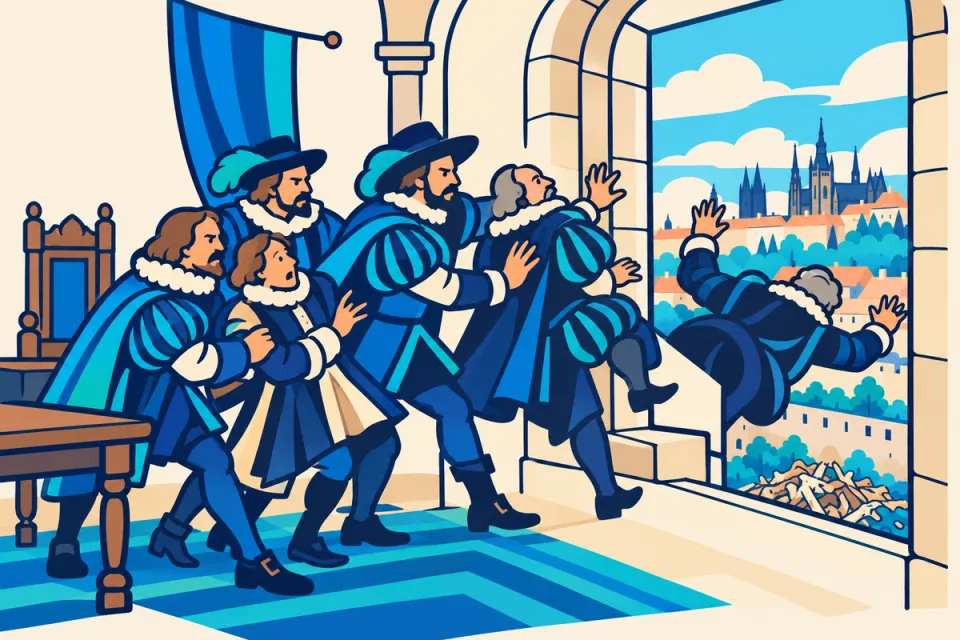
So that is what the crowd did. Three men, out of a high castle window.
And then something amazing happened. All three were already getting up. They all survived.
The Catholics said God had saved them. Later, Protestant writers said the men had simply landed on a pile of garbage — a story that was probably made up to mock the miracle. The two sides could not even agree on the rescue.
The throwing set off a revolt in Bohemia, and the revolt grew into a religious war, the Thirty Years’ War, which burned across Europe for thirty years.
And the secretary? The emperor later made him a baron. His title meant, roughly, Baron of Highfall. That is a true story. Every word of it.
322 words · about 2 min to read · retell it in about 2 minutes
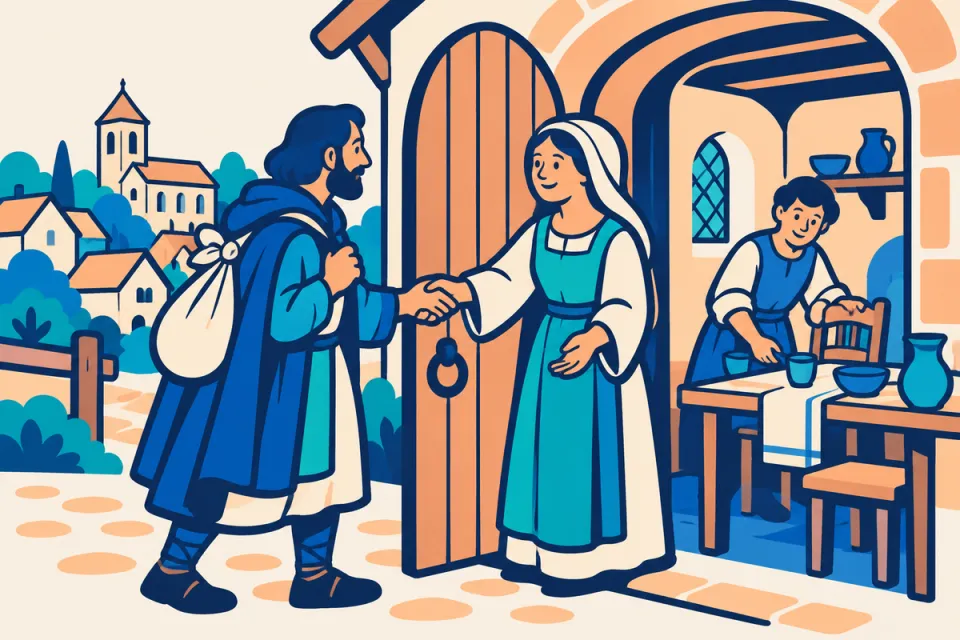
In 1618, the kingdom of Bohemia — today’s Czech Republic — was ruled by Catholic Habsburg kings over a mostly Protestant people. The emperor had once granted Protestants the right to worship freely, in a document called the Letter of Majesty, in 1609. But in 1618 his successor, Emperor Matthias, ordered the building of some Protestant chapels on royal land stopped — and to Bohemia’s Protestants, that broke the promise.
On May 23, 1618, an assembly of Protestant nobles marched to Prague Castle. In the council room they held a trial, on the spot, of two imperial governors, counts Vilém Slavata and Jaroslav Bořita of Martinice: guilty of subversion of majesty and of rebellion against the kingdom. Their secretary, Philip Fabricius, was left in the room with them.
The punishment was the window.
All three men were thrown out. And then came the part nobody could explain: they survived. All three were already getting up, reaching for a ladder that supporters inside had put out from a lower window.
Each side came to tell the story its own way. Catholic writers declared a miracle — angels, or the Virgin Mary herself, had caught the men. Protestant pamphleteers had a less holy explanation: the governors had landed on a pile of garbage and filth below the window — a story, historians say, that appears in no contemporary account and was probably invented to mock the miracle. Same event, opposite sermons.
The fall itself was less important than what followed. Bohemia rose against the Habsburgs, and the revolt grew into the Thirty Years’ War, which ground on until 1648. All of that, hanging on three men who got up and escaped.
Oh — and Fabricius, the secretary, was later rewarded by the emperor with a noble title: Baron von Hohenfall. Baron of Highfall. Prague, it turns out, had thrown officials out of windows before, in 1419, and would again. In the city’s memory, it is practically a form of politics.
456 words · about 2 min to read · retell it in about 4 minutes
In May 1618, in the castle above Prague, a crowd of Protestant nobles tried two royal governors in the council room itself. The verdict was guilty, the sentence was a window, and what followed — the Thirty Years’ War, running from 1618 to 1648 — began, more or less, in mid-air.
Here is the background. Bohemia was ruled by the Catholic Habsburgs, and its people were largely Protestant. In 1609, Emperor Rudolf the Second had guaranteed their religious liberty in a charter called the Letter of Majesty. Then, in 1618, Emperor Matthias’s deputies halted the building of Protestant chapels at Klostergrab and Braunau. To Bohemia’s Protestants, this tore up Rudolf’s charter.
So the estates called an assembly, and on May 23 a crowd led by Count Thurn pushed into the Bohemian Chancellery at Prague Castle. Two imperial regents, Counts Vilém Slavata of Chlum and Jaroslav Bořita of Martinice, were put on the spot and found guilty of subversion of majesty, enemies of the estates and the common good, and rebels against the Kingdom of Bohemia. Their secretary, Philip Fabricius, was left in the room with them.
Then the room emptied of hesitation. Martinice was seized first and thrown out. Slavata grabbed the window ledge and begged the Virgin Mary for help — until the crowd pushed him out too. Poor Fabricius, who had clung to a Protestant nobleman for protection, was peeled off and followed. By one common count it was the third time Prague had thrown officials out of a window — after 1419, at the start of the Hussite Wars, and 1483.
And then the story becomes a theological dispute.
All three survived. All three were already getting up below, reaching for a ladder that allies had put out from a lower window. Catholic Europe declared a miracle: angels, or the Virgin herself, had caught God’s servants. Protestant pamphleteers answered with less poetry — the governors, they said, had landed on a pile of trash and filth below the window. Historians note that the dunghill story appears nowhere among contemporary accounts; it was probably invented precisely to mock the miracle. Even the fall had two versions, and each side preached its own.
The rebels’ triumph lasted a breath. The Bohemian revolt became one of the opening phases of the Thirty Years’ War; two years later, at White Mountain, the Catholic side crushed the Bohemians and took Prague back.
But the strangest footnote belongs to Fabricius. The emperor rewarded the surviving secretary with a title of nobility: Baron von Hohenfall. Baron of Highfall. The word defenestrate is believed to have entered English in reference to what Prague’s crowds had done. Prague had thrown a war into motion out of a window — and the three men it threw got up alive.
Read it once, close the page, and tell it back. The coach listens for pace, fillers and the facts.
Key facts and sources
Catholic authorities shuttered the Protestant chapels at Klostergrab and Braunau; the defensors called an assembly.
“When a Protestant assembly spurned by the shuttered chapels in Klostergrab and Braunau attracted a massive crowd” — Windows Onto History: The Defenestrations of Prague (1419–1997), The Public Domain Review
The 1609 Letter of Majesty of Emperor Rudolf II granted Protestant religious liberty.
“In 1609, to strengthen his hold on Bohemia, Rudolf issued the Letter of Majesty, which granted Bohemia’s largely Protestant estates the right to freely exercise their religion” — Defenestrations of Prague, Wikipedia
On 23 May 1618, a Protestant assembly at Prague Castle tried the regents and threw two governors and their secretary out of a window.
“the disgruntled Protestant estates threw two royal governors and their secretary out of a window of the Hradčany Castle” — Defenestrations of Prague, Wikipedia
The victims were Jaroslav Bořita of Martinice, Vilém Slavata of Chlum and their secretary Fabricius.
“This left Count Vilém Slavata of Chlum and Count Jaroslav Bořita of Martinice (who had replaced Thurn as castellan), both known Catholic hard-liners, and Philip Fabricius, the secretary to the regents.” — Defenestrations of Prague, Wikipedia
The verdict: ‘subversion of majesty, enemies of the estates and the common good, and rebels against the Kingdom of Bohemia’.
“found guilty of “subversion of majesty, enemies of the estates and the common good, and rebels against the Kingdom of Bohemia”” — Defenestrations of Prague, Wikipedia
About 200 representatives of the Protestant estates stormed the Bohemian Chancellery at Prague Castle.
“a group of about 200 representatives of the Protestant Bohemian estates protested against restrictions on their religious freedom by storming the Bohemian Chancellery at Prague Castle” — Defenestration of Prague on May 23, 1618 (1629), German History in Documents and Images
The crowd was led by Count Thurn.
“led by Count Thurn, who had been deprived of his post as castellan” — Defenestrations of Prague, Wikipedia
Martinice was thrown out first.
“chucked Martinice out the window first” — Windows Onto History: The Defenestrations of Prague (1419–1997), The Public Domain Review
Slavata held the ledge begging the Virgin’s intercession.
“Slavata, meanwhile, held onto the ledge, begging for the Virgin’s intercession.” — Windows Onto History: The Defenestrations of Prague (1419–1997), The Public Domain Review
Secretary Fabricius clung to Protestant nobleman Joachim von Schlick before being tossed.
“he clung to the prominent Protestant nobleman Joachim von Schlick for protection” — Windows Onto History: The Defenestrations of Prague (1419–1997), The Public Domain Review
All three victims survived and escaped.
“in 1618 all three victims survived and were able to escape.” — Defenestration of Prague on May 23, 1618 (1629), German History in Documents and Images
The three were getting up and reached a ladder extended from a lower window.
“Martinice and Slavata were alive, as was their secretary, and the three were already getting up to reach for a ladder extended by allies from a lower window in the castle.” — Windows Onto History: The Defenestrations of Prague (1419–1997), The Public Domain Review
Catholic propagandists insisted the Virgin Mary saved them.
“Catholic propagandists insisted that the Virgin Mary had saved them” — Windows Onto History: The Defenestrations of Prague (1419–1997), The Public Domain Review
Catholics maintained the men were saved by angels or the Virgin’s intercession.
“Catholics maintained the men were saved by angels or by the intercession of the Virgin Mary, who caught them” — Defenestrations of Prague, Wikipedia
Protestant pamphleteers said they fell onto a dung heap — a story unknown to contemporaries, probably coined against the miracle claim.
“later Protestant pamphleteers asserted that they survived due to falling onto a dung heap, a story unknown to contemporaries and probably coined in response to divine intervention claims.” — Defenestrations of Prague, Wikipedia
Protestants noted a pile of trash below broke the fall.
“noted that a pile of trash and human sh” — Windows Onto History: The Defenestrations of Prague (1419–1997), The Public Domain Review
Fabricius was later ennobled as Baron von Hohenfall (‘Baron of Highfall’).
“Philip Fabricius was later ennobled by the Emperor and granted the title Baron von Hohenfall (literally ‘Baron of Highfall’).” — Defenestrations of Prague, Wikipedia
The 1618 defenestration caused the Bohemian Estates’ Revolt and led to the Thirty Years’ War.
“This defenestration significantly influenced the history of Europe, by causing the Bohemian Estates’ Revolt and thus led to the Thirty Years’ War.” — Defenestrations of Prague, Wikipedia
The defenestration marked the beginning of the Bohemian Protestant revolt against the Catholic Habsburg monarchy.
“The defenestration marked the beginning of the Bohemian Protestant revolt against the Catholic Habsburg monarchy.” — Defenestration of Prague on May 23, 1618 (1629), German History in Documents and Images
Two years later the Catholics won the Battle of White Mountain, on November 8, 1620.
“Just two years after the defenestration, Ferdinand and the Catholics regained power in the Battle of White Mountain on November 8, 1620.” — Defenestrations of Prague, Wikipedia
The word defenestrate is believed to have first been used in English for the 1618 Prague episodes.
“the word defenestrate is believed to have first been used in English in reference to the episodes in Prague in 1618” — Defenestrations of Prague, Wikipedia
An earlier defenestration happened in Bohemia in 1419, at the start of the Hussite Wars.
“A similar incident had occurred in Bohemia in 1419, at the beginning of the Hussite Wars.” — Defenestration of Prague on May 23, 1618 (1629), German History in Documents and Images
Bohemia was ruled by Catholic Habsburg kings over a largely Protestant people.
“The Kingdom of Bohemia since 1526 had been governed by Habsburg kings, who did not force their Catholic religion on their largely Protestant subjects.” — Defenestrations of Prague, Wikipedia
Ferdinand had the emperor order construction of some Protestant chapels on royal land stopped.
“in 1618 he forced the Emperor to order the cessation of construction of some Protestant chapels on royal land” — Defenestrations of Prague, Wikipedia
The Thirty Years’ War ran from 1618 to 1648.
“triggered the Thirty Years’ War (1618-48)” — Windows Onto History: The Defenestrations of Prague (1419–1997), The Public Domain Review
The 1618 event was the third defenestration in Prague’s history; the first was in 1419.
“The first governmental defenestration occurred in 1419, the second in 1483 and the third in 1618” — Defenestrations of Prague, Wikipedia
Sources consulted for this story: Defenestrations of Prague (Wikipedia, accessed 2026-10-25); Windows Onto History: The Defenestrations of Prague (1419–1997) (The Public Domain Review, accessed 2026-10-25); Defenestration of Prague on May 23, 1618 (1629) (German History in Documents and Images, accessed 2026-10-25). Every story is checked against its sources before it is published — how we verify stories.
Why this story is worth telling
The war started mid-air, and even the rescue became an argument about God.