
Diego, the Tortoise Who Saved His Species
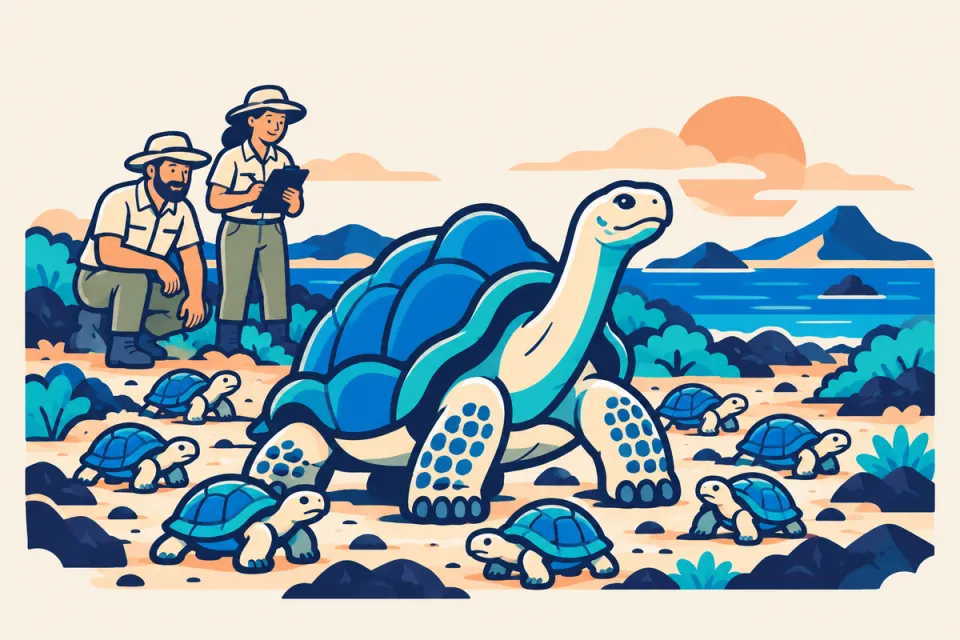
Diego, the Tortoise Who Saved His Species
Before 1920–2020Galápagos, Ecuador, and San Diego, USANature & animals
With his species down to about 15, scientists found a forgotten male in San Diego — he fathered around 900 babies.
Reading level
The same true story, told at three lengths. Pick one to read, close your eyes, and tell it back in your own words.
220 words · about 1 min to read · retell it in about 2 minutes
Diego is a giant tortoise. He was born on a faraway island in the Galápagos, in the Pacific, long ago. As a young tortoise he was put on a ship and taken far away to a zoo in America. For many years he lived there, and nobody knew what kind of tortoise he was.
Far away, things were going very badly for his family. On his home island, Española, sailors had eaten almost all of his kind. Only about fifteen tortoises were left, and most were female. Scientists wanted more males to help the species grow.
Scientists searched zoos around the world. In San Diego they found Diego. A test showed he was a missing Española tortoise. In 1977 he went back to the Galápagos to join a breeding program.
And Diego became a father. Again and again and again. He sired hundreds of babies, about nine hundred in all, four in ten of the program’s babies. His children were set free on the island year after year.
In 2020, when he was about one hundred years old, scientists said the tortoises could keep growing on their own. More than two thousand tortoises lived there. Diego was carried back to Española and set free among the cactus.
His species was saved, thanks in part to one very busy old tortoise.
323 words · about 2 min to read · retell it in about 2 minutes
Diego is a giant tortoise, and for more than four decades he was one of the most important fathers his species ever had.
He hatched on Española, a remote island in the Galápagos, probably before 1920. As a young adult he was captured and shipped to the United States, and by the late 1940s he was living at the San Diego Zoo. Nobody there even knew what species he was.
Back home, his species was collapsing. Sailors, whalers and pirates had hunted the giant tortoises for food, and by the 1800s they had nearly wiped them out. On Española, the survivors were hunted out and pushed aside by goats. When scientists finally set up a breeding program, only about a dozen females and two males could be found. With so few males, the species was down to a handful of breeders.
So the program searched the world’s zoos. In San Diego, DNA testing identified Diego as a true Española tortoise. In 1977 he was sent to the Galápagos and given one job: start a family.
He turned out to be remarkably good at it. A conservation biologist described him as aggressive, active and vocal in his courtship, and over the following decades he fathered around nine hundred offspring, some forty percent of everything the program produced. His children were released on Española as young tortoises once or twice a year, and in time they had young of their own.
In January 2020 the program was declared over: more than two thousand tortoises now lived on the island, and they no longer needed help. That June, after more than four decades in the program, Diego and the other originals were carried by rangers onto his home island, and Diego, by then over a hundred years old, was set free among the cactus. He had left as a captured tortoise whose species no one knew. He came home as the tortoise who saved his species.
475 words · about 2 min to read · retell it in about 4 minutes
Every species-saving story needs a hero, but few heroes look like Diego: a giant tortoise with a temper, a voice, and, by the end, around nine hundred children.
Diego hatched on Española, a remote, uninhabited island in the Galápagos, probably before 1920. As a young adult he was captured, put on a ship and carried to the United States. By the late 1940s he was an exhibit at the San Diego Zoo, and nobody there knew what species he was. His island, meanwhile, was emptying. In the 1800s sailors, whalers and pirates hunted the giant tortoises for food, and on Española the survivors also had to compete with introduced goats for food. When a captive breeding program got under way in the mid-1960s, by most accounts, only about fifteen Española tortoises were known to exist, most of them female. There were only two males among them.
So the program did something desperate and sensible: it searched the world’s zoos for lost Española tortoises, especially males. In San Diego, DNA tests identified Diego. In 1977 he was transferred to Santa Cruz Island in the Galápagos and inducted into the breeding program.
He threw himself into the work, so to speak. A conservation biologist described him as quite aggressive, active and vocal in his courtship, and the females, it seemed, appreciated the enthusiasm. Over four decades he fathered roughly nine hundred offspring, some forty percent of the program’s entire output. The press said he had “had so much sex he saved his species”. The quietly amusing twist: a second male, E5, actually fathered most of the rest, but E5 had a reserved character, a less interesting name, and was seldom seen in the act, so, it is said, Diego got the fame.
The mathematics of the rescue are stark. Nearly 1,900 tortoises raised by the program were released onto Española, and by 2020 the island held a self-sufficient population of more than 2,000, its future secure once the goats had finally been eradicated. In January 2020, the program’s end was announced, and it was deemed a success. From those fifteen founders, Diego and the island survivors, twelve females and three males in all, came an island full of tortoises.
There was one ceremony left. Their release had been delayed since March by the pandemic. On 15 June 2020 the fifteen original tortoises were carried home together, Diego among them, and released among the cactus. Diego was over a hundred years old by then, 80 kilograms and nearly 90 centimetres long, carried by rangers, home more than eighty years after he was taken. Scientists think he could live to 150. The minister put it plainly: they had saved a species that would otherwise have become extinct.
And at Las Tunas on Española, among the cactus, the great patriarch was simply left to wander on his own.
Read it once, close the page, and tell it back. The coach listens for pace, fillers and the facts.
Key facts and sources
Diego is a Hood Island giant tortoise thought to have been hatched on Española in the Galápagos.
“Diego is a Hood Island giant tortoise. Thought to have been hatched on Española Island, Galápagos” — Diego (tortoise), Wikipedia
He was captured and shipped to the United States as a young adult sometime between 1928 and 1933.
“captured and transported to the United States as a young adult sometime between 1928 and 1933” — Diego (tortoise), Wikipedia
By the late 1940s he was at the San Diego Zoo, and nobody knew his species.
“By the late 1940s, he was at the San Diego Zoo, though his species was not known.” — Diego (tortoise), Wikipedia
When the breeding effort began only about 15 Española tortoises were known to survive.
“by which time only 15 individuals were known to survive” — Diego (tortoise), Wikipedia
The species was hunted for food and suffered from goats competing for food.
“was threatened by hunting for food and competition from goats” — Diego (tortoise), Wikipedia
Sailors, whalers and pirates hunted the giant tortoises.
“The giant tortoises were depleted from the island, hunted by sailors, whalers, and pirates for food” — Diego, the 100-Year-Old Tortoise Who Fathered 900 Babies, Returns to the Wild, Smithsonian Magazine
The program searched worldwide for more Española tortoises, especially males.
“It was necessary to do a worldwide search to determine if there were more individuals, especially males” — Española Tortoises Return Home Following Closure of Successful Breeding Program, Galápagos Conservancy
Diego was identified as a Hood Island tortoise by DNA testing.
“DNA testing proved that he was a Hood Island tortoise” — Diego (tortoise), Wikipedia
He joined the breeding program on Santa Cruz Island in 1977.
“he was transferred to Santa Cruz Island, Galápagos to join the program in 1977” — Diego (tortoise), Wikipedia
Diego fathered around 900 offspring, some 40 percent of the program’s output.
“Diego fathered around 900 offspring, some 40% of the program’s output” — Diego (tortoise), Wikipedia
A second male, E5, fathered most of the rest.
“A second tortoise, known as E5, fathered most of the remaining 60%” — Diego (tortoise), Wikipedia
Diego was described as aggressive, active and vocal in his mating habits.
“has been described as aggressive, active and vocal in the act of mating” — Diego (tortoise), Wikipedia
The breeding program ended in January 2020.
“The breeding program ended in January 2020 and Diego is officially retired” — Diego (tortoise), Wikipedia
By then the wild population on Española was more than 2,000.
“there are now more than 2,300 tortoises on the island” — Española Tortoises Return Home Following Closure of Successful Breeding Program, Galápagos Conservancy
Diego and 14 other tortoises were released on Española on 15 June 2020.
“Diego and 14 other tortoises from the program were released on Española on 15 June 2020” — Diego (tortoise), Wikipedia
At his release he weighed 80 kilograms and measured about 90 centimetres long.
“At the time of his release he weighed 80 kilograms (180 lb) and measured 90 centimetres (35 in) in length” — Diego (tortoise), Wikipedia
Diego is more than 100 years old.
“Diego is more than 100 years old” — Española Tortoises Return Home Following Closure of Successful Breeding Program, Galápagos Conservancy
It is thought he could live to 150.
“It is thought that he could live to reach 150 years old.” — Diego (tortoise), Wikipedia
The 15 original tortoises returned home after 55 years in the program.
“the release of the 15 original Española Island tortoises back to their island home after 55 years in the program” — Española Tortoises Return Home Following Closure of Successful Breeding Program, Galápagos Conservancy
The program reintroduced nearly 1,900 Española tortoises.
“the eventual reintroduction of nearly 1,900 Española tortoises to their island or origin through the breeding program” — Española Tortoises Return Home Following Closure of Successful Breeding Program, Galápagos Conservancy
Diego returned home almost 80 years after he was removed.
“has also returned to his island of origin almost 80 years after he was removed” — Española Tortoises Return Home Following Closure of Successful Breeding Program, Galápagos Conservancy
The island could support the population after introduced goats were eradicated.
“following the eradication of introduced goats” — Española Tortoises Return Home Following Closure of Successful Breeding Program, Galápagos Conservancy
The environment minister said the program saved a species that would otherwise have become extinct.
“we managed to save a species that would otherwise have become extinct” — Española Tortoises Return Home Following Closure of Successful Breeding Program, Galápagos Conservancy
The third male, E3, produced very few offspring.
“with the third male, E3, producing very few offspring” — Diego (tortoise), Wikipedia
E5 is believed to have been more successful because of a more reserved character, a less interesting name, and seldom being seen mating.
“This is believed to be because E5 had a more reserved character, a less interesting name, and was seldom witnessed in the act of mating” — Diego (tortoise), Wikipedia
When the program began in 1976 there were only 12 females and 3 males left on Española.
“A breeding program was set up in 1976, at which point there were only 12 females and 3 males remaining on the island.” — Diego (tortoise), Wikipedia
Diego is thought to have hatched on Española before 1920.
“Diego is thought to have been hatched on Española Island, one of the Galápagos Islands, before 1920.” — Diego (tortoise), Wikipedia
Sources consulted for this story: Diego (tortoise) (Wikipedia, accessed 2026-10-25); Española Tortoises Return Home Following Closure of Successful Breeding Program (Galápagos Conservancy, accessed 2026-10-25); Diego, the 100-Year-Old Tortoise Who Fathered 900 Babies, Returns to the Wild (Smithsonian Magazine, accessed 2026-10-25); Diego the tortoise, father to hundreds and saviour of his species, finally retires (The Guardian, accessed 2026-10-25). Every story is checked against its sources before it is published — how we verify stories.
Why this story is worth telling
One improbable old male helped turn a dying species into thousands. And a rival quietly out-fathered him.