The Boy Who Unlocked Vanilla
The Boy Who Unlocked Vanilla
1841Réunion, Indian OceanFood & everyday things
Almost every vanilla pod on Earth is pollinated by hand, using a trick a 12-year-old enslaved boy invented in 1841.
Reading level
The same true story, told at three lengths. Pick one to read, close your eyes, and tell it back in your own words.
204 words · about 1 min to read · retell it in about 2 minutes
Nearly every vanilla pod grown on a farm today was pollinated by a human hand. And the trick behind that hand came from a twelve-year-old boy.
His name was Edmond. He was born into slavery in 1829 on the island of Réunion. His mother died when he was born.
A planter on the island wanted to grow vanilla. The vines grew, but they never made a single pod. In Mexico, the plant’s home, special bees do that job. On Réunion, there were no such bees.
One day in 1841, the planter Ferréol Bellier-Beaumont was walking through his garden with Edmond. On his old vine, he saw two pods. Edmond said he had made them himself, by hand. The man did not believe him. A few days later, more pods appeared. So he asked the boy to show him.
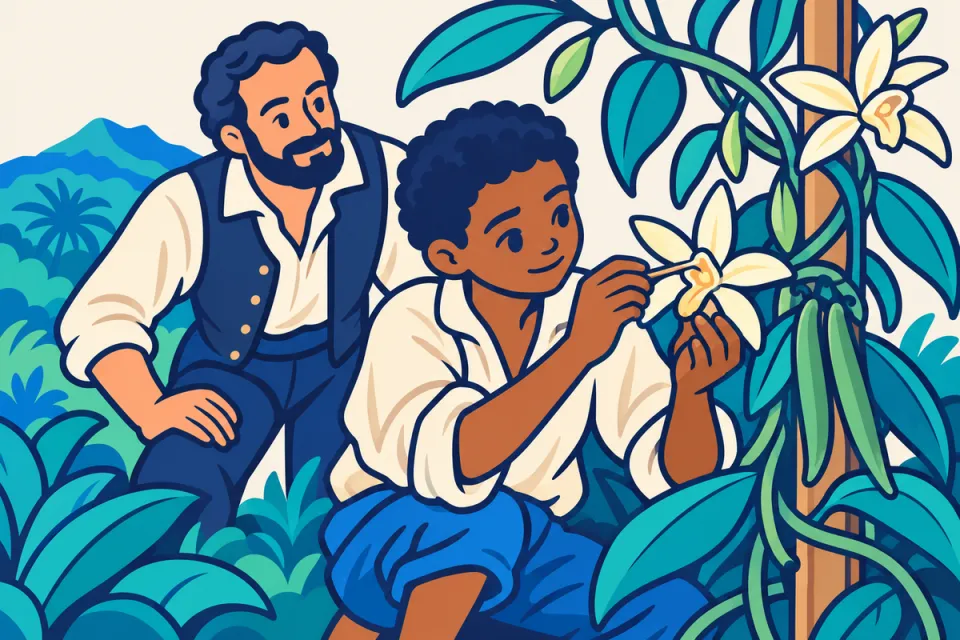
Edmond took a thin stick and lifted a tiny flap inside the flower. Then he smeared the sticky pollen across with his thumb. That was all.
Soon Edmond was sent around the island to teach others. For a time, Réunion was the biggest vanilla supplier in the world. But no reward ever came. He died poor in 1880.
Next time you taste vanilla, remember Edmond’s thumb.
310 words · about 2 min to read · retell it in about 2 minutes
Nearly every vanilla pod grown on a farm today was pollinated by a human hand. The trick behind that hand was worked out by a twelve-year-old enslaved boy who never got paid for it.
His name was Edmond. He was born in 1829 on Réunion, an island in the Indian Ocean, and his mother died during his birth. As a small child he was sent to work on the Belle-vue plantation, where the planter Ferréol Bellier-Beaumont taught him the basics of botany, including how to pollinate watermelon flowers by hand.
French planters dreamed of vanilla. The vines grew and even flowered on the island, but they never produced a single pod. Back in Mexico, bees do the job, and those bees did not live on Réunion. A Belgian professor had published a method in 1837, but it was too slow to make money.
Then, one day in 1841, Bellier-Beaumont was walking through his garden with Edmond and stopped. On his lonely old vine hung two pods. Edmond told him he had done it himself, by hand. The planter didn’t believe a word. A few days later more pods appeared, and this time he asked the boy to show him.
Edmond picked up a thin stick, lifted the tiny flap that keeps the male and female parts apart, and smeared the sticky pollen across with his thumb. It was simple, and it worked.
Soon Edmond was being taken from plantation to plantation to teach the trick. Réunion became, for a time, the largest vanilla supplier on earth.
And Edmond? When slavery ended in 1848, he became Edmond Albius, a surname from alba, meaning white. He worked as a kitchen servant, was later convicted of theft, and Bellier-Beaumont tried and failed to win him a pension. He died poor in 1880.
The whole industry still runs on his thumb. Edmond got nothing.
507 words · about 3 min to read · retell it in about 4 minutes
Here is something most people don’t know about vanilla: almost every vanilla plant farmed anywhere in the world is pollinated by hand, one flower at a time. And the method those hands use was worked out by a twelve-year-old enslaved boy on a small island in the Indian Ocean.
His name was Edmond. He was born in 1829 on Réunion, then called Bourbon, and his mother died during his birth. He grew up on the estate of a planter, Ferréol Bellier-Beaumont, a man who taught the boy the basics of botany, including how to pollinate watermelon flowers by hand.
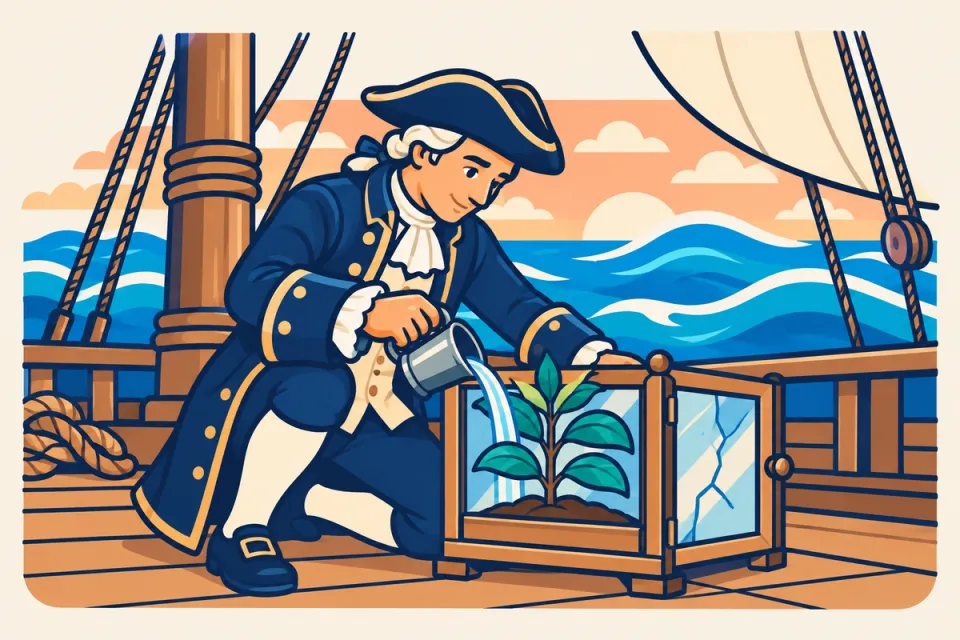
Now, the French planters on the island had a dream, and the dream was vanilla. Bellier-Beaumont had received vanilla cuttings back in the late 1810s; only one of his vines survived and grew, the flowers opened, and then nothing. Not one pod. In its home in Mexico, bees do the job, and those bees did not live on the island. A Belgian professor had published a hand method in 1837, but it was so slow and fiddly that nobody could make money with it.
Then, in 1841, Bellier-Beaumont was walking through his garden with Edmond when he stopped in front of his one old vine. Two pods were hanging from it. The boy said, quite simply, that he had done that himself. The planter refused to believe it. A few days later, more pods appeared, and he finally asked Edmond to show him.
So Edmond did. He took a thin stick, lifted the little flap inside the flower that keeps the male and female parts apart, and with his thumb pressed the pollen onto the other side. That was it.
Within days, other planters came to watch. Edmond was carried from plantation to plantation to teach the gesture. In 1858 Réunion shipped two tonnes of vanilla to France; by 1898, two hundred tonnes. For a time, this tiny island was the biggest vanilla supplier in the world.
And this is where the story turns. Slavery ended in the French colonies in 1848. He became Edmond Albius, a surname from alba, meaning white. He found work as a kitchen servant, was convicted of stealing jewellery, and the governor granted him clemency in light of what he had given the colony. Bellier-Beaumont pressed the state for a pension for him. The appeals went nowhere.
Then a French botanist, Jean Michel Claude Richard, claimed he had developed the same method three or four years earlier and that Edmond must have watched him demonstrate it. Bellier-Beaumont replied in writing that Richard could hardly have taught the boy the technique in 1838, when Edmond was only eight years old. Later researchers concluded there is very little doubt that Edmond worked out the method on his own.
Edmond died in poverty in 1880. The local paper called it a destitute and miserable end.
Today, Madagascar, which learned his technique, remains the world’s chief vanilla producer. So the next time you smell it in a bakery, picture a boy’s thumb, pressing pollen into a flower.
Read it once, close the page, and tell it back. The coach listens for pace, fillers and the facts.
Key facts and sources
Edmond was born into slavery in 1829 on Réunion.
“Edmond was born into slavery in 1829, in Sainte-Suzanne on the island of Bourbon (modern-day Réunion).” — Edmond Albius: the boy who revolutionised the vanilla industry, The Linnean Society of London
His mother died when he was born.
“His mother, an enslaved woman, died during his birth.” — Edmond Albius, Wikipedia
Vanilla planted on Réunion produced no pods because its pollinating insect was absent.
“the plant didn’t develop any fruits (seed pods) because of the absence of the pollinating insect outside of the plant’s natural range” — Edmond Albius, Wikipedia
In its native Mexico, vanilla is pollinated by Eulaema bees.
“In its native Mexico, Vanilla planifolia is pollinated by bees of the Eulaema genus” — Edmond Albius: the boy who revolutionised the vanilla industry, The Linnean Society of London
In 1841, walking in his garden with Edmond, Bellier-Beaumont found two fruits on his single old vine.
“Then, whilst walking through his gardens with the young Edmond in 1841, Bellier-Beaumont discovered two fruits on this solitary 20-year-old vine.” — Edmond Albius: the boy who revolutionised the vanilla industry, The Linnean Society of London
Edmond said he had fertilised the flower by hand.
“To his astonishment, Edmond claimed that he had been able to fertilise the flower by hand.” — Edmond Albius: the boy who revolutionised the vanilla industry, The Linnean Society of London
Bellier-Beaumont at first did not believe the 12-year-old.
“Initially, Bellier-Beaumont did not believe that this 12-year-old boy had achieved something that so many had failed to do before him.” — Edmond Albius: the boy who revolutionised the vanilla industry, The Linnean Society of London
A few days later more pods appeared and he asked Edmond to show his technique.
“A few days later Bellier-Beaumont noticed more pods developing, and requested that Edmond show him his specific technique for hand pollination.” — Edmond Albius: the boy who revolutionised the vanilla industry, The Linnean Society of London
The method uses a thin stick or blade of grass and a thumb gesture.
“using a thin stick or blade of grass and a simple thumb gesture” — Edmond Albius, Wikipedia
The stick lifts the flap separating male and female parts; the thumb smears the pollen across.
“lift the rostellum, the flap that separates the male anther from the female stigma, and then, with their thumbs, smear the sticky pollen from the anther over the stigma” — Edmond Albius, Wikipedia
Edmond was taken around Réunion to demonstrate his technique on other plantations.
“The young Edmond was transported around Réunion to demonstrate his technique to slaves on other plantations.” — Edmond Albius: the boy who revolutionised the vanilla industry, The Linnean Society of London
Réunion became for a time the world’s largest supplier of vanilla.
“Réunion became for a time the world’s largest supplier of vanilla” — Edmond Albius, Wikipedia
Edmond never received a stipend for his contribution.
“He died aged 51 not receiving any type of stipend for his monumental contribution.” — Edmond Albius: the boy who revolutionised the vanilla industry, The Linnean Society of London
Albius died in poverty in 1880.
“Albius died in poverty in St. Suzanne in 1880.” — Edmond Albius, Wikipedia
Nearly all vanilla is still pollinated by hand using his method.
“Albius’s manual pollination method is still used today, as nearly all vanilla is pollinated by hand.” — Edmond Albius, Wikipedia
Bellier-Beaumont had taught Edmond how to hand-pollinate watermelon.
“Bellier-Beaumont realised the technique was similar to his own method for hand pollinating watermelon plants, which he had shown Edmond previously.” — Edmond Albius: the boy who revolutionised the vanilla industry, The Linnean Society of London
In 1837 Belgian botanist Charles Morren published a hand-pollination method, but it was slow and laborious.
“In 1837, Charles Morren, a professor of botany at the University of Liège in Belgium, published a method of hand-pollination, but his technique was slow and required too much effort to make cultivating vanilla a moneymaking proposition.” — Edmond Albius, Wikipedia
France abolished slavery in its colonies in 1848.
“In 1848, France outlawed slavery in its colonies” — Edmond Albius, Wikipedia
He worked as a kitchen servant in St. Denis after leaving the plantation.
“Albius left the plantation for St. Denis, where he worked as a kitchen servant” — Edmond Albius, Wikipedia
He took the surname Albius, from alba, white, after the vanilla flower’s colour.
“He adopted Albius as his new surname from alba “white” in reference to the vanilla orchid’s colour.” — Edmond Albius, Wikipedia
He was convicted of stealing jewellery.
“He was convicted of stealing jewelry” — Edmond Albius, Wikipedia
The governor granted clemency in light of his contribution to vanilla.
“the governor granted him clemency in light of his enormous contribution to vanilla production in Réunion” — Edmond Albius, Wikipedia
Bellier-Beaumont tried to secure him a state pension, without success.
“Bellier-Beaumont tried to secure him a state pension for his services to the vanilla industry, but his appeals fell on deaf ears.” — Edmond Albius: the boy who revolutionised the vanilla industry, The Linnean Society of London
A French botanist, Richard, claimed to have taught the method years earlier.
“The French botanist Jean Michel Claude Richard claimed that he had developed the same method of hand pollination 3 or 4 years earlier” — Edmond Albius: the boy who revolutionised the vanilla industry, The Linnean Society of London
Bellier-Beaumont replied: How could Mr. Richard have taught the young boy this technique in 1838—when he was only eight years old?
““How could Mr. Richard have taught the young boy this technique in 1838—when he was only eight years old?” — Edmond Albius: the boy who revolutionised the vanilla industry, The Linnean Society of London
Richard’s claim has been debunked.
“claimed to have discovered the technique three or four years earlier but this has been debunked” — Edmond Albius, Wikipedia
Réunion shipped 2 tonnes of vanilla to France in 1858 and 200 tonnes by 1898.
“In 1858, Réunion was able to transport 2 tonnes of vanilla beans back to France; by 1867 this had increased to 20 tonnes and by 1898, 200 tonnes.” — Edmond Albius: the boy who revolutionised the vanilla industry, The Linnean Society of London
The local paper called his death a destitute and miserable end.
“It was a destitute and miserable end.” — Edmond Albius: the boy who revolutionised the vanilla industry, The Linnean Society of London
Madagascar, using his technique, remains the chief vanilla producer.
“French colonists used Albius’s technique in Madagascar to cultivate vanilla, and Madagascar remains the world’s chief vanilla producer.” — Edmond Albius, Wikipedia
Albius’s thinking enabled artificial pollination on a mass scale.
“His ingenious thinking enabled artificial pollination on a mass scale” — Edmond Albius: the boy who revolutionised the vanilla industry, The Linnean Society of London
Bellier-Beaumont taught Edmond the basics of botany.
“Albius’s owner, Mr. Beaumont, taught him the basics of botany, including how to fertilize flowers.” — Edmond Albius, Wikipedia
In the late 1810s Bellier-Beaumont received vanilla cuttings.
“In the late 1810s, Bellier-Beaumont received vanilla cuttings from Pierre-Henri Philibert, captain of the fluyt Rhône” — Edmond Albius: the boy who revolutionised the vanilla industry, The Linnean Society of London
Within days other planters came to see Edmond’s technique.
“Within days other planters made their way to Belle-vue to see Edmond’s technique.” — Edmond Albius: the boy who revolutionised the vanilla industry, The Linnean Society of London
Sources consulted for this story: Edmond Albius (Wikipedia, accessed 2026-10-25); Edmond Albius: the boy who revolutionised the vanilla industry (The Linnean Society of London, accessed 2026-10-25). Every story is checked against its sources before it is published — how we verify stories.
Why this story is worth telling
A child solved what experts could not, and the world kept the trick but forgot the boy.