
The Officer Who Shared His Water With a Coffee Tree
The Officer Who Shared His Water With a Coffee Tree
1720–1774France to MartiniqueFood & everyday things
In 1720, by his own account, a French officer carried a coffee tree across the Atlantic and shared his drinking water with it.
Reading level
The same true story, told at three lengths. Pick one to read, close your eyes, and tell it back in your own words.
210 words · about 1 min to read · retell it in about 2 minutes
In 1720, according to his own later account, a French navy officer named Gabriel de Clieu did a strange thing. He took a small coffee tree on a ship, and sailed across the Atlantic with it.
The coffee plants grew in the Jardin royal des plantes, the king’s garden. They had come from Holland. De Clieu wanted a piece of one for the French island of Martinique. One account says the king said no, so de Clieu took a cutting at night. Another story says his lover stole three plants for him.
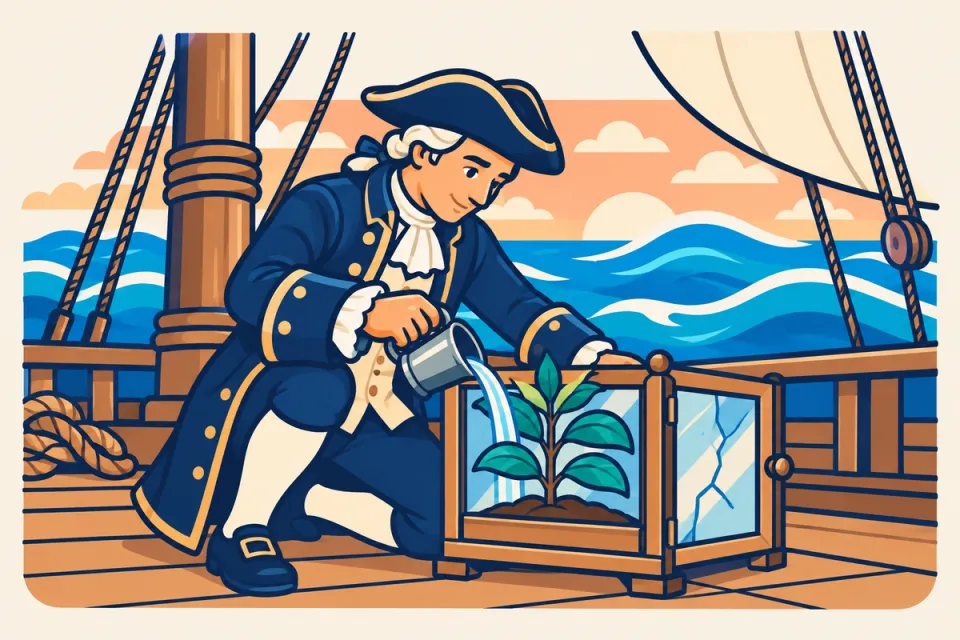
The voyage was long and terrible. Water was rationed, and each person got only a little. De Clieu later wrote that he gave part of his own share to the little tree.
There was a storm. Pirates attacked. The glass box around the plant broke. The little tree held on.
On Martinique, he planted it. It grew. In a few years, there were coffee plantations on the island. Millions of coffee trees followed, and the island even grew more coffee than all of France could drink. From Martinique, coffee trees spread to other islands and on to South America.
So the next time you smell fresh coffee, think of a sailor sharing his drinking water with a tree.
310 words · about 2 min to read · retell it in about 2 minutes
Here is a story coffee lovers like to tell. In 1720, a French naval officer named Gabriel de Clieu carried a coffee plant across the Atlantic, and when the drinking water ran low on the voyage, he shared his own ration with the plant.
Why would anyone do that? Coffee grew in the Jardin royal des plantes, the king’s garden, from plants that had arrived from Holland in 1713. But coffee did not grow on Martinique. De Clieu wanted a cutting for the island. Getting it out of the royal garden is where the legends begin. One account says King Louis XV refused permission, so de Clieu took a cutting in a night-time burglary. A museum exhibition in Fullerton tells it with more romance: his French lover stole three plants from King Louis XIV for him.
Whichever version you prefer, the voyage itself nearly killed the plant. The ship met an Atlantic storm and a pirate attack. The glass box protecting the little tree broke. And then came the worst part: the water ration. De Clieu later wrote that he shared his own ration with the seedlings.
He planted it on Martinique, and it thrived. In a few years there were coffee plantations; eventually some eighteen million trees. The island produced more coffee than all of France drank, and from Martinique the trees spread to neighbouring islands and on to Central and South America.
There is a catch, and I like the catch. The voyage story comes from de Clieu’s own account, published decades later, and a recent history points out that coffee was already growing in the Americas before his voyage, in Saint-Domingue since 1715 and Surinam since 1718. De Clieu may simply have told the best story.
Even so, he may well have crossed an ocean with a seedling, and perhaps even watered it from his own ration.
456 words · about 2 min to read · retell it in about 4 minutes
Let me tell you the most famous story in the history of coffee, and then let me spoil it a little, because the truth is more interesting than the legend.
The legend goes like this. In 1720, Gabriel de Clieu, a French naval officer, carried a coffee seedling across the Atlantic to Martinique. Getting the plant was the first adventure: it grew in the Jardin royal des plantes, the king’s garden, from stock that had come from Holland in 1713. One account says King Louis XV refused him permission, so de Clieu took a cutting during a night-time burglary. A museum exhibition in Fullerton spices it up further: a French lady stole three plants from King Louis XIV for him.
Then came the ocean. The ship sailed into a storm and was attacked by pirates. The glass case around the seedling broke. And when the fresh water ran short and the crew’s ration was cut, de Clieu did something storytellers have retold for some two and a half centuries: he split his own water ration with the plant. Two of the three plants died, if you believe the lady story. The tree lived.
On Martinique it took off. Within a few years there were coffee plantations; in time, some eighteen million trees, and the island was producing more coffee than the whole of France drank. From there, seedlings travelled to Santo Domingo, Guadeloupe and onward to Central and South America. De Clieu himself became governor of Guadeloupe in 1737 and held the post for fifteen years. And the exhibition’s curator went further: every coffee plant in the Americas, she said, descends from the one plant de Clieu brought to Martinique.
Now the spoil. Our whole picture of this voyage comes from de Clieu’s own account, published in 1774, decades after the trip. And a recent history points out something awkward: coffee was already growing in the Americas, in the French colony of Saint-Domingue since 1715 and in Dutch Surinam since 1718. De Clieu was not first. He is largely credited, in the reference works, because of close timing and his dramatic journal accounts. In other words: he won the storytelling, if not the race.
But hold on to what survives the scrutiny. It may well be true that he carried a seedling to Martinique, and perhaps even that he shared his water ration with it. Martinique’s coffee industry is credited to him, and the island went on to produce more coffee than France could drink. The pirate, the storm, the broken glass case and the shared water may be embellished. The image is not: a man on a slow ship, dividing his last cup between his own thirst and a small tree in a glass box.
Read it once, close the page, and tell it back. The coach listens for pace, fillers and the facts.
Key facts and sources
Gabriel de Clieu was a French naval officer.
“was a French naval officer and the governor of Guadeloupe from 1737 to 1752” — Gabriel de Clieu, Wikipedia
He arranged to take coffee offshoots from the royal garden greenhouses to Martinique in 1720, according to his own account.
“he arranged to transport three offshoots from coffee plants from the greenhouses of the Jardin royal des plantes” — Gabriel de Clieu, Wikipedia
The Paris plants had come from Holland in 1713.
“which had originally received two plants from lieutenant général d’artillerie M.Ressou who brought them back from Holland in 1713” — Gabriel de Clieu, Wikipedia
According to de Clieu, water was rationed on the voyage and he shared his ration with the seedlings.
“According to de Clieu’s account, water was rationed on the voyage, and he shared his ration with the seedlings.” — Gabriel de Clieu, Wikipedia
The ship faced a pirate attack and an Atlantic storm.
“Clieu faced many challenges while transporting the coffee plant, including a pirate attack and an Atlantic storm.” — Coffee production in Martinique, Wikipedia
The glass box carrying the plant broke; facing a water shortage he shared his ration with it.
“The glass box in which the plant was being carried broke; and when faced with water shortage during the voyage he shared his water ration with the plant.” — Coffee production in Martinique, Wikipedia
One account says King Louis XV refused permission, and de Clieu took a cutting from the royal gardens during a night time burglary.
“In spite of King Louis XV refusing permission to do so, de Clieu took a cutting from a coffee plant in the royal gardens during a night time burglary” — Coffee production in Martinique, Wikipedia
A Fullerton museum exhibition tells it differently: his paramour stole three plants from King Louis XIV.
“The captain had his French paramour steal three coffee plants from King Louis XIV; then he set sail for the Caribbean island of Martinique.” — A Stimulating Look at Where Coffee Has Bean, Los Angeles Times
Two plants died at sea; de Clieu saved the third by carefully rationing his drinking water.
“Two of the plants died at sea, but de Clieu saved the third by carefully rationing his drinking water.” — A Stimulating Look at Where Coffee Has Bean, Los Angeles Times
In a few years coffee plantations were established in Martinique.
“he planted the crop, which grew and in a few years, coffee plantations were established in the Martinique.” — Coffee production in Martinique, Wikipedia
Some 18 million coffee trees were planted in Martinique.
“Coffee plantations proliferated in Martinique, with some 18 million coffee trees planted” — Coffee production in Martinique, Wikipedia
Martinique produced more coffee than France consumed.
“this island produced by itself more coffee than was required for the consumption of the whole of France” — Coffee production in Martinique, Wikipedia
Coffee trees spread from Martinique to neighbouring islands and on to Central and South America.
“From Martinique some coffee trees were sent to Santo Domingo, Guadeloupe, and other neighboring islands, and on to Central and South America.” — Coffee production in Martinique, Wikipedia
The story of the introduction comes from de Clieu’s own account published in 1774.
“The story of his introduction of coffee comes from his account in the Année littéraire of 1774.” — Gabriel de Clieu, Wikipedia
Historians note coffee was already growing in the hemisphere: in Saint-Domingue since 1715 and Surinam since 1718.
“coffee was already growing in the Western Hemisphere: in the French colony of Saint-Domingue since 1715 and in the Dutch colony of Surinam since 1718” — Gabriel de Clieu, Wikipedia
De Clieu is largely credited because of close timing and his dramatic journal accounts.
“he is largely credited due to close timing and his dramatic journal accounts” — Gabriel de Clieu, Wikipedia
A recent history says it may well be true that de Clieu brought a seedling and even shared his water ration.
“a recent history points out that though it may well be true that de Clieu brought a seedling to Martinique, and perhaps even that he shared his water ration with it” — Gabriel de Clieu, Wikipedia
Coffee production in Martinique dates to 1723 and is credited to de Clieu.
“Coffee production in Martinique dates to 1723 and its establishment is credited to the French naval officer Gabriel de Clieu.” — Coffee production in Martinique, Wikipedia
A museum curator said every coffee plant in the Americas is a descendant of de Clieu’s plant.
““Every coffee plant in the Americas,” La Bate said, “is a descendant of the one plant De Clieu brought to Martinique--and that accounts for about 90% of the world’s coffee.”” — A Stimulating Look at Where Coffee Has Bean, Los Angeles Times
Coffee came to the Americas through the chicanery of a French officer, according to the exhibition.
“Coffee came to the Americas through the chicanery of a French infantry colonial, Capt. Gabriel Mathieu de Clieu.” — A Stimulating Look at Where Coffee Has Bean, Los Angeles Times
De Clieu was governor of Guadeloupe from 1737 to 1752.
“the governor of Guadeloupe from 1737 to 1752” — Gabriel de Clieu, Wikipedia
Sources consulted for this story: Gabriel de Clieu (Wikipedia, accessed 2026-10-25); Coffee production in Martinique (Wikipedia, accessed 2026-10-25); A Stimulating Look at Where Coffee Has Bean (Los Angeles Times, accessed 2026-10-25). Every story is checked against its sources before it is published — how we verify stories.
Why this story is worth telling
A legend of devotion to a plant, and a lesson in how the best storyteller wins.