The Fortune Cookie Isn’t Chinese
The Fortune Cookie Isn’t Chinese
19th century–1983Kyoto, Japan and San Francisco, USAFood & everyday things
The fortune cookie most likely began as a Japanese tea cracker, and World War II helped make it “Chinese” in America.
Reading level
The same true story, told at three lengths. Pick one to read, close your eyes, and tell it back in your own words.
211 words · about 1 min to read · retell it in about 2 minutes
Here is a surprise for your next Chinese dinner. The fortune cookie is not Chinese. In China, people see it as something American.
The story starts in Japan. Back in the 1800s, bakers in Kyoto made a folded cookie very much like it. A little paper fortune sat in the bend. You can still buy them near a famous shrine there.
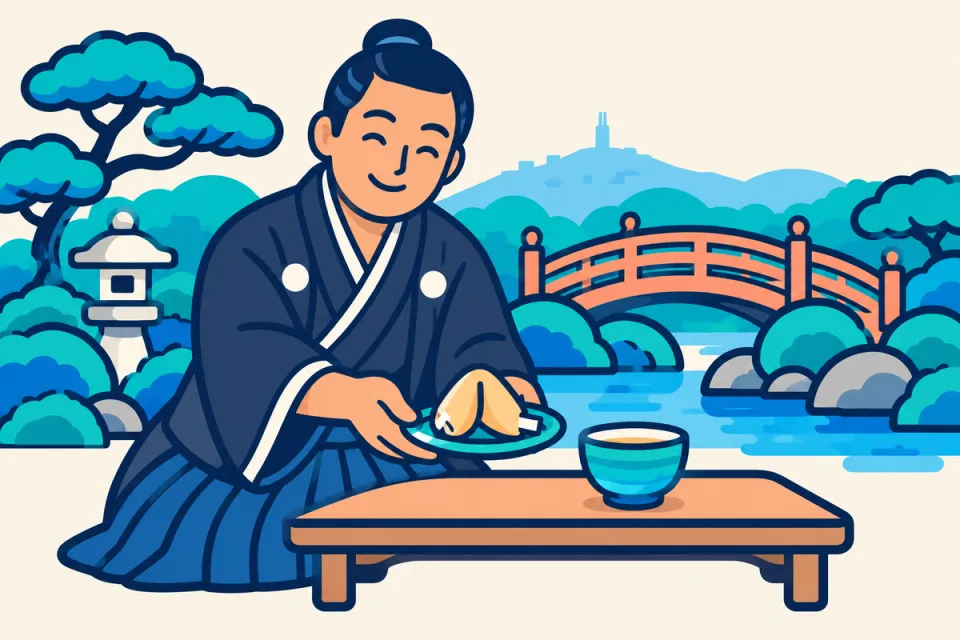
Now jump to San Francisco. A Japanese man named Makoto Hagiwara ran the Japanese Tea Garden in Golden Gate Park. In the early 1900s, he served little fortune cookies with tea. A local bakery made them. People called them fortune tea cakes.
Then came the Second World War. The US government sent about 120,000 Japanese Americans to camps, including Hagiwara’s family. Japanese bakeries stopped making the cookies. Chinese-owned factories filled the gap and made the cookies even more popular in the years after.
Much later, in 1983, a San Francisco court tried to settle who invented it. Los Angeles said a man there did. During the hearing, one cookie was shown as evidence. Its message said: “S.F. Judge who rules for L.A. Not Very Smart Cookie.” The judge chose San Francisco.
So open your next one slowly. It is a Japanese tea cake with an American life.
316 words · about 2 min to read · retell it in about 2 minutes
Next time you crack open a fortune cookie after Chinese food, here’s something to tell the table: it isn’t Chinese. In fact, when an American company tried to sell fortune cookies in China in 1992, it gave up. People there found them too American.
So where do they come from? Japan. As far back as the 1800s, bakers in Kyoto made a folded cookie that looks almost the same. It was a bit bigger and darker, with sesame and miso in the dough, and the paper fortune was tucked into the bend instead of hidden inside. They are still sold today near Kyoto’s famous Fushimi Inari shrine.
The cookie most likely crossed the Pacific with Japanese immigrants. In San Francisco, a man named Makoto Hagiwara ran the Japanese Tea Garden in Golden Gate Park, and in the early 1900s he is said to have been the first in America to serve the modern version, with tea. A bakery in the city made them. Until the war, people called them fortune tea cakes.
And then the war changed everything. About 120,000 Japanese Americans were sent to internment camps, the Hagiwara family among them. Japanese-run cookie factories went silent. Chinese-owned factories filled the gap, and that is one reason a Japanese tea cake became the signature ending of a Chinese meal in America.
The fight over who invented it never really ended. In 1983, San Francisco’s Court of Historical Review heard the case against a Los Angeles noodle maker who claimed he’d invented it in 1918. One cookie was entered as evidence. Its fortune read: “S.F. Judge who rules for L.A. Not Very Smart Cookie.” The judge ruled for San Francisco. Los Angeles condemned the decision.
So the most famous Chinese dessert in America is Japanese, made popular by Chinese Americans, and still seen in China as an American import. Now that is a fortune.
468 words · about 2 min to read · retell it in about 4 minutes
Here is a fact to drop at your next Chinese takeout: the fortune cookie isn’t Chinese. Not even a little. When a big American manufacturer tried to sell fortune cookies in China in 1992, it gave up, because people there considered them too American.
So whose cookie is it? Follow the crumbs back to Japan. As far back as the nineteenth century, bakers in Kyoto made a folded cracker almost identical in shape. It was a little larger and darker, with sesame and miso in the batter, and the paper fortune wasn’t hidden inside; it was wedged into the bend. A Japanese author, Yasuko Nakamachi, even found an illustration from the Edo period showing a vendor making these folded crackers. The old fortunes could be proverbs, jokes, or lines from popular songs. You can still buy them near the Fushimi Inari shrine in Kyoto.
Then the cookie sailed east. In San Francisco, a Japanese immigrant named Makoto Hagiwara designed the Japanese Village for the 1894 Midwinter Exposition in Golden Gate Park, and the garden he tended became the Japanese Tea Garden. In the early 1900s, the story goes, he became the first person in America to serve the modern fortune cookie, with tea. A local bakery, Benkyodo, made them. Hagiwara never patented the recipe, and Chinese American merchants soon opened factories of their own in Chinatown. Until around the Second World War, people called them fortune tea cakes.
The war is usually named as the turning point. The United States forced about 120,000 Japanese Americans into internment camps, and the Hagiwara family was among them. Japanese-run cookie factories stopped. Chinese-owned factories filled the gap. In 1948, one Chinese American family even bought a cookie machine from a Japanese American baker. And slowly, a Japanese tea cake became the last bite of the Chinese American meal.
The argument over who invented it never went away, and in 1983 San Francisco’s Court of Historical Review tried to settle it. Los Angeles had a rival claimant, a noodle company founder who said he had made the first one in 1918. During the proceedings, one cookie was entered into evidence. Its fortune read: “S.F. Judge who rules for L.A. Not Very Smart Cookie.” The judge ruled for San Francisco. Los Angeles condemned the decision.
Hagiwara’s great-great-grandson put it best: “There’s no such thing as a Chinese fortune cookie.” It is, he said, “a Japanese tea cookie.”
About three billion are made every year now, and they can still cause trouble. In 2005, a hundred and ten lottery players won about nineteen million dollars between them, all using the lucky numbers printed on the back of their fortunes. Each one carries a little hidden history: a Japanese recipe, a wartime injustice, and a Chinese American business that kept it alive.
Read it once, close the page, and tell it back. The coach listens for pace, fillers and the facts.
Key facts and sources
Fortune cookies are served in Chinese restaurants but are not Chinese in origin.
“Fortune cookies are often served as a dessert in Chinese restaurants in the United States, Canada, Australia, and other countries, but they are not Chinese in origin.” — Fortune cookie, Wikipedia
In China, fortune cookies are seen as a foreign idea introduced by Americans.
“But in China, fortune cookies are considered a foreign concept--introduced by Americans and shipped across the Pacific.” — Surprise Ancestry of the Fortune Cookie, Los Angeles Times
In the 19th century, a cookie very like the fortune cookie was made in Kyoto.
“As far back as the 19th century, a cookie very similar in appearance to the modern fortune cookie was made in Kyoto, Japan” — Fortune cookie, Wikipedia
In the Japanese version, the paper slip was wedged into the bend of the cookie.
“the small slip of paper was wedged into the bend of the cookie rather than placed inside the hollow portion” — Fortune cookie, Wikipedia
The Japanese cookie, tsujiura senbei, is still sold near Fushimi Inari shrine in Kyoto.
“It is also sold in the neighborhood of Fushimi Inari-taisha shrine in Kyoto.” — Fortune cookie, Wikipedia
Makoto Hagiwara of the Japanese Tea Garden in Golden Gate Park reportedly first served the modern cookie in the US, in the early 1900s.
“Makoto Hagiwara of Golden Gate Park’s Japanese Tea Garden in San Francisco is reported to have been the first person in the U.S. to have served the modern version of the cookie when he did so at the tea garden in the early 1900s.” — Fortune cookie, Wikipedia
The cookies were made by the San Francisco bakery Benkyodo.
“The fortune cookies were made by a San Francisco bakery, Benkyodo.” — Fortune cookie, Wikipedia
Hagiwara designed the Japanese Village at the 1894 Midwinter Exposition in Golden Gate Park.
“designed and tended the Japanese Village, a display of traditional Japanese life at the 1894 Midwinter International Exposition in Golden Gate Park” — Surprise Ancestry of the Fortune Cookie, Los Angeles Times
He served the crackers with tea at the Japanese Tea Garden.
“later serving the crackers that would become best known as “fortune cookies” with tea at the pavilion renamed the Japanese Tea Garden” — Surprise Ancestry of the Fortune Cookie, Los Angeles Times
Hagiwara never patented the recipe.
“Hagiwara never thought to patent the recipe.” — Surprise Ancestry of the Fortune Cookie, Los Angeles Times
Before WWII they were called fortune tea cakes.
“Up to around World War II, fortune cookies were known as “fortune tea cakes”” — Fortune cookie, Wikipedia
During WWII about 120,000 Japanese Americans, including the Hagiwaras, were interned.
“prompting the internment of 120,000 Japanese Americans, including the Hagiwaras” — Surprise Ancestry of the Fortune Cookie, Los Angeles Times
Production at Japanese-run factories halted during the war, and Chinese-owned factories filled the gap.
“Production at Japanese-run factories halted during World War II when many Japanese Americans were forced into internment camps. Chinese-owned factories filled the gap” — From Japan to America, the changing fortunes of fortune cookies, CNN
In 1983 San Francisco’s Court of Historical Review tried to settle the dispute with Los Angeles.
“San Francisco’s Court of Historical Review attempted to settle the dispute in 1983.” — Fortune cookie, Wikipedia
LA’s David Jung claimed he invented the cookie in 1918.
“David Jung, founder of the Hong Kong Noodle Company in Los Angeles, made a competing claim that he invented the cookie in 1918.” — Fortune cookie, Wikipedia
A cookie in evidence read: S.F. Judge who rules for L.A. Not Very Smart Cookie.
“a fortune cookie was introduced as a piece of evidence with a message reading, “S.F. Judge who rules for L.A. Not Very Smart Cookie”” — Fortune cookie, Wikipedia
The court ruled for Hagiwara and San Francisco; Los Angeles condemned the decision.
“determined that the cookie originated with Hagiwara and the court ruled in favor of San Francisco. The city of Los Angeles condemned the decision.” — Fortune cookie, Wikipedia
A company tried selling fortune cookies in China in 1992 but gave up because they were too American.
“Wonton Food attempted to expand its fortune cookie business into China in 1992, but gave up after fortune cookies were considered “too American”.” — Fortune cookie, Wikipedia
Hagiwara’s great-great-grandson said: There’s no such thing as a Chinese fortune cookie. It’s a Japanese tea cookie.
““There’s no such thing as a Chinese fortune cookie,” says Erik Hagiwara-Nagata, the great-great-grandson of the man credited with “inventing” the fortune cookie. “It’s a Japanese tea cookie.”” — Surprise Ancestry of the Fortune Cookie, Los Angeles Times
Japanese author Yasuko Nakamachi found an Edo-period illustration of a vendor making folded senbei almost identical to fortune cookies.
“She also found an illustration from Japan’s Edo period, between 1603 and 1868, showing a vendor making folded senbei — almost identical to modern fortune cookies.” — From Japan to America, the changing fortunes of fortune cookies, CNN
About 3 billion fortune cookies are made each year.
“There are approximately 3 billion fortune cookies made each year globally” — Fortune cookie, Wikipedia
Edo-era fortunes held proverbs, jokes, and song lyrics.
““In the past, they contained short phrases, proverbs, humorous lines, or even snippets of popular song lyrics of the Edo period,”” — From Japan to America, the changing fortunes of fortune cookies, CNN
Chinese-American merchants set up their own factories in Chinatown.
“It wasn’t long before some savvy Chinese-American merchants saw the novelty of the fortune cookies and installed their own factories in Chinatown.” — Surprise Ancestry of the Fortune Cookie, Los Angeles Times
In 1948 the Louie family bought a cookie machine from a Japanese-American baker.
“bought a fortune cookie-making machine from a Japanese-American baker in 1948” — Surprise Ancestry of the Fortune Cookie, Los Angeles Times
The Japanese cookie dough contains sesame and miso.
“their batter contains sesame and miso” — Fortune cookie, Wikipedia
Fortune cookies most likely came from cookies made by Japanese immigrants to the US.
“They most likely originated from cookies made by Japanese immigrants to the United States in the late 19th or early 20th century.” — Fortune cookie, Wikipedia
Hagiwara was a Japanese man who emigrated to California.
“Makoto Hagiwara, a Japanese lord who emigrated to California” — Surprise Ancestry of the Fortune Cookie, Los Angeles Times
In 2005, 110 Powerball players won about $19 million using lucky numbers from fortunes.
“after 110 Powerball lottery players won about $19 million after using the “lucky numbers” on the back of fortunes” — Fortune cookie, Wikipedia
The Japanese cookie was larger and made of darker dough.
“they are a little bit larger; are made of darker dough; and their batter contains sesame and miso” — Fortune cookie, Wikipedia
Sources consulted for this story: Fortune cookie (Wikipedia, accessed 2026-10-25); Surprise Ancestry of the Fortune Cookie (Los Angeles Times, accessed 2026-10-25); From Japan to America, the changing fortunes of fortune cookies (CNN, accessed 2026-10-25). Every story is checked against its sources before it is published — how we verify stories.
Why this story is worth telling
An everyday dessert hides a cross-cultural story of immigration, injustice and a very silly court case.