The Scholar Who Pretended to Be Mad

The Scholar Who Pretended to Be Mad
c. 1010–1021Cairo, EgyptScience & discovery
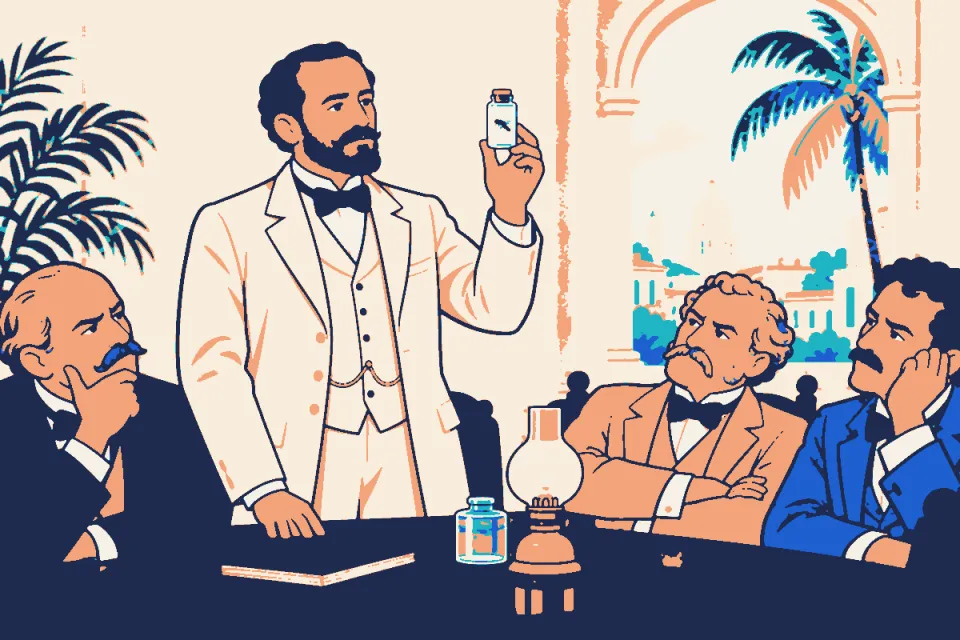
A thousand years ago, legend says, a scientist faked madness to escape a cruel caliph, and used his house arrest to explain how we see.
Reading level
The same true story, told at three lengths. Pick one to read, close your eyes, and tell it back in your own words.
218 words · about 1 min to read · retell it in about 2 minutes
About a thousand years ago, a scholar from Basra became famous for his knowledge of mathematics. His name was Ibn al-Haytham. The ruler of Egypt, Caliph al-Hakim, invited him to regulate the floods of the Nile, and Ibn al-Haytham planned a dam.
This was a dangerous man to disappoint. Al-Hakim once ordered all the dogs to be killed. He had killed his own ministers on a whim.
Ibn al-Haytham travelled along the Nile and studied a place for a dam, south of Aswan. Slowly he understood the truth. His plan could not work. And he was afraid for his life.
So, the story goes, he pretended to be mad. It worked. Nobody killed him. But he lost his books and his things, and he was locked in his house for about ten years.
What do you do, shut in your house for about ten years? He studied light. The story goes that he wrote a Book of Optics in seven volumes. In it he explained that we see because light bounces off things and travels into our eyes. Famous thinkers before him, like Euclid and Ptolemy, believed the opposite. They thought our eyes sent out rays.
Al-Hakim died in 1021, and Ibn al-Haytham was free again. His book shaped science for centuries. Sometimes a prison becomes a laboratory.
304 words · about 2 min to read · retell it in about 2 minutes
About a thousand years ago, a scholar from Basra had a reputation that travelled across Iraq, Syria and Egypt. Ibn al-Haytham was brilliant at mathematics and physics, and he planned to control the floods of the Nile with a dam. The caliph of Egypt, al-Hakim, had invited him to do it.
Now, al-Hakim was not an easy boss. He banned certain foods. He ordered people to work at night and rest by day. He had all the dogs killed. And he had killed his own tutors and ministers on a whim.
Ibn al-Haytham set off along the Nile to plan a great dam south of Aswan. And out there, looking at the river, he realized his plan was impractical. Picture that moment. A dangerous ruler is counting on you to tame the Nile, and you have just discovered you cannot deliver it.
So, according to the old accounts, he faked madness. The trick saved his life, but it cost him nearly everything. He was stripped of his books and possessions and kept under house arrest for about ten years.
He did not waste them. In that time, the story goes, he wrote his Book of Optics, seven volumes long. He showed by experiment that light travels in straight lines. And he argued that we see because light reflects off objects and enters our eyes. That sounds obvious today, but Euclid and Ptolemy had taught that our eyes send out rays.
In 1021 al-Hakim died. Ibn al-Haytham got his possessions back and lived near the Azhar Mosque in Cairo, teaching and earning money by copying books.
Nearly two centuries later his Book of Optics was translated into Latin, and it influenced European thinkers all the way to Johannes Kepler. A man who pretended to lose his mind ended up changing how the world understood seeing.
475 words · about 2 min to read · retell it in about 4 minutes
What do you do when you have taken on a job you cannot finish, for a man who kills people on a whim?
That was the position of Ibn al-Haytham, a scholar born in Basra around the year 965. His knowledge of mathematics and physics was talked about in Iraq, Syria and Egypt, and he had a plan to dam the Nile. The Fatimid caliph of Egypt, al-Hakim, invited him to come and try.
Al-Hakim was one of history’s more frightening employers. He banned certain foods, ordered people to work through the night and rest by day, and had every dog killed. He had also killed his own tutors and ministers whenever the mood took him.
Ibn al-Haytham travelled along the river to plan a dam south of Aswan. And there, on the river itself, the engineer in him had to admit the truth: the scheme was impractical. He had failed, and he knew exactly what failure might cost.
Here the sources disagree on details, and historians warn that the stories of his life are often contradictory. But the best-known version is unforgettable. To escape the caliph’s anger, Ibn al-Haytham faked insanity. It worked, up to a point. He was stripped of his books and possessions and kept under house arrest for about ten years, until al-Hakim died in 1021.
Most of us would have spent those years staring at the walls. According to legend, he spent them writing the Book of Optics, a work in seven volumes. In his studies of light he showed by experiment that light travels in straight lines. He used a darkened room with a small opening, a camera obscura, to study a partial eclipse of the sun. And he settled an ancient argument. Euclid and Ptolemy had taught that we see because our eyes shoot out rays. Ibn al-Haytham showed the opposite: light reflects off an object and travels into the eye.
What makes him feel modern is his attitude. He wrote that anyone who studies the works of scientists, if truth is the goal, must make himself an enemy of all that he reads. And then he added the hard part: he should suspect himself too. Because he insisted that ideas be tested by experiment, he is sometimes described as the world’s first true scientist.
When al-Hakim died, the confiscated possessions came back. Ibn al-Haytham lived quietly near the Azhar Mosque in Cairo, teaching, writing and earning a living by copying texts, until his death in 1040.
His book did not stay in Cairo. It was translated into Latin around the year 1200 and influenced European thinkers from Roger Bacon to Johannes Kepler. So the next time someone tells you a setback has ruined their plans, you can tell them about the man who pretended to lose his mind, and used the time to explain how we see.
Read it once, close the page, and tell it back. The coach listens for pace, fillers and the facts.
Key facts and sources
Ibn al-Haytham was born around 965 in Basra.
“was born c. 965 to a family of Arab or Persian origin in Basra, Iraq” — Ibn al-Haytham, Wikipedia
Caliph al-Hakim of Egypt invited him to help regulate the flow of the Nile.
“He was invited by Al-Hakim bi-Amr Allah, the Fatimid Caliph of Egypt to help in regulating the flow of the Nile during the floods.” — Ibn Al-Haytham: Father of Modern Optics, Oman Journal of Ophthalmology (PubMed Central)
Al-Hakim issued arbitrary edicts, including banning certain foods, killing all the dogs and forcing people to work at night.
“prohibiting the consumption of certain foods, preventing women from leaving their homes, killing all the dogs, and forcing people to work during the night and rest by day” — Ibn Al-Haytham: Father of Modern Optics, Oman Journal of Ophthalmology (PubMed Central)
Al-Hakim was brutal and had killed his tutors and ministers on a whim.
“He was quite brutal and had killed his tutors and ministers on a whim.” — Ibn Al-Haytham: Father of Modern Optics, Oman Journal of Ophthalmology (PubMed Central)
On field work along the Nile he realized his plan for a dam south of Aswan was impractical and feared for his life.
“When Ibn al-Haytham realized on his field work along the Nile that his scheme to regulate the Nile’s water flow by building a dam south of Aswan was impractical, he feared for his life.” — Ibn Al-Haytham: Father of Modern Optics, Oman Journal of Ophthalmology (PubMed Central)
He faked insanity to avoid the caliph’s anger.
“To avoid the potential of the deadly wrath and anger of his temperamental and mentally unstable patron, he faked insanity.” — Ibn Al-Haytham: Father of Modern Optics, Oman Journal of Ophthalmology (PubMed Central)
He was stripped of his possessions and books and kept under house arrest for about 10 years until al-Hakim died in 1021.
“He was stripped of his possessions and books, and was kept under house arrest for about 10 years until the time of Al-Hakim’s death in 1021” — Ibn Al-Haytham: Father of Modern Optics, Oman Journal of Ophthalmology (PubMed Central)
According to legend he feigned madness, was kept under house arrest, and wrote the Book of Optics during that time.
“Legend has it that Alhazen feigned madness and was kept under house arrest during this period. During this time, he wrote his influential Book of Optics.” — Ibn al-Haytham, Wikipedia
The Book of Optics is a seven-volume treatise written from 1011 to 1021.
“Alhazen’s most famous work is his seven-volume treatise on optics Kitab al-Manazir (Book of Optics), written from 1011 to 1021.” — Ibn al-Haytham, Wikipedia
He was the first to explain that vision happens when light reflects from an object and passes into the eyes.
“Ibn al-Haytham was the first to explain that vision occurs when light reflects from an object and then passes to one’s eyes” — Ibn al-Haytham, Wikipedia
He contradicted Ptolemy’s and Euclid’s theory that we see by rays coming out of the eyes.
“he contradicted Ptolemy’s and Euclid’s theory of vision that objects are seen by rays of light emanating from the eyes” — Ibn Al-Haytham: Father of Modern Optics, Oman Journal of Ophthalmology (PubMed Central)
He showed by experiment that light travels in straight lines.
“Alhazen showed through experiment that light travels in straight lines” — Ibn al-Haytham, Wikipedia
After the caliph’s death his confiscated possessions were returned to him.
“after which his confiscated possessions were returned to him” — Ibn al-Haytham, Wikipedia
Afterwards he lived near the Azhar Mosque in Cairo, teaching, writing and earning money by copying texts.
“he lived in a domed building (Qubbah) close to the Azhar Mosque in Cairo, teaching mathematics and physics, writing science texts, and making money by copying texts.” — Ibn Al-Haytham: Father of Modern Optics, Oman Journal of Ophthalmology (PubMed Central)
The Book of Optics was translated into Latin around the end of the 12th or start of the 13th century.
“Optics was translated into Latin by an unknown scholar at the end of the 12th century or the beginning of the 13th century.” — Ibn al-Haytham, Wikipedia
His optical writings influenced Western thinkers including Roger Bacon and Johannes Kepler.
“His optical writings influenced many Western intellectuals such as Roger Bacon, John Pecham, Witelo, and Johannes Kepler.” — Ibn Al-Haytham: Father of Modern Optics, Oman Journal of Ophthalmology (PubMed Central)
He wrote that a seeker of truth should make himself an enemy of all that he reads.
“is to make himself an enemy of all that he reads” — Ibn al-Haytham, Wikipedia
He wrote that the investigator should also suspect himself.
“He should also suspect himself as he performs his critical examination of it” — Ibn al-Haytham, Wikipedia
He is sometimes described as the world’s first true scientist.
“he is sometimes described as the world’s “first true scientist”” — Ibn al-Haytham, Wikipedia
Stories about his life are often contradictory depending on the historian.
“The stories related to his life are often contradictory, depending on the historian relating them.” — Ibn Al-Haytham: Father of Modern Optics, Oman Journal of Ophthalmology (PubMed Central)
He died in Cairo in 1040.
“died in Cairo, Egypt in the year 1040” — Ibn Al-Haytham: Father of Modern Optics, Oman Journal of Ophthalmology (PubMed Central)
His knowledge of mathematics and physics was famous in Iraq, Syria and Egypt.
“His knowledge in mathematics and physics became legendary and he was well known in Iraq, Syria and Egypt.” — Ibn Al-Haytham: Father of Modern Optics, Oman Journal of Ophthalmology (PubMed Central)
He used a camera obscura to observe a partial solar eclipse.
“Ibn al-Haytham used a camera obscura mainly to observe a partial solar eclipse.” — Ibn al-Haytham, Wikipedia
Sources consulted for this story: Ibn al-Haytham (Wikipedia, accessed 2026-10-25); Ibn Al-Haytham: Father of Modern Optics (Oman Journal of Ophthalmology (PubMed Central), accessed 2026-10-25). Every story is checked against its sources before it is published — how we verify stories.
Why this story is worth telling
A terrifying failure turned into roughly ten years of confinement that, by the best-known account, changed science.