
The Man Who Could Only Say Tan
The Man Who Could Only Say Tan
1861Paris, FranceMind & behavior
A Paris patient could say only one word, “tan” — and that syllable showed science where language lives in the brain.
Reading level
The same true story, told at three lengths. Pick one to read, close your eyes, and tell it back in your own words.
219 words · about 1 min to read · retell it in about 2 minutes
In a big hospital near Paris, in the 1800s, there lived a patient called Tan. That was not his name. It was the only word he could say. For about twenty years he could speak nothing else. “Tan.”
Here is the strange part. Tan understood everything. He just could not turn his thoughts into words.
In 1861, a well-known doctor named Paul Broca met him. Broca was curious about him, and watched. Tan was already very sick, and within a week he died. Broca opened his body and looked at his brain. On the left side, in the front, he found a damaged spot.
Broca showed the brain to others and said: this spot is where speech lives. Many did not believe him. Then he found more patients like Tan, with damage in the same place, and the doubters went quiet. That spot is still called Broca’s area today.
And Tan? His real name was Louis Victor Leborgne. He was one of seven children. His father was a teacher. He had seizures since childhood, but he still worked with his hands, as a craftsman, until he lost his speech at thirty. A historian shared this discovery only in 2013, more than 150 years later.
Tan said one word for twenty years. That word taught us where words come from.
324 words · about 2 min to read · retell it in about 2 minutes
In the Bicêtre Hospital outside Paris there was a patient the staff simply called Tan. That was not his name. It was the only syllable he could produce, and he had been saying nothing but “tan” for about twenty years. Two astonishing things about him: first, he understood everything said to him. Second, nobody knew who he was.
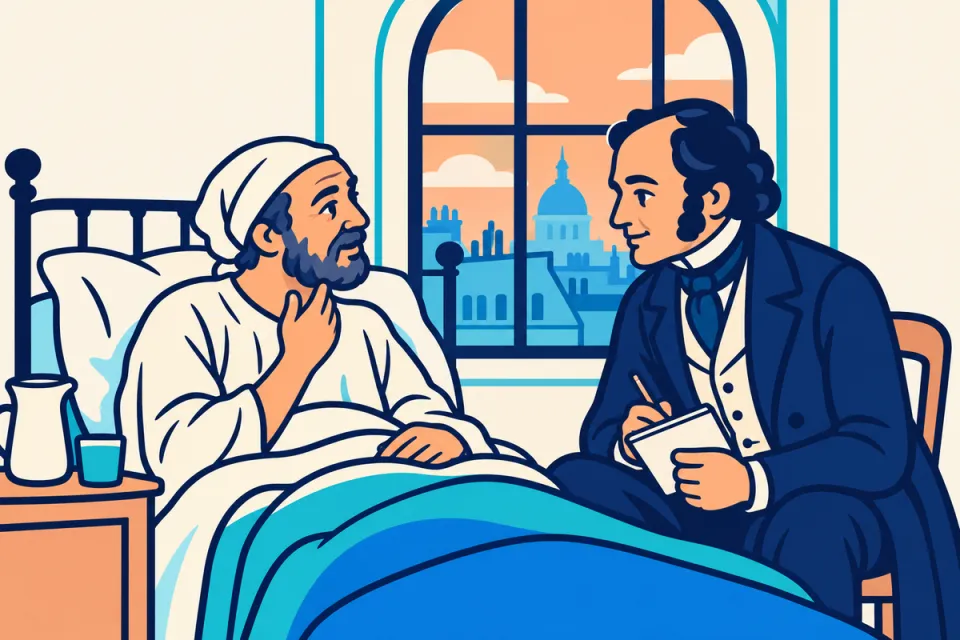
In April 1861, the surgeon and researcher Paul Broca was asked to see him. Tan had lost the use of his right side, and the leg had turned gangrenous. Broca studied the strange patient. Tan could produce only his one word, but he clearly understood.
He died within days. Broca performed the autopsy promptly, and there it was: a damaged patch on the third fold of the brain’s left frontal lobe.
Now remember what people believed in 1861. At the time, most physicians rejected the idea that one patch of brain could hold one power; it smelled of phrenology, the discredited practice of reading character from the shape of the skull. When Broca presented his case and said this area governs speech, most doctors refused to believe him.
Then he found another patient, an 84-year-old called Lelong, who could say only five words: yes, no, three, always, and his own name. Same damage, same spot. Within two years Broca had collected more cases, and the argument was over. The area is still known as Broca’s area.
But one mystery remained. Who was Tan? Most historians pictured a poor, illiterate laborer; others guessed his silence came from madness. Only in 2013 did the Polish historian Cezary Domanski publish what he had found: Tan’s death certificate. Louis Victor Leborgne, born in 1809 in Moret, France, one of seven children of a schoolteacher, a craftsman and church keeper until he lost his speech at thirty, likely because of epilepsy. For 150 years, what has been called the most famous brain in neuroscience belonged to a man nobody could identify.
481 words · about 2 min to read · retell it in about 4 minutes
Consider what it means to have something to say for twenty-one years and only one syllable to say it with. In the Bicêtre Hospital outside Paris, there lived such a man. The staff called him Tan, because “tan” was all he could utter. He was not mute, and he was not simple. He understood what people said to him. He just could not answer. Nobody knew his history; he had been admitted in 1840 and essentially parked there, slowly deteriorating.
In April 1861 he landed in the ward of Paul Broca, a surgeon and scientist, because his right side had grown paralyzed and the leg gangrenous. Broca was intrigued for a precise reason: the man’s mouth and tongue seemed to work fine. The problem had to be upstream, in the brain. Broca examined him, saw that he understood but could produce only his one syllable, and waited. Tan died within the week, and Broca promptly opened the skull. There, on the third fold of the left frontal lobe, was a lesion.
Broca presented the case to the anatomical society and made a claim that was almost scandalous: this patch of tissue is where spoken language lives. The science of the day disliked that idea. Most physicians rejected it, because localization sounded like phrenology, the now-discredited practice of reading character from the shape of the skull. What answered the doubt was not argument but autopsy. An elderly patient named Lelong, who managed five words, yes, no, three, always, and his own name, turned out to have damage in the same spot. Over the next two years Broca accumulated case after case. The doubters went quiet, and the region has carried his name ever since: Broca’s area.
Then the story disappears into an archive for a century and a half. Tan’s brain sat in a museum in Paris, famous and anonymous at once; scientists of a later age even re-scanned it and found the damage reached deeper than Broca could have seen. Most historians assumed the man had been a poor, illiterate laborer; others said syphilis had driven him mad, and that the madness had struck him silent.
In a study published in 2013, the Polish medical historian Cezary Domanski reported that, digging through old medical records, he had found the death certificate. The man with the famous brain was Louis Victor Leborgne, born in 1809 in Moret, France, one of seven children of a schoolteacher. He had suffered epilepsy since childhood and still grown up to work as a craftsman and a church keeper, until at thirty he lost his speech; epilepsy is thought to have caused the damage.
For 150 years, one of the most important people in the history of medicine was a nameless syllable. He was a person with a childhood, a trade and a family. The spot came to bear Broca’s name. Domanski gave the man his back.
Read it once, close the page, and tell it back. The coach listens for pace, fillers and the facts.
Key facts and sources
Broca’s 1861 patient Louis Victor Leborgne had a 21-year progressive loss of speech, was paralyzed, and retained comprehension and mental function.
“In 1861, Broca visited a patient in the Bicêtre Hospital named Louis Victor Leborgne, who had a 21-year progressive loss of speech and paralysis but not a loss of comprehension nor mental function.” — Paul Broca, Wikipedia
He was nicknamed Tan because he could not clearly say any word other than “tan”.
“He was nicknamed “Tan” due to his inability to clearly speak any words other than “tan”” — Paul Broca, Wikipedia
A wordless patient was admitted to the Bicêtre Hospital outside Paris in 1840 for aphasia and was essentially just kept there.
“In 1840, a wordless patient was admitted to the Bicêtre Hospital outside Paris for aphasia, or an inability to speak. He was essentially just kept there, slowly deteriorating.” — Scientists knew his brain — now they know his name, NBC News / LiveScience
Broca first saw the patient on April 12, 1861, when he was 51 and had been hospitalized for about 20 years; he was transferred to Broca’s ward with paralysis and gangrene in his right leg.
“he was 51 years old, and had been hospitalized for 20 years, after he lost his ability to speak. He was transferred to Broca’s surgical ward because he had gradually become paralyzed on his right side and now exhibited symptoms of gangrene in his paralyzed right leg.” — Scientist of the Day - Paul Broca, Linda Hall Library
Broca was intrigued because the man’s mouth and tongue appeared to work normally, implying the problem was in the brain.
“Broca was intrigued by Laborgne’s inability to speak, because it appeared his mouth and tongue had normal function, and thus the problem was one of loss of control, which meant a disruption in the brain.” — Scientist of the Day - Paul Broca, Linda Hall Library
The patient died within a week; Broca’s autopsy found a lesion on the third convolution of the left frontal lobe.
“When Laborgne died within a week, Broca did an immediate autopsy, and found that the patient had a lesion on one of the left frontal lobes of his brain, specifically on the “third convolution” of the left frontal lobe” — Scientist of the Day - Paul Broca, Linda Hall Library
Lazare Lelong, an 84-year-old grounds worker, could say only five simple words, and his autopsy showed a lesion in much the same area.
“Lazare Lelong was an 84-year-old grounds worker who was being treated at Bicêtre for dementia. He had also lost the ability to speak other than five simple, meaningful words” — Paul Broca, Wikipedia
Broca’s area is important for speech production.
“the area of the brain important for speech production” — Paul Broca, Wikipedia
The brain region controlling speech was later renamed Broca’s area in his honor.
“That region of the brain was later renamed Broca’s area in honor of the doctor.” — Scientists knew his brain — now they know his name, NBC News / LiveScience
Domanski uncovered a death certificate for Louis Victor Leborgne, born in 1809 in Moret, France.
“he finally uncovered a death certificate for Louis Victor Leborgne, who was born in 1809 in Moret, France.” — Scientists knew his brain — now they know his name, NBC News / LiveScience
Louis Leborgne was one of seven children of a teacher, with educated siblings.
“Louis Leborgne was one of seven children of a teacher (his father) and his wife, and that his siblings were educated.” — Scientists knew his brain — now they know his name, NBC News / LiveScience
Despite epilepsy from childhood, Leborgne grew up to be a craftsman and church keeper until he lost speech at 30.
“But despite his seizures, he grew up to be a craftsman and a church keeper, and worked there until he was 30 years old, when he lost the ability to speak and was taken to the hospital.” — Scientists knew his brain — now they know his name, NBC News / LiveScience
The 2013 finding identified the famous patient as Louis Leborgne, a French craftsman who battled epilepsy his entire life.
“identifies the famous patient as Monsieur Louis Leborgne, a French craftsman who battled epilepsy his entire life.” — Scientists knew his brain — now they know his name, NBC News / LiveScience
One day after Tan’s death Broca presented his findings to the anthropological society.
“One day after Tan’s death Broca presented his findings to the anthropological society.” — Paul Broca, Wikipedia
Many physicians opposed localization because it was associated with phrenology.
“belief in the localization of cerebral functions was a key element of the now-discredited science of phrenology” — Scientist of the Day - Paul Broca, Linda Hall Library
Most historians believed Tan was a poor, illiterate laborer, while others blamed madness from syphilis.
“Most historians believed he was a poor, illiterate laborer, while others said he had gone mad from syphilis and that madness could explain his inability to speak.” — Scientists knew his brain — now they know his name, NBC News / LiveScience
Over 100 years later Nina Dronkers re-examined the preserved brains with MRI and found damage beyond what Broca saw.
“Over 100 years later Nina Dronkers, an American cognitive neuroscientist, obtained permission to re-examine these brains using modern MRI technology.” — Paul Broca, Wikipedia
Domanski said for 150 years no one could determine the name of the man whose brain is exhibited in a museum.
“for 150 years no one could even determine the name of the man —the same man whose brain is exhibited in a museum and shown in many books” — Scientists knew his brain — now they know his name, NBC News / LiveScience
Over the next two years Broca accumulated more aphemia cases.
“over the next two years, Broca accumulated 8 cases of what he called aphémie” — Scientist of the Day - Paul Broca, Linda Hall Library
Broca played a major role in resolving the localization of function debate with Leborgne and twelve more cases.
“by resolving the issue scientifically with Leborgne and his 12 cases thereafter” — Paul Broca, Wikipedia
The brain was preserved for 150 years in the Musée Dupuytren in Paris and has been called the most famous brain in the history of the neurosciences.
“It has been called the most famous brain in the history of the neurosciences” — Scientist of the Day - Paul Broca, Linda Hall Library
Broca concluded the region controlled speech, and epilepsy likely caused the damage.
“Epilepsy likely caused the damage that took away Leborgne’s power of speech.” — Scientists knew his brain — now they know his name, NBC News / LiveScience
At the time, language was viewed in Europe as a God-given ability, part of the soul.
“it was viewed at that time in Europe as a God-given ability in humans, it was considered part of the soul and therefore not material” — Scientists knew his brain — now they know his name, NBC News / LiveScience
Broca presented his findings to the Society of Anatomy the next day.
“Broca gave a presentation to the Society of Anatomy the next day” — Scientist of the Day - Paul Broca, Linda Hall Library
Most physicians opposed localization because it was associated with phrenology.
“Most physicians opposed the idea, primarily because belief in the localization of cerebral functions was a key element of the now-discredited science of phrenology” — Scientist of the Day - Paul Broca, Linda Hall Library
Sources consulted for this story: Paul Broca (Wikipedia, accessed 2026-10-25); Scientists knew his brain — now they know his name (NBC News / LiveScience, accessed 2026-10-25); Scientist of the Day - Paul Broca (Linda Hall Library, accessed 2026-10-25); Glimpsed at last – the life of neuropsychology's most important patient (BPS Research Digest, accessed 2026-10-25). Every story is checked against its sources before it is published — how we verify stories.
Why this story is worth telling
What has been called the most famous brain in neuroscience belonged to a man with no known identity for 150 years.