Tamam Shud: The Man With No Name
Tamam Shud: The Man With No Name
1948–2022Adelaide, AustraliaMysteries & oddities
A well-dressed man died on an Australian beach in 1948 with a scrap of paper reading ‘it is finished’. DNA hinted at a name 73 years on.
Reading level
The same true story, told at three lengths. Pick one to read, close your eyes, and tell it back in your own words.
205 words · about 1 min to read · retell it in about 2 minutes
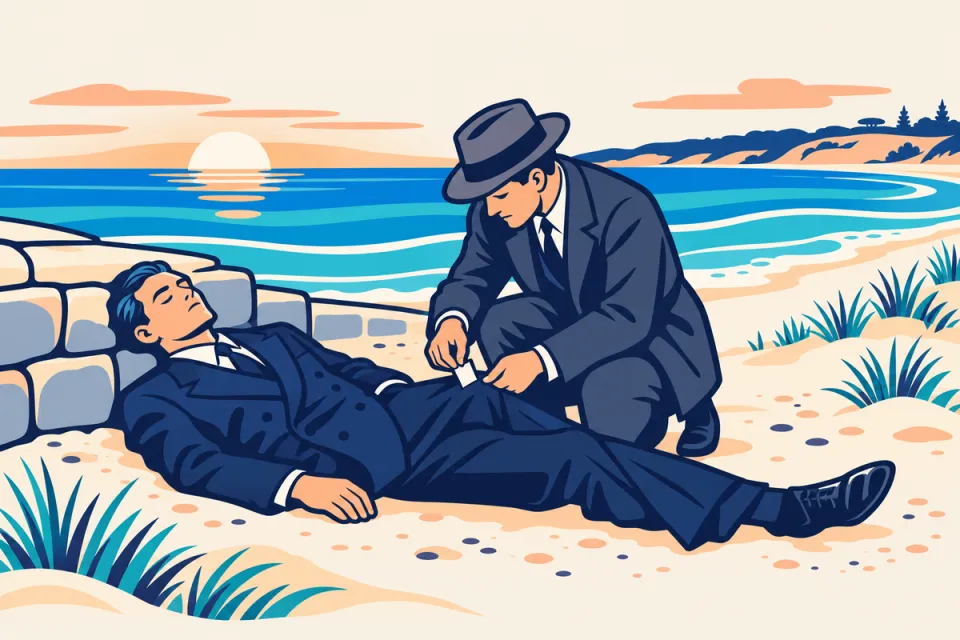
In December 1948, on a beach in Adelaide, Australia, people found the body of a man. He was dressed in a brown suit. Every label had been cut out of his clothes. He had no name, no wallet and no papers.
The doctors thought he had been poisoned. But they could not find any poison, and nobody ever came to ask about him.
Then things got stranger. A small piece of paper was found hidden in a tiny pocket inside his trousers. On it were two words: Tamam Shud. They mean “It is finished” in Persian. The paper had been torn from a book of old poems.
When the book was found, there was writing inside the cover. It looked like a secret code. Nobody has ever convincingly read it. One phone number in the book belonged to a young nurse who lived near the beach. She said she did not know him.
For seventy-three years, nobody knew his name. Then scientists read DNA from his hair, kept in a plaster death mask. They said he was Carl Webb, an engineer from Melbourne who loved poetry. After all those years, a few hairs may have solved it, but the police have not confirmed it yet.
372 words · about 2 min to read · retell it in about 3 minutes
On the morning of 1 December 1948, on Somerton Beach in Adelaide, Australia, passers-by found a man lying against a sea wall, dead. He was about forty, in good shape and wearing a smart suit. Every label had been cut from his clothes. There was no wallet, no identification, and nobody ever reported him missing.
The autopsy pointed to poison, but tests found none, and the coroner did not rule out murder. Then the clues turned strange. In a suitcase left at the railway station, believed to be his, some clothes carried the name Keane, but no T. Keane was missing anywhere in the English-speaking world. Later, a tiny rolled paper was found hidden deep in a fob pocket of his trousers. It read Tamam Shud, “It is finished”, torn from the last page of the Rubaiyat of Omar Khayyam, a book of Persian poems about living fully and ending without regrets.
After a public appeal, a man handed in the book itself; he said it had been thrown into the back of his car around the time of the death. On its back cover were a phone number and faint indentations that looked like a secret code. The code has never been convincingly read. The phone number belonged to a young nurse, Jessie Thomson, who lived a short walk from the beach. She denied knowing him. Years later her daughter said her mother had known who the man was, but would never tell. The case became one of Australia’s most profound mysteries, and the theories ran wild: spies, Russians, Americans.
In 2021, police dug up his grave for DNA. In July 2022, a researcher named Derek Abbott and genealogist Colleen Fitzpatrick announced an answer. DNA from hairs stuck in his plaster death mask led through a family tree of thousands of people to one name: Carl “Charles” Webb, a forty-three-year-old electrical engineer from Melbourne who loved poetry. He had split from his wife, who had moved to South Australia, and Abbott suggested he may have come looking for her. Even the name Keane fits: it was his sister’s married name.
Police have not yet confirmed the identification. But after seventy-three years, the man with no name may finally have one back.
575 words · about 3 min to read · retell it in about 4 minutes
Some mysteries are famous because they were never solved. The Somerton Man was one of them for seventy-three years, until he very nearly was.
On the morning of 1 December 1948, on Somerton Beach in Adelaide, people found a man dead against a sea wall, legs stretched out, head resting against it. He was about forty and in top physical condition, dressed in a smart double-breasted jacket. Every label had been removed from his clothes. No wallet, no identification, and every name people put forward for him turned out to be wrong. Passers-by had seen a man in that spot the night before and assumed he was drunk or asleep. The autopsy suggested poison; the tests found none, and the coroner prepared to find that the man had been poisoned, possibly by another hand. A suitcase turned up at the railway station in January, its label removed, its clothes tagged, in places, with the name Keane. No Keane was missing anywhere in the English-speaking world.
Then came the detail that made the case immortal. Later, a tiny rolled scrap of paper was found hidden deep in a fob pocket of the dead man’s trousers. It read Tamam Shud, Persian for “It is finished”, torn from the final page of the Rubaiyat of Omar Khayyam, a book whose theme is living fully and ending without regrets. After a public appeal, a man handed in the book, saying he had found it in the back of his car around the time of the death. Inside its back cover were a local phone number and faint indentations resembling a code, which has never been convincingly deciphered. The number belonged to a young nurse, Jessie Thomson, who lived just hundreds of meters from the beach. She denied knowing him. Decades later, her daughter said her mother had known who the man was but would not say. A taxidermist who was there when she was shown the plaster death mask said it was obvious she knew the man.
The theories ran wild. One documentary maker recalled the era of guesswork: “We had all these grandiose ideas about him being Russian, American and European.” The case was called one of Australia’s most profound mysteries, and the code fed cold-war spy fantasies.
The end came from a plaster bust. In 2021 police exhumed the body, and in July 2022 Derek Abbott of the University of Adelaide and the genealogist Colleen Fitzpatrick announced that DNA from hairs stuck in the death mask, read through a family tree of about four thousand people, pointed to one name: Carl “Charles” Webb, a forty-three-year-old electrical engineer and instrument maker from Melbourne. According to his wife, Webb loved poetry and wrote bleak verses of his own. He had separated from his wife, who had moved to South Australia, so possibly, Abbott said, he had come to track her down. Even the Keane tags may make sense now: Freda Keane was Webb’s sister. The researchers believe the deaths of four close relatives in seven years sent him into a spiral, and that the autopsy suggests he poisoned himself. Abbott said he was 99.9 percent confident. The police have not verified the result, and the coroner has yet to confirm it.
So perhaps the case is closed, and perhaps not quite. But one thing is clear: the clue that pointed to his name was on his head all along, pressed into plaster, waiting for science to catch up.
Read it once, close the page, and tell it back. The coach listens for pace, fillers and the facts.
Key facts and sources
On 1 December 1948 the body of a man was found on Somerton Park beach, a suburb of Adelaide.
“The Somerton Man is an unidentified man whose body was found on 1 December 1948 on the beach at Somerton Park, a suburb of Adelaide, South Australia” — Somerton Man, Wikipedia
He looked about 40 and was in top physical condition.
“the man was of “Britisher” appearance and thought to be aged about 40–45; he was in “top physical condition”” — Somerton Man, Wikipedia
Every label had been cut from his clothes, and he carried no identification or wallet.
“All labels on his clothes had been removed, and he had no hat (unusual for 1948) or wallet. He was clean-shaven and carried no identification” — Somerton Man, Wikipedia
Witnesses had seen a man in the same spot on the evening of 30 November.
“Witnesses who came forward said that on the evening of 30 November they had seen an individual resembling the dead man lying on his back in the same spot where the corpse was later found.” — Somerton Man, Wikipedia
They assumed he was drunk or asleep.
“they had thought it most likely that he was drunk or asleep, and thus did not investigate further.” — Somerton Man, Wikipedia
The autopsy suggested poison, but tests found no foreign substance in the body.
“tests failed to reveal any foreign substance in the body. The pathologist, John Dwyer, concluded: “I am quite convinced the death could not have been natural ... the poison I suggested was a barbiturate or a soluble hypnotic”” — Somerton Man, Wikipedia
The coroner said he was prepared to find that the man died of poison that was not accidentally administered.
“I would be prepared to find that he died from poison, that the poison was probably a glucoside and that it was not accidentally administered; but I cannot say whether it was administered by the deceased himself or by some other person.” — Somerton Man, Wikipedia
The doctor who did the autopsy believed he died of heart failure due to poisoning, and the coroner did not rule out murder.
“The doctor who carried out the autopsy at the time of the discovery believed the man had died from heart failure due to poisoning, and the coroner didn’t rule out murder.” — Mystery of Somerton man's identity solved after 73 years, researchers in Australia say, The Guardian
In January 1949 a suitcase with its label removed was found at Adelaide railway station.
“On 14 January 1949, staff at the Adelaide railway station discovered a brown suitcase with its label removed” — Somerton Man, Wikipedia
Some clothes in the suitcase carried the name Keane.
“police found the name “T. Keane” on a tie, “Keane” on a laundry bag and “Kean” on a singlet” — Somerton Man, Wikipedia
No missing person named T. Keane was found in any English-speaking country.
“A search concluded that no T. Keane was missing in any English-speaking country.” — Somerton Man, Wikipedia
A rolled scrap of paper reading Tamam Shud was found sewn into a fob pocket of his trousers.
“a tiny piece of rolled-up paper with the words “Tamám Shud” printed on it was found in a fob pocket sewn within the dead man’s trouser pocket” — Somerton Man, Wikipedia
The phrase means ‘ended’ or ‘finished’, from the last page of the Rubaiyat of Omar Khayyam.
“Public library officials called in to translate the text identified it as a phrase meaning “ended” or “finished” found on the last page of Rubaiyat of Omar Khayyam.” — Somerton Man, Wikipedia
After a public appeal the book itself was found in the back of a car.
“A copy of The Rubaiyat with the page containing “Tamam Shud” torn out is handed in to the police on July 22, 1949, by a man who says he found it in the back of his car” — The Somerton Man has been named. What do we know about Carl 'Charles' Webb?, ABC News (Australia)
On the back cover were a phone number, another number and writing that looked like a code.
“On the inside back cover, detectives could read indentations left from previous handwriting: a local telephone number, another unidentified number, and text that resembled a coded message.” — Somerton Man, Wikipedia
The code has not been deciphered in a way that satisfies authorities.
“The text has not been deciphered or interpreted in a way that satisfies authorities on the case.” — Somerton Man, Wikipedia
One phone number belonged to a young nurse, Jessie Thomson, who lived just hundreds of meters from the beach.
“One of the telephone numbers belongs to a nurse called Jessie Thomson, who lives just hundreds of metres from where the body was found.” — The Somerton Man has been named. What do we know about Carl 'Charles' Webb?, ABC News (Australia)
When police interviewed her, she denied knowing the man.
“In July 1949, police interview Jessie Thomson but she denies knowing the Somerton Man.” — The Somerton Man has been named. What do we know about Carl 'Charles' Webb?, ABC News (Australia)
The case has been called one of Australia’s most profound mysteries.
“the case has been considered “one of Australia’s most profound mysteries”” — Somerton Man, Wikipedia
People had grand theories that he was Russian, American or European.
““We had all these grandiose ideas about him being Russian, American and European.”” — Mystery of Somerton man's identity solved after 73 years, researchers in Australia say, The Guardian
Theories about the case included cold-war spies.
“leaving room for theories featuring jilted lovers and cold war spies” — Mystery of Somerton man's identity solved after 73 years, researchers in Australia say, The Guardian
In 2013 the nurse’s daughter said her mother had known who the man was but would not say.
““She said to me she knew who he was, but she wasn’t going to let that out of the bag,” Kate Thomson tells current affairs program 60 Minutes.” — The Somerton Man has been named. What do we know about Carl 'Charles' Webb?, ABC News (Australia)
When the nurse was shown a death mask, a taxidermist who was present said it was obvious she knew the man.
“When Thomson was taken by authorities to visit a death mask of Somerton man’s face, the taxidermist present, Paul Lawson, told ABC’s Australian Story last year it was obvious she knew the man.” — Mystery of Somerton man's identity solved after 73 years, researchers in Australia say, The Guardian
The body was exhumed on 19 May 2021.
“An exhumation was carried out on 19 May 2021.” — Somerton Man, Wikipedia
In July 2022, Derek Abbott of the University of Adelaide and genealogist Colleen Fitzpatrick announced they believed the man was Carl “Charles” Webb.
“University of Adelaide researcher Derek Abbott and American genealogist Colleen Fitzpatrick announce that they believe the Somerton Man’s name is Carl “Charles” Webb.” — The Somerton Man has been named. What do we know about Carl 'Charles' Webb?, ABC News (Australia)
Webb was an electrical engineer and instrument maker from Melbourne, born in Footscray in 1905.
“Carl “Charles” Webb, an electrical engineer and instrument maker born on 16 November 1905, in Footscray, a suburb of Melbourne” — Somerton Man, Wikipedia
The DNA came from hairs stuck in a plaster death mask made by police in the late 1940s.
“Abbott claimed his DNA identification came from strands of hair found in the plaster death mask made by South Australian Police in the late 1940s” — Somerton Man, Wikipedia
The team built out a family tree of about 4,000 people.
““The tree included about 4,000 people when that happened.”” — Mystery of Somerton man's identity solved after 73 years, researchers in Australia say, The Guardian
Police have not verified the identification.
“South Australia Police and Forensic Science South Australia have not verified the result” — Somerton Man, Wikipedia
The coroner had yet to confirm the identification.
“The match is yet to be formally confirmed by South Australia’s coroner” — The Somerton Man has been named. What do we know about Carl 'Charles' Webb?, ABC News (Australia)
Abbott said he was 99.9 percent confident in the identification.
“Professor Abbott says he is 99.9 per cent confident they have correctly identified the Somerton Man.” — The Somerton Man has been named. What do we know about Carl 'Charles' Webb?, ABC News (Australia)
The researchers believe Webb spiralled down after losing four close relatives in seven years, and the autopsy findings suggest he poisoned himself.
“Abbott and Fitzpatrick believe that Webb had serious mental health issues and “spiralled down” after losing four close relatives in seven years. His history and the autopsy findings suggest he died by suicide by poisoning himself.” — Somerton Man, Wikipedia
Webb had separated from his wife, who had moved to South Australia; he may have come to find her.
““We have evidence that he had separated from his wife, and that she had moved to South Australia, so possibly he had come to track her down.”” — Mystery of Somerton man's identity solved after 73 years, researchers in Australia say, The Guardian
His oldest sister was Freda Grace Keane, née Webb.
“Webb’s oldest sister, Freda Grace Keane (née Webb)” — Somerton Man, Wikipedia
Webb loved poetry and wrote poems of his own, mostly about death.
“She stated he was fond of poetry and wrote several poems of his own, “most of them on the subject of death, which he claims to be his greatest desire”” — Somerton Man, Wikipedia
Abbott’s research suggests Webb bet on horses, so the code could be horse names.
“Abbott’s research indicates Webb enjoyed betting on horses; thus, the coded messages in the book could be horse names.” — Somerton Man, Wikipedia
The Rubaiyat’s theme is living life fully with no regrets when it ends.
“the poems touch on themes including the need to live life to the fullest and having no regrets when it ends” — The Somerton Man has been named. What do we know about Carl 'Charles' Webb?, ABC News (Australia)
A documentary maker said no one had noticed he was missing.
““and that he died, and no one obviously noticed he was missing, or no one followed up with the police that he was missing”” — Mystery of Somerton man's identity solved after 73 years, researchers in Australia say, The Guardian
Police exhumed the grave hoping DNA would solve the case.
“South Australian police exhume the Somerton Man’s remains from Adelaide’s West Terrace Cemetery in the hope DNA samples will solve the case.” — The Somerton Man has been named. What do we know about Carl 'Charles' Webb?, ABC News (Australia)
The scrap was found hidden deep in the fob pocket.
“A tiny rolled-up piece of paper inscribed with the words “Tamam Shud” is found hidden deep in the fob pocket of the man’s trousers” — The Somerton Man has been named. What do we know about Carl 'Charles' Webb?, ABC News (Australia)
The man was well dressed.
“well-dressed man found slumped by a sea wall” — Mystery of Somerton man's identity solved after 73 years, researchers in Australia say, The Guardian
His identity remained a mystery for 73 years.
“For 73 years, the identity of a well-dressed man found slumped by a sea wall of Somerton beach, south of Adelaide, in 1948 has been a mystery” — Mystery of Somerton man's identity solved after 73 years, researchers in Australia say, The Guardian
He was wearing a fashionable double-breasted jacket.
“fashionable grey and brown double-breasted jacket of reportedly “American” tailoring” — Somerton Man, Wikipedia
The body was lying back with its head resting against the sea wall and its legs extended.
“He was lying back with his head resting against the seawall, with his legs extended and his feet crossed.” — Somerton Man, Wikipedia
No one came forward to identify him.
“When no one came forward to identify “Somerton man”” — Mystery of Somerton man's identity solved after 73 years, researchers in Australia say, The Guardian
The back of the book held faint indentations that made up the code.
“In the back of the book were faint indentations representing five lines of text, in capital letters.” — Somerton Man, Wikipedia
Tamam Shud means ‘finished’ in Persian.
“a scrap of paper with the printed words “tamám shud”, meaning “finished” in Persian.” — Mystery of Somerton man's identity solved after 73 years, researchers in Australia say, The Guardian
The phone number belonged to a young nurse.
“the phone number of young nurse” — Mystery of Somerton man's identity solved after 73 years, researchers in Australia say, The Guardian
The body was discovered on the morning of 1 December 1948.
“On 1 December 1948 at 6:30 am, the police were contacted after the body of a man was discovered by a couple on Somerton Park beach” — Somerton Man, Wikipedia
The Rubaiyat is a book of ancient Persian poetry.
“The torn paper is later traced back to a book of ancient Persian poetry, the Rubaiyat of Omar Khayyam” — The Somerton Man has been named. What do we know about Carl 'Charles' Webb?, ABC News (Australia)
The quote came from documentary maker Carolyn Bilsborow.
“Carolyn Bilsborow, a film-maker and director of the documentary Missing Pieces about Somerton man” — Mystery of Somerton man's identity solved after 73 years, researchers in Australia say, The Guardian
The man who found the book said it had been thrown into the back of his car.
“He said it had been thrown into the back of his car around the time of the incident.” — Mystery of Somerton man's identity solved after 73 years, researchers in Australia say, The Guardian
Webb was 43 years old.
“the 43-year-old’s body was found slumped on Adelaide’s Somerton Beach in 1948” — The Somerton Man has been named. What do we know about Carl 'Charles' Webb?, ABC News (Australia)
He was wearing a brown suit.
“He was wearing a brown suit, had a clean-shaven face and appeared to be about 40 years old.” — The Somerton Man has been named. What do we know about Carl 'Charles' Webb?, ABC News (Australia)
A plaster bust held strands of the man’s hair.
“The South Australian Police Historical Society holds the plaster bust, which contains strands of the man’s hair.” — Somerton Man, Wikipedia
Sources consulted for this story: Somerton Man (Wikipedia, accessed 2026-10-25); The Somerton Man has been named. What do we know about Carl 'Charles' Webb? (ABC News (Australia), accessed 2026-10-25); Mystery of Somerton man's identity solved after 73 years, researchers in Australia say (The Guardian, accessed 2026-10-25). Every story is checked against its sources before it is published — how we verify stories.
Why this story is worth telling
A dead man, an unreadable code and an answer hidden in a plaster death mask.