
Describe a Wild Animal: IELTS Speaking Part 2-Style Practice with the True Story of Diego the Tortoise
A strong answer to "describe a wild animal" tells one animal's story, not facts about a whole species. Diego, a giant tortoise from the Galápagos, fathered around 900 offspring and helped bring his species back from about 15 survivors to more than 2,000 — what the animal is, where it lives, and why it matters.
Updated · 5 sources · How we work
SoulfulStories is an independent speaking-practice tool. It is not affiliated with, endorsed by or connected to IELTS, the British Council, IDP: IELTS or Cambridge University Press & Assessment. IELTS is a trademark of its respective owners. Our feedback is practice feedback, not an IELTS score or band.
What does "describe a wild animal" ask you to say?
The card wants one animal, four points, and a reason. Most answers fail on the third bullet — "what is special about it" — because a species has no special moment. An animal with a story does. Here is the practice card, our own wording in the official style:
Describe a wild animal you find interesting.
You should say:
- what the animal is and where it lives
- how you learned about it
- what is special about it
and explain why you find it interesting.
The animal below is Diego, the tortoise who saved his species. Read the story first — it takes a few minutes at your reading level — and keep the facts straight with the checklist.
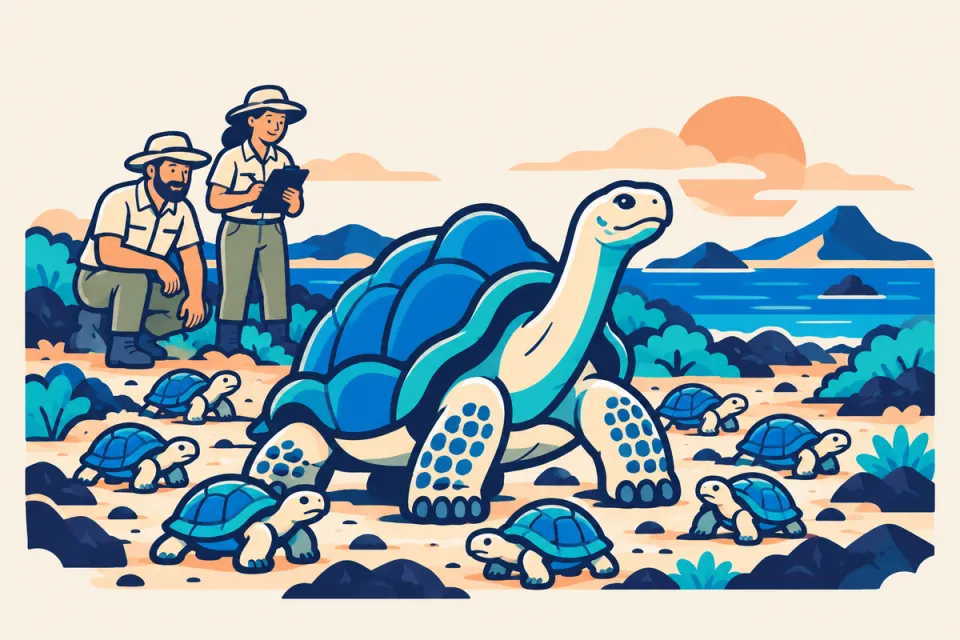
Facts you’ll need — each one is checked, with its source, on the story page:
- Española island, in the Galápagos; thought to have hatched before 1920
- Hunted for food by sailors, whalers and pirates; goats competed for food
- 12 females and 3 males on Española in 1976 — about 15 survivors
- Shipped to the US between 1928 and 1933; San Diego Zoo by the late 1940s
- Identified by DNA testing; joined the breeding programme in 1977
- Around 900 offspring, about 40% of the programme's output; E5 fathered most of the rest
- Programme ended January 2020; more than 2,000 tortoises; released 15 June 2020 with 14 others
Why tell one animal's story instead of facts about a species?
Facts about a species ("it lives on the Galápagos, it eats plants, it is endangered") fill thirty seconds and then stop. An animal with a history has a beginning, a crisis, a turn and a result — the same shape as any story, and the same shape as the card's four points. It also survives nerves: you are remembering events, not composing sentences.
That is the whole argument of story retelling as practice: the material comes with you, so the two minutes fill themselves.
How do you fit Diego's story into two minutes?
Two minutes is about 250–300 spoken words. This outline compresses the story into five moves; learn the moves, not the sentences. During your preparation minute, write one word per point — nothing more.
- Opener (~35 words)Name the animal: Diego, a Hood Island (Española) giant tortoise from the Galápagos, thought to have hatched before 1920. Then your part: how you learned about him.
- Crisis (~70 words)Sailors, whalers and pirates hunted the giant tortoises for food, and introduced goats competed for what was left to eat. When the breeding programme began in 1976, only 12 females and 3 males were left on Española — about 15 known survivors.
- Turn (~70 words)Diego had been captured and shipped to the United States as a young adult, between 1928 and 1933. By the late 1940s he was at the San Diego Zoo and nobody knew his species. DNA testing identified him, and in 1977 he joined the breeding programme on Santa Cruz Island.
- Result (~60 words)He fathered around 900 offspring, about 40 percent of the programme's output. It ended in January 2020 with more than 2,000 tortoises on Española, once the goats had been eradicated. On 15 June 2020 Diego, more than 100 years old, was released with 14 others — almost 80 years after he was removed.
- Explain (~45 words)One forgotten animal changed the fate of a species. Optional twist: a quieter male, E5, fathered most of the rest. Then your part: what it made you think.
The part I find special is the turn. Diego had been sitting in a zoo for decades, just an old tortoise nobody could place, and then a DNA test said he was one of the last Hood Island tortoises — so in 1977 he went back to the Galápagos and basically restarted a species.One sample paragraph only — the rest stays an outline on purpose. A memorised script collapses when the card differs by one word; facts survive nerves.
About 251 words in total — 1:40 to 2:00 spoken at 125–150 words per minute.
| Card point | Your note |
|---|---|
| what the animal is and where it lives | tortoise |
| how you learned about it | article |
| what is special about it | saved species |
| and explain why you find it interesting | one animal |
One word per point, written in the preparation minute — never a sentence you could recite by accident.
If you want the arithmetic for your own pace, the words-to-minutes calculator converts minutes to words at any speed.
Which words help on an animal cue card?
Endangered, breeding programme, offspring, conservation, extinct, release into the wild — six expressions that carry this story, all reusable on any conservation or wildlife card. Notice they are mostly nouns and noun phrases: examiners' descriptors for lexical resource reward topic-appropriate word choice, not rare poetry. One collocation worth stealing: to father offspring. And a hedge worth keeping: is thought to have hatched before 1920 — hedging shows control.
What do examiners listen for?
The four criteria are the ones in the public band descriptors. What the app can measure is narrower, and it never produces a score or band for any of them:
- Fluency and coherence
- Carry the answer on a clear time sequence — at first, by the 1940s, in 1977, finally — so the two minutes organise themselves.SoulfulStories measures: your pace, your pauses and your filler words — how long you keep the floor and how your answer is organised.
- Lexical resource
- Use the topic's own words once each: endangered, breeding programme, offspring, conservation, extinct, release into the wild.SoulfulStories measures: the CEFR level of the words you used, and where you rephrased around a missing word.
- Grammatical range and accuracy
- This story is full of passives (was captured, was identified, was released) and past perfect (had been shipped) — exactly the range this criterion rewards.SoulfulStories measures: nothing — grammar is not measured, because a transcript-based check would be guesswork; the examiner on test day judges it.
- Pronunciation
- Say the numbers clearly — fifteen versus fifty decides the story — and chunk the long noun phrases (the San Diego Zoo, a breeding programme).SoulfulStories measures: nothing automatic today — pitch and volume variation are measured, but clear pronunciation is yours to hear in the playback.
What if the card says "an animal you have seen"?
Say where you came across it and move on: a documentary, a zoo enclosure, an article about the release — the San Diego Zoo, where Diego spent decades, is a natural place to start. The examiner wants the points covered, not a biography check, and the same moves fit other cards:
- Describe an interesting true story you heard or readDiego's story is one you read — that card is the same retelling with a survival story instead.
- Describe a person you admireThe same spine in a person: one determined individual changes an outcome against the odds.
The full angle-switching method is on the Part 2 practice page.
How do you practise this answer out loud?
Read Diego's story once at your level. Close the page. Note your four words. Speak for two minutes into the recorder, and read where the facts and the pace went — the same report you get on any retelling, with a methodology you can check. Record it tomorrow as well; the second take is where the pauses shrink.
Read Diego's story, close the page, and tell it in two minutes.
Feedback on your pace, filler words, pauses, which key facts you covered, and the CEFR level of your vocabulary. Free to try, no card — and no score or band.
Questions and answers
Can I talk about an animal I have only read about?
If the card asks for an animal you find interesting, yes. If it asks for one you have seen, say where you saw a similar animal, then tell the story you know. Cover every point on the card either way.
How long should a Part 2 answer about an animal be?
Aim for close to two minutes — roughly 250 to 300 words at a natural pace. Use the minute of preparation to note one word per point on the card.
Who is Diego the tortoise?
A giant tortoise from Española in the Galápagos. After decades at the San Diego Zoo he joined a breeding programme in 1977, fathered around 900 offspring and was released home in June 2020.
Does SoulfulStories give an IELTS band score?
No. SoulfulStories is independent practice and is not affiliated with IELTS. It gives feedback on pace, filler words, pauses, which key facts you included, and the CEFR level of your vocabulary.
Sources
Every outside fact on this page comes from the story’s cited sources, listed with their accessed dates on the story page.
- Diego (tortoise) — Wikipedia · accessed 25 October 2026
- Española Tortoises Return Home Following Closure of Successful Breeding Program — Galápagos Conservancy · accessed 25 October 2026
- Diego, the 100-Year-Old Tortoise Who Fathered 900 Babies, Returns to the Wild — Smithsonian Magazine · accessed 25 October 2026
- Diego the tortoise, father to hundreds and saviour of his species, finally retires — The Guardian · accessed 25 October 2026
- IELTS Academic: Speaking test format — ielts.org · accessed 1 November 2026
Keep going
- IELTS Speaking Part 2 cue cardsPart 2-style practice cue cards backed by true, sourced stories, with a one-minute note grid and a model outline.
- IELTS Speaking Part 2 Practice: The Long Turn AloneA free, repeatable loop for the long turn: one minute of notes, two recorded minutes, one listen, one fix — with a worked cue card taken three ways.
- How to Retell a Story Out Loud: 5 Steps + a True StoryA five-step retelling method worked on one true story shown at its three reading levels — beginner, intermediate and advanced.
- Words per minute speaking testRead a 150-word passage aloud, time yourself and see your reading pace in words per minute.
- Diego, the Tortoise Who Saved His SpeciesWith his species down to about 15, scientists found a forgotten male in San Diego — he fathered around 900 babies.
IELTS is a registered trademark of its owners. SoulfulStories is not affiliated with, endorsed by or connected to IELTS, the British Council, IDP or Cambridge. We don't give band scores.