Hoover, the Seal Who Talked
Hoover, the Seal Who Talked
1971–1985Cundy's Harbor, Maine, and Boston, USANature & animals
A Maine fisherman raised an orphaned seal pup that grew up speaking — in the fisherman’s own gruff accent.
Reading level
The same true story, told at three lengths. Pick one to read, close your eyes, and tell it back in your own words.
183 words · about 1 min to read · retell it in about 1 minutes
In 1971, on the coast of Maine, a tiny baby seal was found alone on the shore. His mother was dead. A man named George Swallow took the little pup home.
The pup would not drink milk. Then a neighbor had an idea: grind up fish. The baby seal sucked it up like a vacuum cleaner, so they named him Hoover.
Hoover lived like a dog. He swam in a pond behind the house, and he rode into town with his head out the car window. The family talked to him all day. And something strange happened. He started to copy George. He copied George’s thick, gruff voice.
Later, Hoover went to live at an aquarium in Boston. George told the workers, my seal can talk. Nobody believed him.
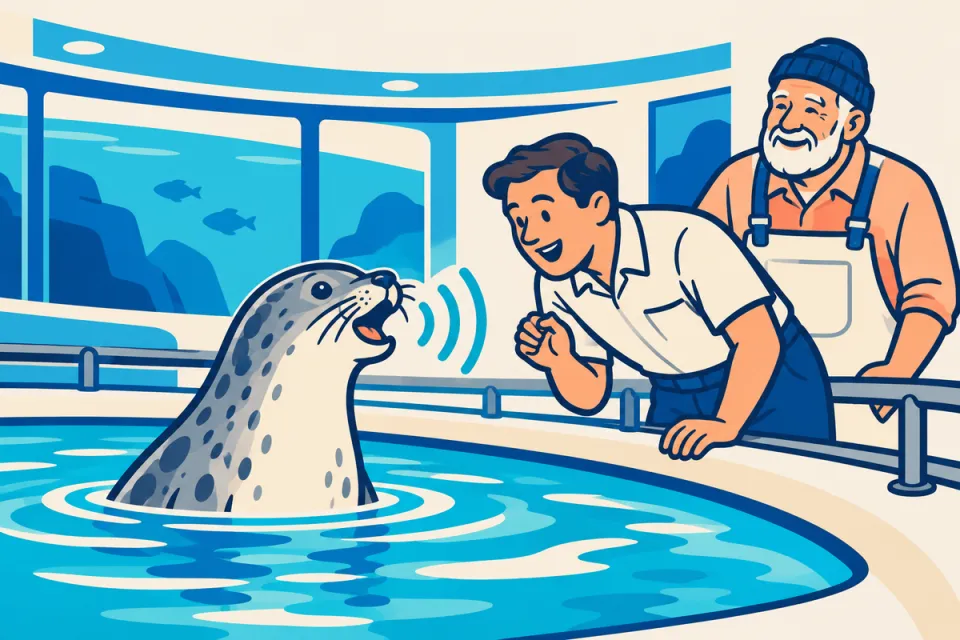
For years, Hoover said nothing. Then, in his gruff voice, he began to talk. Visitors could not believe their ears. A seal, talking like a fisherman from Maine.
Hoover became famous. When he died in 1985, a Boston newspaper wrote his obituary. And at the aquarium today, his grandson Chacoda still loves to chat.
309 words · about 2 min to read · retell it in about 2 minutes
In the spring of 1971, on the coast of Maine, a man named Scottie Dunning found a tiny seal pup alone on the shore of Cundy’s Harbor. The pup’s mother was dead. Dunning called his brother-in-law, a fisherman named George Swallow, and George did something unexpected: he took the orphan home.
Feeding him was a struggle until a neighbor suggested grinding up fish. The pup inhaled it, sucking it up like a vacuum cleaner, and the name stuck: Hoover.
Hoover became one of the family. He started in the bathtub, then moved to a spring-fed pond behind the house. He behaved like a dog. He rode into town with his head poking out of the car window. And the Swallows talked to him constantly, the way you talk to a pet you love.
Which is when things got strange. Hoover began to answer, in his own way. He was mimicking George: the thick, gruff Maine accent, the catchphrases, the greetings.
In August, with Hoover growing enormous and eating them out of house and home, the Swallows did the responsible thing and took him to the New England Aquarium in Boston. George told the staff their new seal could talk. They were skeptical. Nobody believed him.
So George let it go. Accounts differ on how long Hoover stayed quiet: one says five years, another says it was 1978 when the staff first heard him say his own name in George’s gruff voice.
The world fell for him. He was written up in Reader’s Digest and The New Yorker and appeared on Good Morning America. Tourists came just to hear the seal chat. He said hello there, come on, hey.
Hoover died in 1985 after fourteen years at the aquarium. None of his six pups ever spoke. But his grandson Chacoda still lives at the aquarium, and he is chatty too.
450 words · about 2 min to read · retell it in about 3 minutes
In May 1971, on the rocky coast of Cundy’s Harbor, Maine, a man named Scottie Dunning found a tiny male seal pup on the shore. Dunning could not find the pup’s mother, so he called his brother-in-law, a fisherman named George Swallow; together they searched and found her lying dead among the rocks. After careful thought, George carried the orphan home.
The pup refused milk from a bottle until a neighbor suggested ground fish, which he inhaled like a vacuum cleaner sucking up dust. The name was never in doubt. Hoover.
What followed reads like a folk tale, except it was covered by The New Yorker and documented on tape. Hoover moved from the Swallows’ bathtub to a spring-fed pond behind the house, where a wire fence enclosed his own small pup tent. He behaved less like a marine mammal than like the family dog: he swam, he rode into town with his head poking out of the car window. And the Swallows, as people do with a pet they adore, talked to him all day long.
Then Hoover started talking back. Not in barks. In words. He had been studying George, and what came back was George: the thick, gruff Maine accent, the greetings, the catchphrases, delivered from a seal.
By August, Hoover’s appetite had outgrown the household, and the Swallows took him to the New England Aquarium in Boston. George told the staff that their new seal could talk. They did not believe a word of it, and he did not press the point. Accounts disagree on how long Hoover kept his secret: one history says five years, while another dates the moment to 1978, when staff heard him say his own name in George’s gruff New England accent.
Fame followed. Reader’s Digest, The New Yorker, Good Morning America. Tourists came to Boston just to hear a seal heckle them. His party pieces included hello there, come on and hey, and a scratchy 1984 recording preserved him growling get over here, come on, come on in a Maine accent.
Scientists cared too: here was a seal that had picked up words from the people around him. The deeper lesson, as one lab puts it, is that making speech sounds is not what makes humans special; it is what we do with them. His phrases, hello there, come on, hey, outlived him, and his voice survives on tape.
Hoover died in July 1985 after fourteen years in the aquarium’s care, and his obituary ran in The Boston Globe. None of his six pups ever spoke a word. But his grandson Chacoda still lives at the aquarium, chatty as ever, waiting for the day a seal finally says something new.
Read it once, close the page, and tell it back. The coach listens for pace, fillers and the facts.
Key facts and sources
Hoover was a harbor seal who could imitate basic human speech.
“was a harbor seal who was able to imitate basic human speech” — Hoover (seal), Wikipedia
On 5 May 1971, Scottie Dunning found a tiny seal pup on the shore at Cundy’s Harbor, Maine.
“On May 5, 1971, Scottie Dunning discovered a tiny male harbor seal pup on the shore of Cundy’s Harbor, Maine” — Hoover (seal), Wikipedia
The pup’s mother was found dead among the rocks.
“later found her dead among the rocks” — Hoover (seal), Wikipedia
Dunning called his brother-in-law George Swallow, who took the pup home.
“Dunning called his brother-in-law George Swallow for help” — Hoover (seal), Wikipedia
The pup refused milk from a bottle until a neighbor suggested ground fish.
“At first, it refused to drink milk from a bottle, but once advice was given by a neighbor to grind up fish and offer it to the pup” — Hoover (seal), Wikipedia
He sucked the fish up like a vacuum cleaner, which gave him his name.
“he sucked it up like a Hoover (vacuum cleaner), hence his name” — Hoover (seal), Wikipedia
He lived in the Swallows’ bathtub and then a spring-fed pond behind the house.
“The Swallows kept him in their bathtub, but this proved too inconvenient within a few days; as such, George moved him out back to a spring-fed pond” — Hoover (seal), Wikipedia
Hoover lived like a family dog and rode into town with his head out the window.
“Hoover lived very much like a family dog and even accompanied George riding into town with his head poking out of the window” — Hoover (seal), Wikipedia
The Swallows talked to the seal constantly.
“The Swallows spoke to the seal pup constantly.” — Hoover (seal), Wikipedia
Hoover began to mimic George’s thick, gruff accent and catchphrases.
“It was during this time that Hoover began to mimic George’s thick, gruff accent and catchphrases” — Hoover (seal), Wikipedia
The Swallows gave him to the New England Aquarium in August.
“In August, they contacted the New England Aquarium, who agreed to accept Hoover at their facility.” — Hoover (seal), Wikipedia
George told the aquarium staff that Hoover could talk, but none of them believed him.
“George informed the Aquarium staff that Hoover could talk, but none of the attendants believed him so he did not press the point” — Hoover (seal), Wikipedia
Five years later Hoover began saying phrases like hello there and come over here in George’s accent.
“began to utter phrases such as: “Hello, there!” and “Come over here!” in a thick New England accent similar to Swallow’s” — Hoover (seal), Wikipedia
In 1978 staff witnessed Hoover saying his own name in George’s gruff New England accent.
“things changed in 1978, when staff members witnessed Hoover saying his own name in George’s gruff, New England accent” — U.S. seal populations have rebounded — and so have their conflicts with humans, Science News
That utterance grew into a repertoire of shouts and belly laughs until his death in 1985.
“That single utterance soon turned into a full repertoire of shouts and belly laughs that entertained crowds until Hoover’s death in 1985” — U.S. seal populations have rebounded — and so have their conflicts with humans, Science News
He appeared in Reader’s Digest, The New Yorker and on Good Morning America.
“appeared along with the Swallows in publications such as Reader’s Digest and The New Yorker and the television program Good Morning, America” — Hoover (seal), Wikipedia
He could say hello there, come on and hey.
“He could say “hello there,” “come on,” and “hey.”” — Archive Dive: A Look Back at New England Aquarium Over the Years, New England Aquarium
Hoover died on 25 July 1985.
“Hoover died on July 25, 1985” — Hoover (seal), Wikipedia
He spent 14 years in the aquarium’s care.
“Hoover passed away in 1985 after spending 14 years in our care” — Archive Dive: A Look Back at New England Aquarium Over the Years, New England Aquarium
None of Hoover’s six pups spoke.
“None of Hoover’s six pups (daughters Joey, Amelia, and Trumpet and sons Lucifer, Cinder, and Spark) spoke” — Hoover (seal), Wikipedia
His grandson Chacoda lives at the aquarium and is skilled at vocalizations.
“his chatty legacy lives on through his grandson, Chacoda, who you can visit at the Aquarium today” — Archive Dive: A Look Back at New England Aquarium Over the Years, New England Aquarium
A 1984 recording captured Hoover saying get over here and come on with a Maine accent.
“you can hear Hoover say “Hoover get over here! Come on, come on!” with a Maine accent” — Hoover the Talking Seal, Boston University, Guenther Lab
Phrases like hello there brought tourists flocking to see the aquarium’s chattiest resident.
“These are only a few of the phrases that brought tourists flocking to Boston’s New England Aquarium to see its chattiest resident” — U.S. seal populations have rebounded — and so have their conflicts with humans, Science News
The lesson scientists draw is that making speech sounds is not what makes humans unique; using them is.
“it’s not the ability to create speech sounds that makes us unique in the animal kingdom, but our ability to use them to convey an infinite number of messages” — Hoover the Talking Seal, Boston University, Guenther Lab
Hoover’s obituary was published in The Boston Globe.
“His obituary was published in The Boston Globe.” — Hoover (seal), Wikipedia
Sources consulted for this story: Hoover (seal) (Wikipedia, accessed 2026-10-25); Archive Dive: A Look Back at New England Aquarium Over the Years (New England Aquarium, accessed 2026-10-25); U.S. seal populations have rebounded — and so have their conflicts with humans (Science News, accessed 2026-10-25); Hoover the Talking Seal (Boston University, Guenther Lab, accessed 2026-10-25). Every story is checked against its sources before it is published — how we verify stories.
Why this story is worth telling
Nobody believed George until the seal opened his mouth at the aquarium.