Clara, the Rhinoceros Who Toured Europe
Clara, the Rhinoceros Who Toured Europe
1738–1758India and EuropeNature & animals
In 1741 a young rhino orphaned in India arrived in Europe, and for 17 years kings and crowds paid to see her.
Reading level
The same true story, told at three lengths. Pick one to read, close your eyes, and tell it back in your own words.
216 words · about 1 min to read · retell it in about 2 minutes
In 1738, in Assam in India, hunters killed a mother rhinoceros. Her baby was only one month old. The baby was a girl. Years later, people would call her Clara.
The head of a Dutch trading company in Bengal took her in. Little Clara ran around his dining hall and entertained his guests. But she kept growing, and soon she was too big for the house.
So a Dutch sea captain, Douwe Mout van der Meer, took her on his ship. In 1741 she landed in Rotterdam. Almost nobody in Europe had ever seen a real rhino. People only knew an old picture from 1515. It showed a rhino with an extra horn on its back and skin like armour.
The captain had a plan. He built a big wooden wagon pulled by eight horses. It had only a tiny window, so people had to pay to see her. For seventeen years, Clara traveled across Europe. Kings came to look at her. In Paris, people even made wigs in her style.
Artists drew every fold of her skin. Thanks to Clara, Europe finally learned what a rhinoceros really looked like.
Clara died in London in 1758, at about twenty. Everybody had wanted to look at her. But in all those years, she never saw another rhinoceros.
319 words · about 2 min to read · retell it in about 2 minutes
In 1738, in Assam in India, hunters killed a mother rhinoceros and captured her baby. The calf was just a month old. Her name would be Clara.
She was taken in by the director of the Dutch East India Company in Bengal, who kept her as a house pet. Picture it: a baby rhino trotting around a dining hall to amuse the dinner guests. It worked, until she grew too big for the room.
So a Dutch sea captain, Douwe Mout van der Meer, sailed her home. In July 1741 Clara stepped onto the dock in Rotterdam, and Europe went wild. For more than two hundred years, people had known rhinos only from a famous print made in 1515 by Albrecht Dürer. It showed a beast with armour plates and an extra horn on its back. Now the real thing had arrived.
The captain saw his chance. He quit the company and took Clara on the road. He built a heavy wooden wagon pulled by eight horses, with only a tiny window, so nobody could see her for free. Her skin was rubbed with fish oil to keep it moist. His posters boasted that she ate thirty kilos of hay and ten kilos of bread a day.
For seventeen years they toured. Frederick the Great saw her in Berlin. King Louis the Fifteenth received her at Versailles. In Paris, people wrote songs about her and wore wigs in rhinoceros style. In Rome she seems to have rubbed off her horn, and a new one slowly grew back. In Venice she was one of the great attractions of the carnival.
Artists studied every fold of her skin, and Europe got a far truer picture of what a rhinoceros looked like.
Clara died in London in April 1758, aged about twenty. She had met kings and crowds. But from the day the hunters took her, she never saw another rhinoceros again.
500 words · about 3 min to read · retell it in about 4 minutes
In 1738, somewhere in Assam in India, hunters killed a mother rhinoceros and carried off her calf. The little female was about a month old. She would become the most famous rhinoceros in the world, and she would never see another of her kind again.
Her first home was the residence of Jan Albert Sichterman, director of the Dutch East India Company in Bengal. He kept the calf as a pet to entertain his guests, and for a while a baby rhinoceros wandered through his dining hall. Then she simply grew too big.
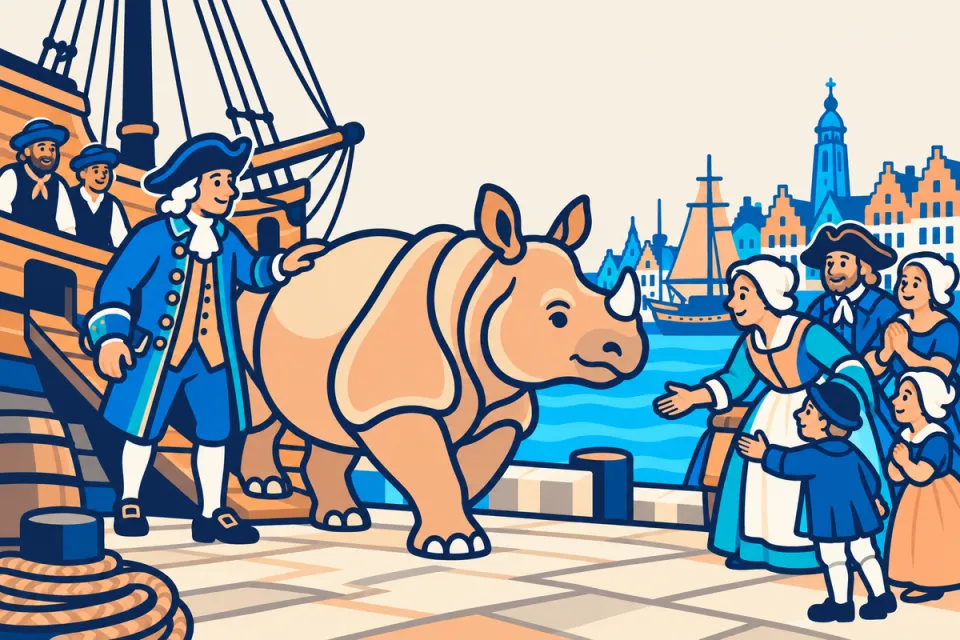
A company sea captain, Douwe Mout van der Meer, took her aboard and sailed for the Netherlands. On 22 July 1741 she walked off the ship in Rotterdam and was put on show right away. To understand the shock, you need to know what Europeans thought a rhinoceros looked like. Their only reference was a print by Albrecht Dürer from 1515, a creature in a suit of armour with a strange extra horn on its back.
Van der Meer saw his chance. In 1744 he left the company to tour with her full time. He had a wooden carriage built, so heavy that it needed eight horses, and he gave it only a small window. If you wanted to see her, you bought a ticket. His posters advertised her appetite: thirty kilos of hay, ten kilos of bread and fourteen buckets of water every day. Her skin was kept moist with fish oil.
In Leiden, a young zoology student named Petrus Camper came again and again, feeding her carrots from his hand. Frederick the Great came to look at her in Berlin. In Würzburg a painter wrote a fond caption calling her Miss Clara. In January 1749 King Louis the Fifteenth received her at Versailles. Paris lost its mind: there were poems, songs and wigs styled after her, and the painter Jean-Baptiste Oudry made a life-size portrait. By then she was eleven years old, more than three and a half metres long, and weighed over two and a half tonnes.
At the end of 1749 she sailed from Marseilles to Italy. In Rome she seems to have rubbed her horn clean off, and a new one slowly grew in. In January 1751 she arrived in Venice and became a major attraction of the carnival, where Pietro Longhi painted her standing before her audience.
There is a quieter side to the story. Clara was almost never free to walk or run. One of the few times she could act like a wild animal was when the road met a river and she had to swim across. Observers noticed that she clearly loved the water.
In 1758 she was back in London, on show at the Horse and Groom in Lambeth. She died there on 14 April, aged about twenty. Her seventeen years on the road changed science and art: Europe finally knew what a rhinoceros really was. And the creature who taught them never once met another rhinoceros.
Read it once, close the page, and tell it back. The coach listens for pace, fillers and the facts.
Key facts and sources
Clara was about a month old when hunters captured her in Assam, India, in 1738.
“Clara was just a month old when hunters captured her in what is now the Indian state of Assam, in 1738” — 10 things to know about Clara the rhinoceros, Rijksmuseum
The hunters killed Clara’s mother.
“The hunters killed her mother.” — 10 things to know about Clara the rhinoceros, Rijksmuseum
Clara never saw another rhinoceros again.
“she never saw another rhinoceros again” — 10 things to know about Clara the rhinoceros, Rijksmuseum
She was taken in by Jan Albert Sichterman, director of the Dutch East India Company in Bengal.
“Sichterman was the director of the Dutch East India Company (Vereenigde Oostindische Compagnie or VOC) in Bengal” — Clara (rhinoceros), Wikipedia
As a pet she roamed his dining hall entertaining guests until she grew too big.
“He kept this unusual pet to entertain the guests – until she grew too big to be roaming around the dining hall.” — 10 things to know about Clara the rhinoceros, Rijksmuseum
Captain Douwe Mout van der Meer took Clara back to the Netherlands.
“Douwe Mout van der Meer, captain of the Knappenhof, who returned to the Netherlands with Clara” — Clara (rhinoceros), Wikipedia
Clara landed in Rotterdam on 22 July 1741 and was shown to the public right away.
“Clara disembarked at Rotterdam on 22 July 1741 and was immediately exhibited to the public.” — Clara (rhinoceros), Wikipedia
Before Clara, Europeans knew rhinos only from Albrecht Dürer’s 1515 print.
“Until Clara’s arrival, all that people knew of her species was from a print made in 1515 by the renowned artist Albrecht Dürer.” — Rijksmuseum Presents Exhibition on the Most Famous Rhinoceros in History, Rijksmuseum
Dürer’s print showed an extra horn on the back and skin like a suit of armour.
“it depicted the rhinoceros with an extra horn on its back, for example, and skin that resembled a suit of armour” — Rijksmuseum Presents Exhibition on the Most Famous Rhinoceros in History, Rijksmuseum
Van der Meer left the Dutch East India Company in 1744 to tour Europe with Clara.
“Douwe Mout van der Meer left the VOC in 1744 to tour Europe with his rhinoceros.” — Clara (rhinoceros), Wikipedia
He built a special wooden carriage pulled by at least eight horses.
“He had a special wooden carriage built to convey her, which had at least eight horses pulling it.” — Clara (rhinoceros), Wikipedia
The carriage had only a small window so people would pay to see her.
“The carriage had only a small window in order to encourage people to pay to see her.” — Clara (rhinoceros), Wikipedia
Her skin was kept moist with fish oil.
“Her skin was kept moist with fish oil.” — Clara (rhinoceros), Wikipedia
Posters said she ate 30 kg of hay and 10 kg of bread and drank 14 buckets of water a day.
“no fewer than 30kg of hay, 10kg of bread and 14 buckets of water!” — 10 things to know about Clara the rhinoceros, Rijksmuseum
Frederick the Great of Prussia saw her in Berlin.
“Clara visited Hanover and Berlin, where King Frederick the Great of Prussia saw her” — Clara (rhinoceros), Wikipedia
King Louis XV received her at Versailles in January 1749.
“was received by King Louis XV in January 1749 at the Royal Menagerie of Versailles” — Clara (rhinoceros), Wikipedia
In Paris, poems and songs were written about her and wigs were made in rhinoceros style.
“letters, poems, and songs were written about her, and wigs were created à la rhinocéros” — Clara (rhinoceros), Wikipedia
Jean-Baptiste Oudry painted a life-size portrait of her.
“Jean-Baptiste Oudry painted a life-size portrait of her” — Clara (rhinoceros), Wikipedia
In Paris at age 11 she was 3.6 m long, 1.7 m tall and weighed more than 2,500 kg.
“This picture shows Clara when she was 11 years old, 3.6m long and 1.7m tall. She weighed more than 2,500kg.” — 10 things to know about Clara the rhinoceros, Rijksmuseum
She rubbed off her horn in Rome.
“She seems to have rubbed off her horn while in Rome” — Clara (rhinoceros), Wikipedia
A new horn eventually grew back.
“A new horn eventually grew in.” — Clara (rhinoceros), Wikipedia
In Venice in January 1751 she was a major carnival attraction and was painted by Pietro Longhi.
“She arrived in Venice in January 1751, where she became a major attraction at the carnival and was painted by Pietro Longhi.” — Clara (rhinoceros), Wikipedia
She was almost never free to walk or run.
“Clara was almost never free to walk or run.” — Rijksmuseum Presents Exhibition on the Most Famous Rhinoceros in History, Rijksmuseum
When she had to cross rivers she swam and clearly enjoyed the water.
“the occasions when she needed to cross a river by swimming, and clearly enjoyed the water” — Rijksmuseum Presents Exhibition on the Most Famous Rhinoceros in History, Rijksmuseum
She returned to London in 1758 and was exhibited at the Horse and Groom in Lambeth.
“She returned to London in 1758, where she was exhibited at the Horse and Groom in Lambeth” — Clara (rhinoceros), Wikipedia
She died there on 14 April, aged about 20.
“This was where she died on 14 April, aged about 20.” — Clara (rhinoceros), Wikipedia
She toured Europe for 17 years.
“became famous during 17 years of touring Europe in the mid-18th century” — Clara (rhinoceros), Wikipedia
Clara led to a better understanding of the rhinoceros and more accurate pictures of it.
“Clara’s appearance on the scene changed all this and led to a better understanding of the rhinoceros and to more accurate portrayals.” — Rijksmuseum Presents Exhibition on the Most Famous Rhinoceros in History, Rijksmuseum
In Leiden, zoology student Petrus Camper fed her carrots from his hand.
“A zoology student named Petrus Camper visited her regularly to look at her. He fed her carrots from his hand, and opened her mouth.” — 10 things to know about Clara the rhinoceros, Rijksmuseum
A painter in Würzburg called her ‘Miss Clara’.
“His caption refers to her affectionately as ‘Miss Clara’.” — 10 things to know about Clara the rhinoceros, Rijksmuseum
Artists became fascinated by every fold of her skin.
“artists became fascinated by every fold of her skin” — Rijksmuseum Presents Exhibition on the Most Famous Rhinoceros in History, Rijksmuseum
Clara sailed from Marseilles to Italy at the end of 1749.
“At the end of 1749, Clara embarked at Marseilles to travel to Italy.” — Clara (rhinoceros), Wikipedia
Clara became the most famous rhinoceros in the world.
“became the most famous rhinoceros in the world” — Rijksmuseum Presents Exhibition on the Most Famous Rhinoceros in History, Rijksmuseum
Longhi’s painting shows Clara standing in front of her audience in Venice.
“a painting by Pietro Longhi showing Clara standing in front of her audience in Venice” — Rijksmuseum Presents Exhibition on the Most Famous Rhinoceros in History, Rijksmuseum
Sources consulted for this story: Clara (rhinoceros) (Wikipedia, accessed 2026-10-25); 10 things to know about Clara the rhinoceros (Rijksmuseum, accessed 2026-10-25); Rijksmuseum Presents Exhibition on the Most Famous Rhinoceros in History (Rijksmuseum, accessed 2026-10-25). Every story is checked against its sources before it is published — how we verify stories.
Why this story is worth telling
Wonder and sadness in one life: she showed Europe what a rhino was, yet never met another.