Who Really Built Great Zimbabwe?
Who Really Built Great Zimbabwe?
c. 1000–1500; debated 1871–1980Masvingo, ZimbabweMysteries & oddities
Europeans saw Africa’s great stone city and credited a Bible queen. One explorer’s evidence: a beam that smelled like his pencil.
Reading level
The same true story, told at three lengths. Pick one to read, close your eyes, and tell it back in your own words.
198 words · about 1 min to read · retell it in about 2 minutes
In southern Africa there are huge stone ruins, and many Europeans, blinded by prejudice, refused to believe Africans had built them. Tall stone walls, put together block by block without any cement, and carved stone birds.
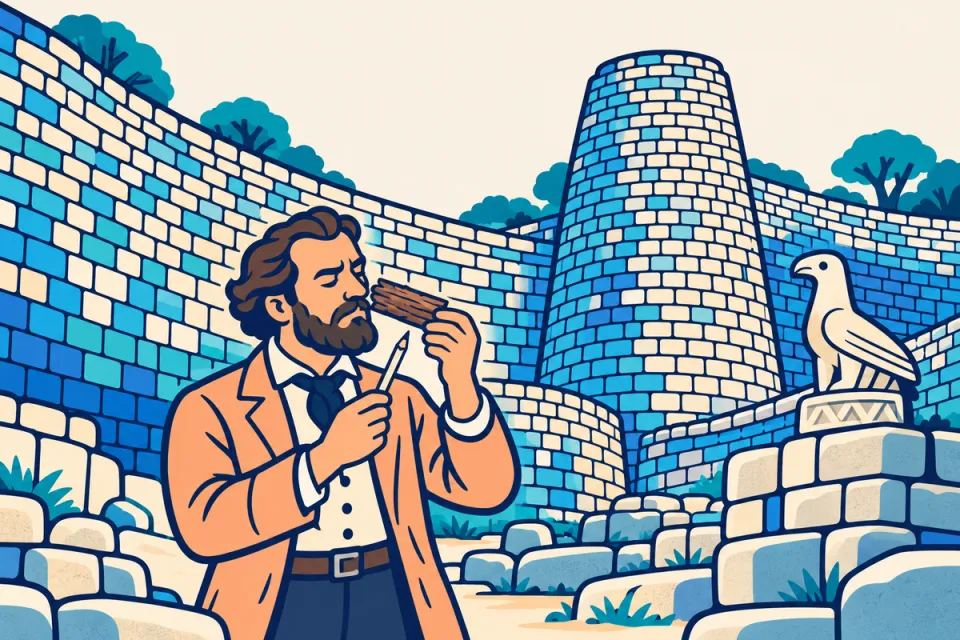
In 1871 a German explorer named Karl Mauch saw the ruins. He decided that Africans could not have built such a city. He said it was probably built as a copy of the palace of the Queen of Sheba from the Bible. As evidence, he pointed to a piece of wood. It smelled like his pencil, he said, so it must be cedar from Lebanon.
That story spread. Later, other Europeans took gold and carvings from the ruins and damaged them.
But science kept asking questions. An archaeologist named Gertrude Caton-Thompson studied the ruins in 1929 and said clearly: the builders were African, and the city was medieval. Other studies agreed.
Today we know the city was built by the ancestors of the Shona people, hundreds of years ago. The country of Zimbabwe is even named after it, and the carved bird appears on its flag. The ruin never needed a queen from a Bible story. It needed only to be believed.
339 words · about 2 min to read · retell it in about 3 minutes
Near the modern town of Masvingo in Zimbabwe stand the largest stone ruins in precolonial southern Africa. Walls of cut granite rise eleven meters, set without a drop of mortar. Carved soapstone birds once watched over the city. Africans built it, ancestors of the Shona people, in the centuries between roughly 1000 and 1500 AD. For a long time, many Europeans refused to believe that.
In 1871, a German geographer named Karl Mauch was led to the ruins by a hunter named Adam Render. Mauch took one look and decided that black Africans could not possibly have built it. The true builders, he argued, were probably biblical: the ruins copied the Queen of Sheba’s palace in Jerusalem, or were the work of Phoenician settlers. His evidence included a wooden beam that smelled, to him, like his pencil, and therefore had to be Lebanese cedar. The story caught on among white settlers. Then came the looters, who stripped gold from the site and carried off some of the carved birds.
Science pushed back, slowly. In 1905 an archaeologist named David Randall-MacIver studied the site and concluded it was medieval and built by the ancestors of the Shona. Few listened. In 1929 Gertrude Caton-Thompson dug careful trenches and came back with a clear verdict: every scrap of evidence fit an African origin and a medieval date. By the 1950s, archaeologists had agreed.
Politics lagged behind science. The white government of Rhodesia, which ruled the country, pressured archaeologists to deny that black Africans had built the ruins, because the truth would have dismantled the story that justified colonial rule. Books were censored, and archaeologists who spoke up were threatened with dismissal or driven out of the country; one account says Peter Garlake was even imprisoned and deported.
In 1980 the country won its independence and took a new name from the ruins its rulers had denied: Zimbabwe. The soapstone bird is now depicted on the national flag. The city never needed a queen from the Bible. It needed only to be believed.
534 words · about 3 min to read · retell it in about 4 minutes
The largest stone structure in precolonial southern Africa stands in the hills near Masvingo, in modern Zimbabwe. Its Great Enclosure is a wall of cut granite about eight hundred feet long, rising as high as thirty-six feet, assembled from roughly a million blocks with no mortar at all. Carved soapstone birds, probably set up on the nearby Hill Complex, once kept watch over the city. Trade goods found in the ruins tell of a rich city: Chinese celadon dishes, Persian bowls, Syrian glass. Its builders were the ancestors of the Shona people, and they raised it between roughly the eleventh and fifteenth centuries. Estimates of its peak population run up to about twenty thousand, though a recent study suggests no more than ten thousand. Today it is a UNESCO World Heritage Site.
None of that should have been a mystery. For generations, Europeans made it one.
In 1871, a German geographer named Karl Mauch was shown the ruins by Adam Render, a hunter who lived with a local tribe. Mauch looked at the stonework and immediately dismissed the possibility that Africans had built it. The city, he decided, was probably built as a copy of the Queen of Sheba’s palace in Jerusalem. His evidence included a wooden lintel that smelled, he said, like his pencil, and was therefore Lebanese cedar carried by Phoenicians. The tale spread through the white settler world like gossip, and worse followed. Looters stripped the site; one carted off a soapstone bird and hid others to fetch later.
The first archaeologist, James Theodore Bent, still credited outsiders in 1891, but the trained excavators who followed kept reaching the wrong answer, by which I mean the true one. David Randall-MacIver excavated in 1905 and concluded the ruins were medieval and built by the ancestors of the Shona. Few listened. In 1929, Gertrude Caton-Thompson spent twelve days digging careful trenches and delivered a verdict whose core has stood ever since, though she softened it slightly by 1931: not one single item of evidence contradicted a Bantu origin and a medieval date. By the 1950s, the profession had accepted the African origin as consensus.
The colony had not. The white government of Rhodesia found African achievement so threatening that it pressured archaeologists to deny the obvious, because admitting the truth would destroy the story it told itself about bringing civilization to the land. From 1965 to 1980 the Rhodesian Front censored books and displays about the site. An archaeologist named Peter Garlake, who insisted on the native origin, was imprisoned and eventually deported, according to a Scientific American account. Another archaeologist recalled that a museum board member threatened him with dismissal if he said publicly that black people had built Zimbabwe.
The ruins outlasted the censors. In 1980 the country took its independence and named itself after the city its rulers had denied: Zimbabwe, a Shona name most often explained as ‘houses of stone,’ though another theory reads it as ‘venerated houses.’ One of the soapstone birds is depicted on the national flag.
That is the satisfying part of this mystery. The puzzle was never who built the great city. The puzzle was why so many people worked so hard not to know.
Read it once, close the page, and tell it back. The coach listens for pace, fillers and the facts.
Key facts and sources
Great Zimbabwe is the largest stone structure in precolonial Southern Africa.
“It is the largest stone structure in precolonial Southern Africa.” — Great Zimbabwe, Wikipedia
Major construction began in the 11th century and continued until the 15th century.
“Major construction on the city began in the 11th century and continued until the 15th century.” — Great Zimbabwe, Wikipedia
The Great Enclosure has dry stone walls up to 11 meters high, built without mortar.
“The Great Enclosure, with its 11 m (36 ft) high dry stone walls (constructed without mortar), was built during the 13th and 14th centuries” — Great Zimbabwe, Wikipedia
The main enclosure wall is about 800 feet long, up to 32 feet high, and used an estimated one million blocks.
“The enclosing wall is 800 feet long and stands 32 feet high at some places; an estimated one million blocks were used in its construction.” — Great Zimbabwe, Scientific American
The ruins were built by ancestors of the Shona people.
“The edifices were erected by ancestors of the Shona people, who live in Zimbabwe and nearby countries.” — Great Zimbabwe, Wikipedia
The name comes from the Shona term dzimbabwe, meaning houses of stone.
“The city’s name derives from the Shona term dzimbabwe, meaning “houses of stone.”” — Great Zimbabwe, Scientific American
Carved soapstone birds found at the site are now a national symbol.
“its famous soapstone bird carvings were retained from the Rhodesian flag and Coat of Arms as a national symbol and depicted in the new Zimbabwean flag” — Great Zimbabwe, Wikipedia
Objects from distant lands, like Chinese celadon dishes and Persian bowls, were found at the city.
“Objects from distant lands made their way to Great Zimbabwe: Syrian glass, Chinese celadon dishes (mostly from the Ming Dynasty, 1368 to 1644), Persian faience bowls” — Great Zimbabwe, Scientific American
In 1867 the ruins were rediscovered by Adam Render, a hunter living with a local tribe; in 1871 he showed them to Karl Mauch.
“The ruins were rediscovered by Europeans during a hunting trip in 1867 by Adam Render, a German-American hunter, prospector and trader in southern Africa, who had been living with a local tribe. In 1871 he showed the ruins to Karl Mauch” — Great Zimbabwe, Wikipedia
Mauch immediately dismissed the idea of African builders.
“Karl Mauch recorded the ruins and immediately discounted any possibility of native construction” — Great Zimbabwe, Wikipedia
Mauch speculated about a biblical connection to King Solomon and the Queen of Sheba.
“proceeded to speculate about a possible Biblical association with King Solomon and the Queen of Sheba” — Great Zimbabwe, Wikipedia
Mauch claimed a wooden lintel was Lebanese cedar brought by Phoenicians.
“claimed a wooden lintel at the site must be Lebanese cedar, brought by Phoenicians” — Great Zimbabwe, Wikipedia
Mauch’s assessment was bolstered by the wood smelling like his pencil.
“it smelled like his pencil; therefore, it was cedar and must have come from Lebanon” — Great Zimbabwe, Scientific American
The Sheba legend spread widely among white settlers.
“The Sheba legend, as promoted by Mauch, became so pervasive in the white settler community” — Great Zimbabwe, Wikipedia
Willi Posselt removed a soapstone bird and concealed others.
“The first looter who found his way to the site, Willi Posselt, removed a native-made soapstone bird and managed to conceal others” — Great Zimbabwe, Wikipedia
In 1905-06 David Randall-MacIver concluded the structures were built by the ancestors of the Shona people.
“Randall-MacIver concluded that all available evidence led him to believe that the Zimbabwe structures were constructed by the ancestors of the Shona people” — Great Zimbabwe, Wikipedia
In 1929 Gertrude Caton Thompson concluded after trenches and a twelve-day visit that the site was created by Bantu builders.
“In mid-1929, Gertrude Caton Thompson concluded, after a twelve-day visit of a three-person team and the digging of several trenches, that the site was indeed created by Bantu.” — Great Zimbabwe, Wikipedia
Caton-Thompson said all the evidence fitted a Bantu origin and medieval date.
“still can produce not one single item that is not in accordance with the claim of Bantu origin and medieval date” — Great Zimbabwe, Wikipedia
By the 1950s archaeologists had reached consensus on the African origin.
“Since the 1950s, there has been consensus among archaeologists as to the African origins of Great Zimbabwe.” — Great Zimbabwe, Wikipedia
The white government of Rhodesia pressured archaeologists to deny that black Africans built it.
“the white government of Rhodesia pressured archaeologists to deny its construction by black Africans” — Great Zimbabwe, Wikipedia
From 1965 to 1980 the Rhodesian Front censored books and materials about Great Zimbabwe.
“From 1965 until independence in 1980, the Rhodesian Front censored all books and other materials available on Great Zimbabwe.” — Great Zimbabwe, Scientific American
Per a Scientific American account, archaeologists who spoke up for the African origin, like Peter Garlake, were imprisoned and deported.
“Archaeologists, such as the noted Peter S. Garlake, who were vocal about the native origin of Great Zimbabwe were imprisoned and eventually deported.” — Great Zimbabwe, Scientific American
Paul Sinclair, interviewed for None But Ourselves, recalled a museum board member threatened to fire him for saying publicly that blacks had built Zimbabwe.
“Once a member of the Museum Board of Trustees threatened me with losing my job if I said publicly that blacks had built Zimbabwe.” — Great Zimbabwe, Wikipedia
In 1980 the new internationally recognised independent country was renamed for the site.
“In 1980 the new internationally recognised independent country was renamed for the site” — Great Zimbabwe, Wikipedia
Great Zimbabwe is a UNESCO World Heritage Site.
“It is recognised as a World Heritage Site by UNESCO.” — Great Zimbabwe, Wikipedia
Estimates of the peak population range up to about 20,000 people, with a recent study suggesting no more than 10,000.
“Earlier estimates suggest a peak population of around 20,000 people. A recent study using archaeological, ethnographic, and historical evidence, along with statistical modeling, suggests that the site’s population did not exceed 10,000.” — Great Zimbabwe, Wikipedia
Radiocarbon dating supports a 12th-to-15th-century chronology.
“all but the first four, from the early days of the use of that method and since viewed as inaccurate, support the 12th-to-15th-centuries chronology” — Great Zimbabwe, Wikipedia
Rhodesians found it inconceivable that indigenous Africans built the structures.
“Mired in racial prejudice, Rhodesians found it inconceivable that the structures could have been built by indigenous Africans” — Great Zimbabwe, Wikipedia
Great Zimbabwe lies in the south-eastern hills of modern Zimbabwe, near Masvingo.
“Great Zimbabwe was a city in the south-eastern hills of the modern country of Zimbabwe, near Masvingo.” — Great Zimbabwe, Wikipedia
Many structures were made of rectangular blocks cut from nearby granite.
“Many of the structures are made of rectangular blocks cut from nearby granite outcroppings.” — Great Zimbabwe, Scientific American
Randall-MacIver suggested a wholly medieval date for the walled fortifications and temple.
“More importantly he suggested a wholly medieval date for the walled fortifications and temple.” — Great Zimbabwe, Wikipedia
W. G. Neal’s men pillaged the ruins, taking gold and everything of value and tearing down structures.
“Neal and his rogues pillaged Great Zimbabwe and other Iron Age sites, taking gold and everything of value, tearing down structures” — Great Zimbabwe, Scientific American
The colonial government denied indigenous construction because acknowledging it would have dismantled its civilising-mission rationale.
“The colonial government pressured archaeologists to deny that the structure was built by indigenous Africans, because acknowledging it would have dismantled their “civilising mission” rationale.” — Great Zimbabwe, Wikipedia
Displays at the site were censored as well.
“Displays at the site itself were censored as well” — Great Zimbabwe, Scientific American
The ruins looked to Mauch like the work of Phoenician or Israelite settlers.
“It looked to Mauch to be the result of Phoenician or Israelite settlers.” — Great Zimbabwe, Scientific American
Randall-MacIver’s claim was not immediately accepted.
“This claim was not immediately accepted” — Great Zimbabwe, Wikipedia
Mauch favoured a legend that the structures replicated the palace of the Queen of Sheba in Jerusalem.
“Mauch went so far as to favour a legend that the structures were built to replicate the palace of the Queen of Sheba in Jerusalem” — Great Zimbabwe, Wikipedia
Great Zimbabwe and surrounding sites were looted by European antiquarians between the 1890s and 1920s.
“Great Zimbabwe and surrounding sites were looted by European antiquarians between the 1890s and 1920s.” — Great Zimbabwe, Wikipedia
Sources consulted for this story: Great Zimbabwe (Wikipedia, accessed 2026-10-25); Great Zimbabwe (Scientific American, accessed 2026-10-25). Every story is checked against its sources before it is published — how we verify stories.
Why this story is worth telling
A mystery manufactured by prejudice, solved by patient archaeology, and honored in a nation’s name.