The Note That Opened the Wall
The Note That Opened the Wall
9 November 1989East Berlin, East GermanyTurning points in history
In 1989, an East German spokesman fumbled one question on live TV — ‘immediately, without delay’ — and that night the Berlin Wall opened.
Reading level
The same true story, told at three lengths. Pick one to read, close your eyes, and tell it back in your own words.
160 words · about 1 min to read · retell it in about 1 minutes
On the evening of November 9, 1989, an East German official stood in front of the cameras and made a small mistake.
His name was Günter Schabowski. A journalist asked when new travel rules would start. Schabowski shuffled his papers, read the note, and guessed: immediately, without delay.
He did not know the rules were meant to start the next morning, with conditions. He said the magic words on live television, and that same night West German news carried them to nearly all of East Germany.
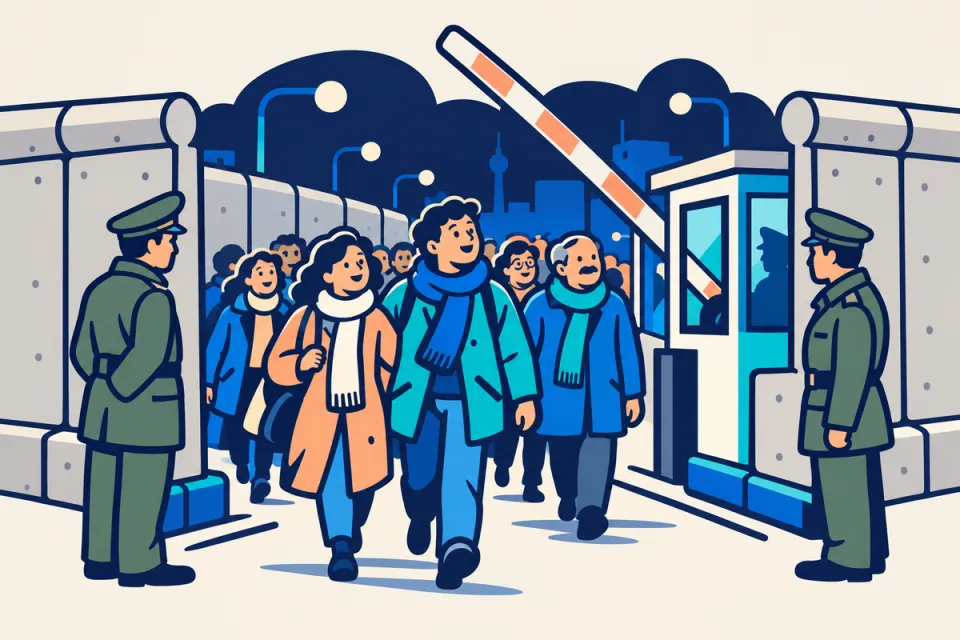
Thousands of people rushed to the Berlin Wall. Nobody was willing to order the guards to shoot. Late that night, the guards at one crossing finally opened the gate.
The wall, which had divided Berlin for twenty-eight years, was done. And the mistake of one official, reading one note too soon, had ended it. Less than a year later, his country had ceased to exist. One fumbled answer helped close an era of history.
377 words · about 2 min to read · retell it in about 3 minutes
Every collapsing empire needs a moment when the dam breaks. In East Germany’s, the dam broke because of a press conference.
It was November 9, 1989. The Berlin Wall had divided the city for twenty-eight years, and the communist government, under pressure from weeks of mass protests, had drafted new travel regulations. They were a concession: East Germans could apply to travel abroad without meeting the old requirements. The plan was to announce them the next morning, calmly, with conditions attached.
Instead, the text landed with Günter Schabowski, the party’s unofficial spokesman, shortly before the press conference — and he had missed the briefing where officials discussed it. He carried the paper with him.
Near the end of the televised press conference, an Italian journalist, Riccardo Ehrman of the ANSA agency, asked about the travel law, and Schabowski pulled out the paper and began reading it aloud. Then a reporter — Ehrman and a German tabloid reporter both later claimed it was them — asked: when does this take effect? Schabowski shuffled his notes, hesitated, and improvised. As far as he knew, he said, it was effective immediately, without delay.
He had just told everyone watching, live, that they could leave.
Because nearly everyone in East Germany could watch West German television, and the evening news carried his words at eight o’clock. Thousands of East Berliners streamed to the checkpoints and demanded to cross. The border guards, vastly outnumbered and phoning their superiors in confusion, tried to stall. Nobody was willing to order them to fire. Late that night — 22:45 by one account, 23:30 by another — the commander of the Bornholmer Street crossing gave up and opened the gate. Other crossings opened that night too.
According to the historian Victor Sebestyen, many of his colleagues could not believe he had made a simple mistake and suspected him of being an American or West German agent.
And here is the coda. The handwritten note he had made for himself before the conference — a list of the points he meant to raise, ending with the words read out travel regulations — survived. A museum bought it, put it on display, and described it as one of the few documents of recent history that can be said to have influenced world history.
491 words · about 2 min to read · retell it in about 4 minutes
Every collapsing regime needs a moment when the dam breaks. East Germany’s broke because a spokesman said “immediately” about rules meant for the next day.
By November 1989, the pressure was enormous. Protesters had filled the streets for weeks; the old leader, Erich Honecker, had been pushed out; and Interior Ministry officials drafted new, temporary travel rules that would let citizens apply to travel abroad without meeting the previous requirements. They could even emigrate through all border crossings, including Berlin’s. The plan was careful: announce them the next morning, with conditions.
That afternoon, the text reached Günter Schabowski — Politburo member, unofficial spokesman of the regime, a newspaperman by trade. He had not been in the room when the rules were discussed, and he later shrugged that all a press conference really required was being able to speak German and read a text without mistakes.
Near the end of that evening’s televised press conference, Riccardo Ehrman, the Berlin correspondent of Italy’s ANSA agency, asked about the travel law, and Schabowski began reading the note aloud. Then a reporter asked when it would take effect — history argues about who, because a German tabloid reporter in the front row claimed it too. But the answer is not in dispute. Schabowski shuffled his papers, paused a few seconds, and improvised: “As far as I know... effective immediately, without delay.”
In German, the fudge was even less graceful. It didn’t matter. The words were already out, live, on a broadcast that nearly all of East Germany could watch. ZDF’s evening news ran clips at 7:17. At 8:00, ARD’s Tagesschau hammered it home, and the news kept repeating all night.
Thousands of East Berliners walked and ran to the checkpoints. The guards, massively outnumbered and making frantic calls to their superiors, tried to stall. Nobody — no minister, no party chief, no officer — was willing to be the one to order shots fired. Late that night — at 22:45 or 23:30, accounts differ — Harald Jäger, the commander of the Bornholmer Street crossing, gave up and let the gates open. Within hours the Wall, twenty-eight years old, was pouring people through.
Ehrman said years afterwards that he understood immediately what Schabowski’s words would do; he sent an urgent message to ANSA headquarters in Rome: “The Wall is gone.” According to the historian Victor Sebestyen, many suspected Schabowski was an American or West German agent and could not believe he had made “a simple cock-up.”
Another paper became an artifact. Schabowski had scribbled a note ordering his talking points, ending with the words read out travel regulations. Decades later the note resurfaced; a German museum paid twenty-five thousand euros for it and put it under glass, with its president calling it one of the few documents of recent contemporary history that influenced world history.
An empire, an Iron Curtain, a divided city — closed out by a reporter’s question, a hasty guess, and a note in a pocket.
Read it once, close the page, and tell it back. The coach listens for pace, fillers and the facts.
Key facts and sources
On 9 November 1989, shortly before the press conference, Krenz handed Schabowski the new travel regulations, embargoed until the next morning.
“On 9 November 1989, shortly before that day’s press conference, Krenz handed Schabowski a text containing new, temporary travel regulations.” — Günter Schabowski, Wikipedia
The rules let citizens apply to travel abroad without the old requirements, including permanent emigration via all crossings, including between East and West Berlin.
“The text stipulated that East German citizens could apply for permission to travel abroad without having to meet the previous requirements for those trips, and it allowed for permanent emigration across all border crossings, including those between East and West Berlin.” — Günter Schabowski, Wikipedia
The text was supposed to be embargoed until the next morning.
“The text was supposed to be embargoed until the next morning.” — Günter Schabowski, Wikipedia
Schabowski had not been present when it was discussed.
“Schabowski had not been on hand when Krenz read the text earlier in the day to several Politbüro members during a cigarette break at that day’s Central Committee plenum or when it was discussed before the full committee.” — Günter Schabowski, Wikipedia
Schabowski was the regime’s unofficial spokesman and a Politburo member.
“he rose to become the First Secretary of the East Berlin chapter of the SED and a full member of the SED Politburo” — Günter Schabowski, Wikipedia
He said all a press conference needed was speaking German and reading a text without mistakes.
“he said later that all one needed to do to conduct a press conference was to be able to speak German and read a text without mistakes.” — Günter Schabowski, Wikipedia
He read the note aloud at the end of the press conference.
“Accordingly, he read the note aloud at the end of the press conference.” — Günter Schabowski, Wikipedia
Riccardo Ehrman of ANSA prompted the question; accounts differ (Bild’s Peter Brinkmann also claimed it).
“Both Riccardo Ehrman, the Berlin correspondent of the ANSA news agency, and the German Bild Zeitung (a tabloid) reporter Peter Brinkmann were sitting in the front row at the press conference and claimed to have asked when the regulations would come into force.” — Günter Schabowski, Wikipedia
After a few seconds’ pause Schabowski answered: ‘As far as I know... effective immediately, without delay.’
“Schabowski assumed that it would be the same day based on the wording of the note, and he replied after a few seconds’ pause: “As far as I know... effective immediately, without delay.”” — Günter Schabowski, Wikipedia
BBC: Schabowski announced ‘right now, immediately’ when pressed.
“And when pressed on when that would happen, Schabowski eventually announced “right now, immediately”.” — Riccardo Ehrman: Journalist who prompted Berlin Wall to fall dies, BBC News
ZDF’s heute showed the press conference at 19:17 and ARD’s Tagesschau at 20:00, reaching nearly all of East Germany.
“The West German public national television channels showed parts of Schabowski’s press conference in their main evening news reports at 19:17 on ZDF’s heute and at 20:00 on ARD’s Tagesschau, which meant that the news was broadcast to nearly all of East Germany as well” — Günter Schabowski, Wikipedia
Thousands of East Berliners headed to the border crossings and demanded to be let through.
“As the night progressed, thousands of East Berliners began proceeding to the six border crossings along the Berlin Wall and demanded to be let through.” — Günter Schabowski, Wikipedia
Guards tried to stall; no one was willing to order deadly force.
“The crowds vastly outnumbered the border guards, who tried initially to stall for time. However, no one was willing to order deadly force.” — Günter Schabowski, Wikipedia
At 23:30 Stasi officer Harald Jäger opened the Bornholmer Straße crossing.
“Finally, at 23:30, Stasi Officer Harald Jäger decided to open the gates at the Bornholmer Straße border crossing and to allow people into West Berlin.” — Günter Schabowski, Wikipedia
The opening came after 28 years of the Wall.
“Massive crowds gathered at the Wall the same night, which forced its opening after 28 years.” — Günter Schabowski, Wikipedia
Colleagues suspected Schabowski of being an American or West German agent rather than believing a ‘simple cock-up’.
“He also wrote that many of Schabowski’s colleagues suspected he was either an American or West German agent and could not believe that he had made “a simple cock-up”.” — Günter Schabowski, Wikipedia
Ehrman sent the message ‘The Wall is gone’ to ANSA in Rome.
“Ehrman said years afterwards he understood immediately what Schabowski’s words would do and sent an urgent message to Ansa headquarters in Rome: “The Wall is gone.”” — Riccardo Ehrman: Journalist who prompted Berlin Wall to fall dies, BBC News
Schabowski’s handwritten note ended with the words ‘read out travel regulations’.
“At the end of the note he writes “read out travel regulations.”” — Note that helped bring down Berlin Wall now on show, Deutsche Welle
The rules were planned to apply only the following day and under certain conditions; those details escaped Schabowski.
“However, the Socialist Party leadership had initially planned that such travel could be applied for only under certain conditions and only the following day. However, these details escaped Schabowski.” — Note that helped bring down Berlin Wall now on show, Deutsche Welle
The note reemerged and was bought by the Haus der Geschichte for 25,000 euros.
“the memo has reemerged and, following careful scrutiny to verify its authenticity, was purchased by the Haus der Geschichte for 25,000 euros.” — Note that helped bring down Berlin Wall now on show, Deutsche Welle
Haus der Geschichte president Hütter called it one of the few documents of recent contemporary history that influenced world history.
““This is one of the few documents of recent contemporary history, from which one can say that it has influenced world history,” said Hans Walter Hütter, president of the Haus der Geschichte.” — Note that helped bring down Berlin Wall now on show, Deutsche Welle
The same night resulted in the fall of the Berlin Wall.
“This resulted the same night in the fall of the Berlin Wall.” — Note that helped bring down Berlin Wall now on show, Deutsche Welle
Protesters in Leipzig had taken to the streets for weeks demanding free speech and unrestricted travel.
“For weeks, protesters in Leipzig had taken to the streets demanding the right of freedom of speech and unrestricted travel.” — Riccardo Ehrman: Journalist who prompted Berlin Wall to fall dies, BBC News
The wall came down within hours of the announcement.
“Within hours the wall came down.” — Riccardo Ehrman: Journalist who prompted Berlin Wall to fall dies, BBC News
East Germany ceased to exist not much later.
“Soon afterward, the entire inner German border was opened; not much later, East Germany ceased to exist.” — Günter Schabowski, Wikipedia
Honecker had quit the previous month.
“Communist leader Erich Honecker had quit the previous month” — Riccardo Ehrman: Journalist who prompted Berlin Wall to fall dies, BBC News
Schabowski shuffled his notes for some time before answering unsurely.
“After shuffling around in his notes for some time, Schabowski responded unsurely” — Riccardo Ehrman: Journalist who prompted Berlin Wall to fall dies, BBC News
Sources consulted for this story: Günter Schabowski (Wikipedia, accessed 2026-10-25); Riccardo Ehrman: Journalist who prompted Berlin Wall to fall dies (BBC News, accessed 2026-10-25); Note that helped bring down Berlin Wall now on show (Deutsche Welle, accessed 2026-10-25); Fall of the Berlin Wall (Wikipedia, accessed 2026-10-25). Every story is checked against its sources before it is published — how we verify stories.
Why this story is worth telling
History pivots on small human errors, not just grand plans.